

2.5 Infrared and Raman Spectra
77
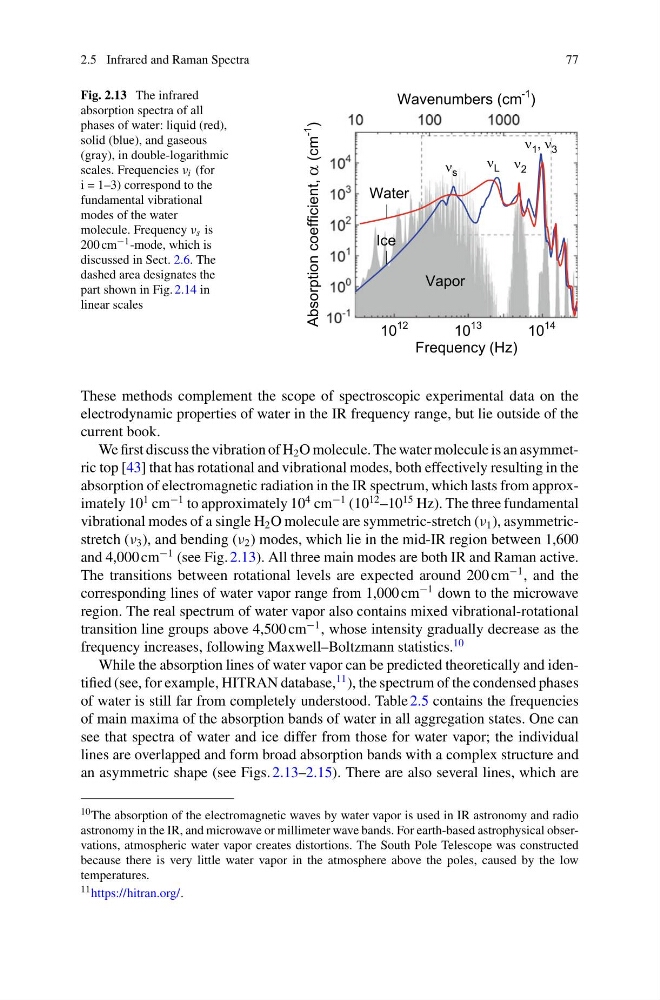
Fig. 2.13 The infrared
absorption spectra of all
phases of water: liquid (red),
solid (blue), and gaseous
(gray), in double-logarithmic
scales. Frequencies ν i (for
i = 1–3) correspond to the
fundamental vibrational
modes of the water
molecule. Frequency ν s is
200 cm −1 -mode, which is
discussed in Sect. 2.6. The
dashed area designates the
part shown in Fig. 2.14 in
linear scales
These methods complement the scope of spectroscopic experimental data on the
electrodynamic properties of water in the IR frequency range, but lie outside of the
current book.
We first discuss the vibration of H 2 O molecule. The water molecule is an asymmetric top [43] that has rotational and vibrational modes, both effectively resulting in the
absorption of electromagnetic radiation in the IR spectrum, which lasts from approximately 10
1 cm
−1 to approximately 10
4 cm
−1 (10
12 –10
15 Hz). The three fundamental
vibrational modes of a single H 2 O molecule are symmetric-stretch (ν 1 ), asymmetricstretch (ν 3 ), and bending (ν 2 ) modes, which lie in the mid-IR region between 1,600
and 4,000 cm
−1 (see Fig. 2.13). All three main modes are both IR and Raman active.
The transitions between rotational levels are expected around 200 cm
−1 , and the
corresponding lines of water vapor range from 1,000 cm
−1 down to the microwave
region. The real spectrum of water vapor also contains mixed vibrational-rotational
transition line groups above 4,500 cm
−1 , whose intensity gradually decrease as the
frequency increases, following Maxwell–Boltzmann statistics.
10
While the absorption lines of water vapor can be predicted theoretically and identified (see, for example, HITRAN database,
11 ), the spectrum of the condensed phases
of water is still far from completely understood. Table 2.5 contains the frequencies
of main maxima of the absorption bands of water in all aggregation states. One can
see that spectra of water and ice differ from those for water vapor; the individual
lines are overlapped and form broad absorption bands with a complex structure and
an asymmetric shape (see Figs. 2.13–2.15). There are also several lines, which are
10 The absorption of the electromagnetic waves by water vapor is used in IR astronomy and radio
astronomy in the IR, and microwave or millimeter wave bands. For earth-based astrophysical observations, atmospheric water vapor creates distortions. The South Pole Telescope was constructed
because there is very little water vapor in the atmosphere above the poles, caused by the low
temperatures.
11 https://hitran.org/.
77
Fig. 2.13 The infrared
absorption spectra of all
phases of water: liquid (red),
solid (blue), and gaseous
(gray), in double-logarithmic
scales. Frequencies ν i (for
i = 1–3) correspond to the
fundamental vibrational
modes of the water
molecule. Frequency ν s is
200 cm −1 -mode, which is
discussed in Sect. 2.6. The
dashed area designates the
part shown in Fig. 2.14 in
linear scales
These methods complement the scope of spectroscopic experimental data on the
electrodynamic properties of water in the IR frequency range, but lie outside of the
current book.
We first discuss the vibration of H 2 O molecule. The water molecule is an asymmetric top [43] that has rotational and vibrational modes, both effectively resulting in the
absorption of electromagnetic radiation in the IR spectrum, which lasts from approximately 10
1 cm
−1 to approximately 10
4 cm
−1 (10
12 –10
15 Hz). The three fundamental
vibrational modes of a single H 2 O molecule are symmetric-stretch (ν 1 ), asymmetricstretch (ν 3 ), and bending (ν 2 ) modes, which lie in the mid-IR region between 1,600
and 4,000 cm
−1 (see Fig. 2.13). All three main modes are both IR and Raman active.
The transitions between rotational levels are expected around 200 cm
−1 , and the
corresponding lines of water vapor range from 1,000 cm
−1 down to the microwave
region. The real spectrum of water vapor also contains mixed vibrational-rotational
transition line groups above 4,500 cm
−1 , whose intensity gradually decrease as the
frequency increases, following Maxwell–Boltzmann statistics.
10
While the absorption lines of water vapor can be predicted theoretically and identified (see, for example, HITRAN database,
11 ), the spectrum of the condensed phases
of water is still far from completely understood. Table 2.5 contains the frequencies
of main maxima of the absorption bands of water in all aggregation states. One can
see that spectra of water and ice differ from those for water vapor; the individual
lines are overlapped and form broad absorption bands with a complex structure and
an asymmetric shape (see Figs. 2.13–2.15). There are also several lines, which are
10 The absorption of the electromagnetic waves by water vapor is used in IR astronomy and radio
astronomy in the IR, and microwave or millimeter wave bands. For earth-based astrophysical observations, atmospheric water vapor creates distortions. The South Pole Telescope was constructed
because there is very little water vapor in the atmosphere above the poles, caused by the low
temperatures.
11 https://hitran.org/.