

2.4 The Static Dielectric Constant
75
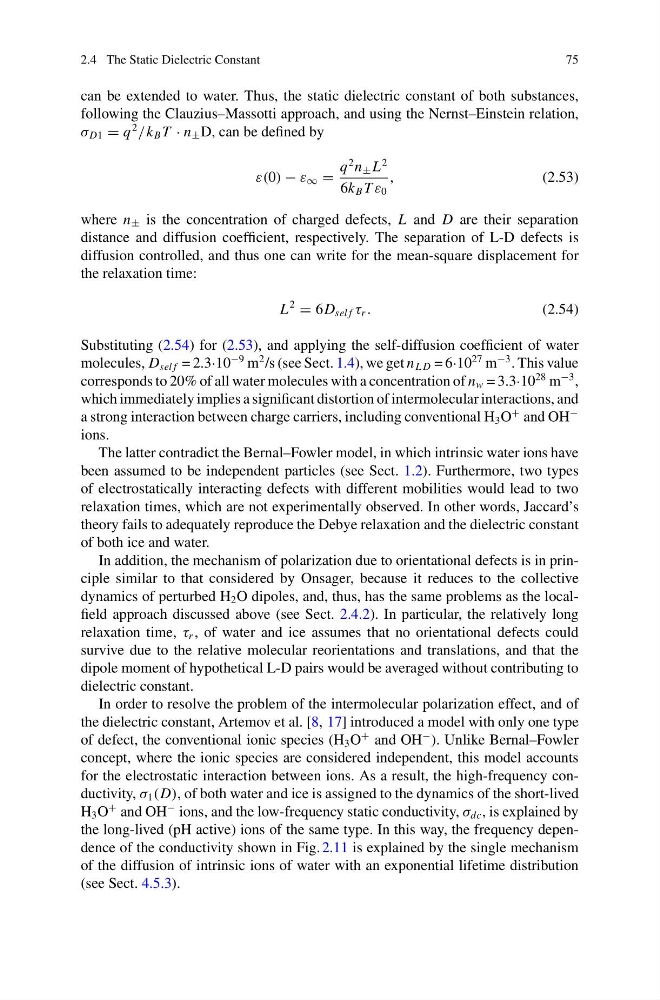
can be extended to water. Thus, the static dielectric constant of both substances,
following the Clauzius–Massotti approach, and using the Nernst–Einstein relation,
σ D1 = q
2
/k B T · n ± D, can be defined by
ε(0) − ε ∞ =
q
2 n ± L
2
6k B T ε 0
,
(2.53)
where n ± is the concentration of charged defects, L and D are their separation
distance and diffusion coefficient, respectively. The separation of L-D defects is
diffusion controlled, and thus one can write for the mean-square displacement for
the relaxation time:
L
2
= 6D sel f τ r .
(2.54)
Substituting (2.54) for (2.53), and applying the self-diffusion coefficient of water
molecules, D sel f = 2.3·10
−9 m
2 /s (see Sect. 1.4), we get n L D = 6·10
27 m
−3 . This value
corresponds to 20% of all water molecules with a concentration of n w = 3.3·10
28 m
−3 ,
which immediately implies a significant distortion of intermolecular interactions, and
a strong interaction between charge carriers, including conventional H 3 O
+ and OH
−
ions.
The latter contradict the Bernal–Fowler model, in which intrinsic water ions have
been assumed to be independent particles (see Sect. 1.2). Furthermore, two types
of electrostatically interacting defects with different mobilities would lead to two
relaxation times, which are not experimentally observed. In other words, Jaccard’s
theory fails to adequately reproduce the Debye relaxation and the dielectric constant
of both ice and water.
In addition, the mechanism of polarization due to orientational defects is in principle similar to that considered by Onsager, because it reduces to the collective
dynamics of perturbed H 2 O dipoles, and, thus, has the same problems as the localfield approach discussed above (see Sect. 2.4.2). In particular, the relatively long
relaxation time, τ r , of water and ice assumes that no orientational defects could
survive due to the relative molecular reorientations and translations, and that the
dipole moment of hypothetical L-D pairs would be averaged without contributing to
dielectric constant.
In order to resolve the problem of the intermolecular polarization effect, and of
the dielectric constant, Artemov et al. [8, 17] introduced a model with only one type
of defect, the conventional ionic species (H 3 O
+ and OH
− ). Unlike Bernal–Fowler
concept, where the ionic species are considered independent, this model accounts
for the electrostatic interaction between ions. As a result, the high-frequency conductivity, σ 1 (D), of both water and ice is assigned to the dynamics of the short-lived
H 3 O
+ and OH
− ions, and the low-frequency static conductivity, σ dc , is explained by
the long-lived (pH active) ions of the same type. In this way, the frequency dependence of the conductivity shown in Fig. 2.11 is explained by the single mechanism
of the diffusion of intrinsic ions of water with an exponential lifetime distribution
(see Sect. 4.5.3).
75
can be extended to water. Thus, the static dielectric constant of both substances,
following the Clauzius–Massotti approach, and using the Nernst–Einstein relation,
σ D1 = q
2
/k B T · n ± D, can be defined by
ε(0) − ε ∞ =
q
2 n ± L
2
6k B T ε 0
,
(2.53)
where n ± is the concentration of charged defects, L and D are their separation
distance and diffusion coefficient, respectively. The separation of L-D defects is
diffusion controlled, and thus one can write for the mean-square displacement for
the relaxation time:
L
2
= 6D sel f τ r .
(2.54)
Substituting (2.54) for (2.53), and applying the self-diffusion coefficient of water
molecules, D sel f = 2.3·10
−9 m
2 /s (see Sect. 1.4), we get n L D = 6·10
27 m
−3 . This value
corresponds to 20% of all water molecules with a concentration of n w = 3.3·10
28 m
−3 ,
which immediately implies a significant distortion of intermolecular interactions, and
a strong interaction between charge carriers, including conventional H 3 O
+ and OH
−
ions.
The latter contradict the Bernal–Fowler model, in which intrinsic water ions have
been assumed to be independent particles (see Sect. 1.2). Furthermore, two types
of electrostatically interacting defects with different mobilities would lead to two
relaxation times, which are not experimentally observed. In other words, Jaccard’s
theory fails to adequately reproduce the Debye relaxation and the dielectric constant
of both ice and water.
In addition, the mechanism of polarization due to orientational defects is in principle similar to that considered by Onsager, because it reduces to the collective
dynamics of perturbed H 2 O dipoles, and, thus, has the same problems as the localfield approach discussed above (see Sect. 2.4.2). In particular, the relatively long
relaxation time, τ r , of water and ice assumes that no orientational defects could
survive due to the relative molecular reorientations and translations, and that the
dipole moment of hypothetical L-D pairs would be averaged without contributing to
dielectric constant.
In order to resolve the problem of the intermolecular polarization effect, and of
the dielectric constant, Artemov et al. [8, 17] introduced a model with only one type
of defect, the conventional ionic species (H 3 O
+ and OH
− ). Unlike Bernal–Fowler
concept, where the ionic species are considered independent, this model accounts
for the electrostatic interaction between ions. As a result, the high-frequency conductivity, σ 1 (D), of both water and ice is assigned to the dynamics of the short-lived
H 3 O
+ and OH
− ions, and the low-frequency static conductivity, σ dc , is explained by
the long-lived (pH active) ions of the same type. In this way, the frequency dependence of the conductivity shown in Fig. 2.11 is explained by the single mechanism
of the diffusion of intrinsic ions of water with an exponential lifetime distribution
(see Sect. 4.5.3).