

5.6 Water in Electrochemical Energy Systems
207
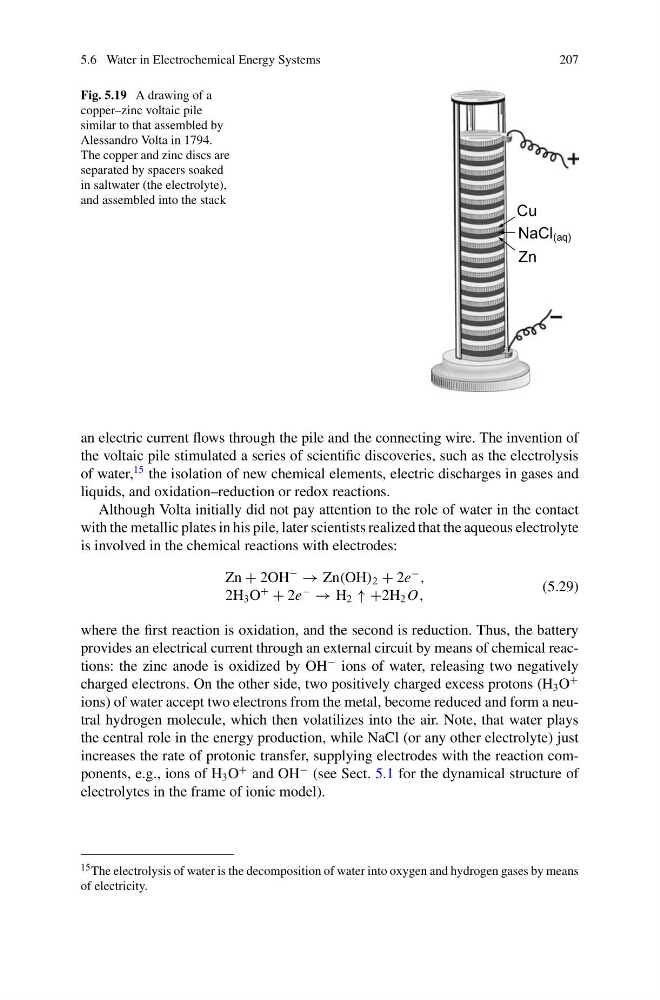
Fig. 5.19 A drawing of a
copper–zinc voltaic pile
similar to that assembled by
Alessandro Volta in 1794.
The copper and zinc discs are
separated by spacers soaked
in saltwater (the electrolyte),
and assembled into the stack
Cu
Zn
NaCl (aq)
an electric current flows through the pile and the connecting wire. The invention of
the voltaic pile stimulated a series of scientific discoveries, such as the electrolysis
of water,
15 the isolation of new chemical elements, electric discharges in gases and
liquids, and oxidation–reduction or redox reactions.
Although Volta initially did not pay attention to the role of water in the contact
with the metallic plates in his pile, later scientists realized that the aqueous electrolyte
is involved in the chemical reactions with electrodes:
Zn + 2OH
−
→ Zn(OH) 2 + 2e
−
,
2H 3 O
+
+ 2e
−
→ H 2 ↑ +2H 2 O,
(5.29)
where the first reaction is oxidation, and the second is reduction. Thus, the battery
provides an electrical current through an external circuit by means of chemical reactions: the zinc anode is oxidized by OH
− ions of water, releasing two negatively
charged electrons. On the other side, two positively charged excess protons (H 3 O
+
ions) of water accept two electrons from the metal, become reduced and form a neutral hydrogen molecule, which then volatilizes into the air. Note, that water plays
the central role in the energy production, while NaCl (or any other electrolyte) just
increases the rate of protonic transfer, supplying electrodes with the reaction components, e.g., ions of H 3 O
+ and OH
− (see Sect. 5.1 for the dynamical structure of
electrolytes in the frame of ionic model).
15 The electrolysis of water is the decomposition of water into oxygen and hydrogen gases by means
of electricity.
207
Fig. 5.19 A drawing of a
copper–zinc voltaic pile
similar to that assembled by
Alessandro Volta in 1794.
The copper and zinc discs are
separated by spacers soaked
in saltwater (the electrolyte),
and assembled into the stack
Cu
Zn
NaCl (aq)
an electric current flows through the pile and the connecting wire. The invention of
the voltaic pile stimulated a series of scientific discoveries, such as the electrolysis
of water,
15 the isolation of new chemical elements, electric discharges in gases and
liquids, and oxidation–reduction or redox reactions.
Although Volta initially did not pay attention to the role of water in the contact
with the metallic plates in his pile, later scientists realized that the aqueous electrolyte
is involved in the chemical reactions with electrodes:
Zn + 2OH
−
→ Zn(OH) 2 + 2e
−
,
2H 3 O
+
+ 2e
−
→ H 2 ↑ +2H 2 O,
(5.29)
where the first reaction is oxidation, and the second is reduction. Thus, the battery
provides an electrical current through an external circuit by means of chemical reactions: the zinc anode is oxidized by OH
− ions of water, releasing two negatively
charged electrons. On the other side, two positively charged excess protons (H 3 O
+
ions) of water accept two electrons from the metal, become reduced and form a neutral hydrogen molecule, which then volatilizes into the air. Note, that water plays
the central role in the energy production, while NaCl (or any other electrolyte) just
increases the rate of protonic transfer, supplying electrodes with the reaction components, e.g., ions of H 3 O
+ and OH
− (see Sect. 5.1 for the dynamical structure of
electrolytes in the frame of ionic model).
15 The electrolysis of water is the decomposition of water into oxygen and hydrogen gases by means
of electricity.