

206
5 Electrodynamics of Aqueous Media
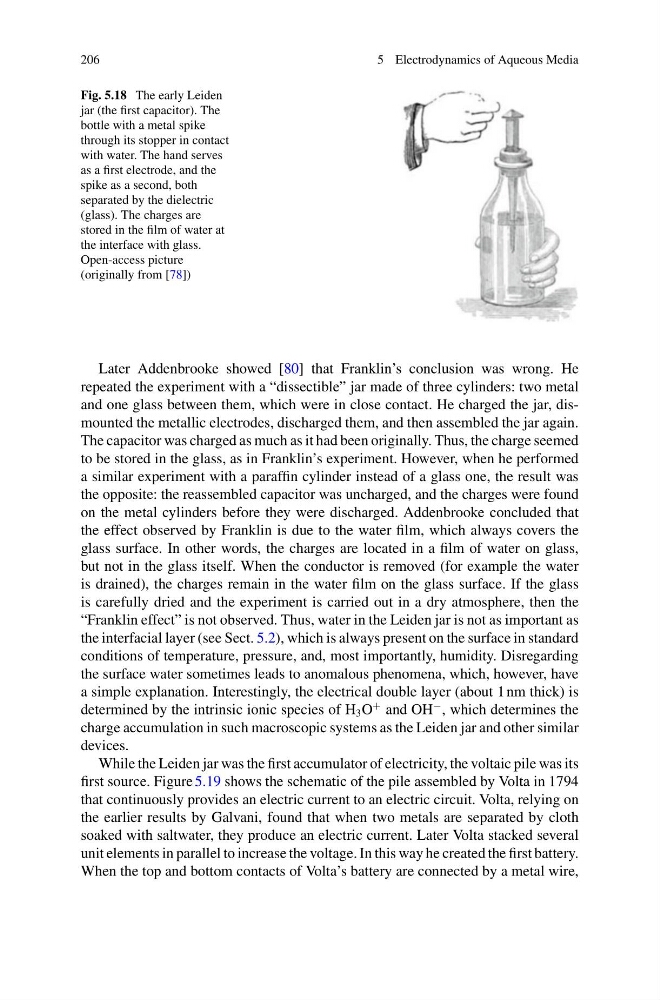
Fig. 5.18 The early Leiden
jar (the first capacitor). The
bottle with a metal spike
through its stopper in contact
with water. The hand serves
as a first electrode, and the
spike as a second, both
separated by the dielectric
(glass). The charges are
stored in the film of water at
the interface with glass.
Open-access picture
(originally from [78])
Later Addenbrooke showed [80] that Franklin’s conclusion was wrong. He
repeated the experiment with a “dissectible” jar made of three cylinders: two metal
and one glass between them, which were in close contact. He charged the jar, dismounted the metallic electrodes, discharged them, and then assembled the jar again.
The capacitor was charged as much as it had been originally. Thus, the charge seemed
to be stored in the glass, as in Franklin’s experiment. However, when he performed
a similar experiment with a paraffin cylinder instead of a glass one, the result was
the opposite: the reassembled capacitor was uncharged, and the charges were found
on the metal cylinders before they were discharged. Addenbrooke concluded that
the effect observed by Franklin is due to the water film, which always covers the
glass surface. In other words, the charges are located in a film of water on glass,
but not in the glass itself. When the conductor is removed (for example the water
is drained), the charges remain in the water film on the glass surface. If the glass
is carefully dried and the experiment is carried out in a dry atmosphere, then the
“Franklin effect” is not observed. Thus, water in the Leiden jar is not as important as
the interfacial layer (see Sect. 5.2), which is always present on the surface in standard
conditions of temperature, pressure, and, most importantly, humidity. Disregarding
the surface water sometimes leads to anomalous phenomena, which, however, have
a simple explanation. Interestingly, the electrical double layer (about 1 nm thick) is
determined by the intrinsic ionic species of H 3 O
+ and OH
− , which determines the
charge accumulation in such macroscopic systems as the Leiden jar and other similar
devices.
While the Leiden jar was the first accumulator of electricity, the voltaic pile was its
first source. Figure 5.19 shows the schematic of the pile assembled by Volta in 1794
that continuously provides an electric current to an electric circuit. Volta, relying on
the earlier results by Galvani, found that when two metals are separated by cloth
soaked with saltwater, they produce an electric current. Later Volta stacked several
unit elements in parallel to increase the voltage. In this way he created the first battery.
When the top and bottom contacts of Volta’s battery are connected by a metal wire,
5 Electrodynamics of Aqueous Media
Fig. 5.18 The early Leiden
jar (the first capacitor). The
bottle with a metal spike
through its stopper in contact
with water. The hand serves
as a first electrode, and the
spike as a second, both
separated by the dielectric
(glass). The charges are
stored in the film of water at
the interface with glass.
Open-access picture
(originally from [78])
Later Addenbrooke showed [80] that Franklin’s conclusion was wrong. He
repeated the experiment with a “dissectible” jar made of three cylinders: two metal
and one glass between them, which were in close contact. He charged the jar, dismounted the metallic electrodes, discharged them, and then assembled the jar again.
The capacitor was charged as much as it had been originally. Thus, the charge seemed
to be stored in the glass, as in Franklin’s experiment. However, when he performed
a similar experiment with a paraffin cylinder instead of a glass one, the result was
the opposite: the reassembled capacitor was uncharged, and the charges were found
on the metal cylinders before they were discharged. Addenbrooke concluded that
the effect observed by Franklin is due to the water film, which always covers the
glass surface. In other words, the charges are located in a film of water on glass,
but not in the glass itself. When the conductor is removed (for example the water
is drained), the charges remain in the water film on the glass surface. If the glass
is carefully dried and the experiment is carried out in a dry atmosphere, then the
“Franklin effect” is not observed. Thus, water in the Leiden jar is not as important as
the interfacial layer (see Sect. 5.2), which is always present on the surface in standard
conditions of temperature, pressure, and, most importantly, humidity. Disregarding
the surface water sometimes leads to anomalous phenomena, which, however, have
a simple explanation. Interestingly, the electrical double layer (about 1 nm thick) is
determined by the intrinsic ionic species of H 3 O
+ and OH
− , which determines the
charge accumulation in such macroscopic systems as the Leiden jar and other similar
devices.
While the Leiden jar was the first accumulator of electricity, the voltaic pile was its
first source. Figure 5.19 shows the schematic of the pile assembled by Volta in 1794
that continuously provides an electric current to an electric circuit. Volta, relying on
the earlier results by Galvani, found that when two metals are separated by cloth
soaked with saltwater, they produce an electric current. Later Volta stacked several
unit elements in parallel to increase the voltage. In this way he created the first battery.
When the top and bottom contacts of Volta’s battery are connected by a metal wire,