

5.4 Kelvin Water Dropper: Converting Gravity to Electricity
199
E 0
F
h
(a)
(b)
(c)
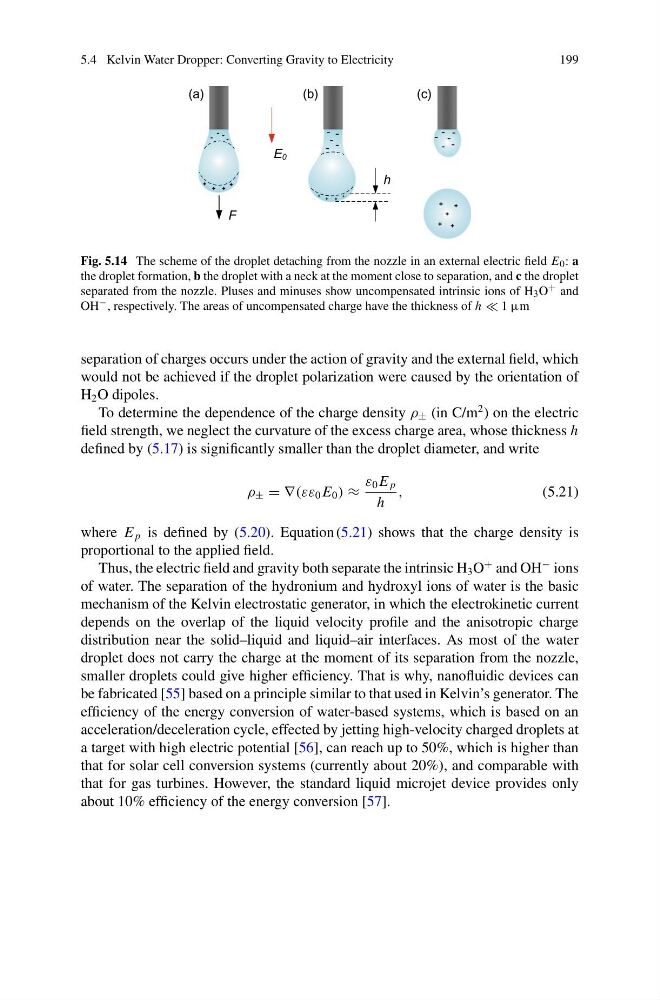
Fig. 5.14 The scheme of the droplet detaching from the nozzle in an external electric field E 0 : a
the droplet formation, b the droplet with a neck at the moment close to separation, and c the droplet
separated from the nozzle. Pluses and minuses show uncompensated intrinsic ions of H 3 O + and
OH − , respectively. The areas of uncompensated charge have the thickness of h 1 µm
separation of charges occurs under the action of gravity and the external field, which
would not be achieved if the droplet polarization were caused by the orientation of
H 2 O dipoles.
To determine the dependence of the charge density ρ ± (in C/m
2 ) on the electric
field strength, we neglect the curvature of the excess charge area, whose thickness h
defined by (5.17) is significantly smaller than the droplet diameter, and write
ρ ± = ∇(εε 0 E 0 ) ≈
ε 0 E p
h
,
(5.21)
where E p is defined by (5.20). Equation (5.21) shows that the charge density is
proportional to the applied field.
Thus, the electric field and gravity both separate the intrinsic H 3 O
+ and OH
− ions
of water. The separation of the hydronium and hydroxyl ions of water is the basic
mechanism of the Kelvin electrostatic generator, in which the electrokinetic current
depends on the overlap of the liquid velocity profile and the anisotropic charge
distribution near the solid–liquid and liquid–air interfaces. As most of the water
droplet does not carry the charge at the moment of its separation from the nozzle,
smaller droplets could give higher efficiency. That is why, nanofluidic devices can
be fabricated [55] based on a principle similar to that used in Kelvin’s generator. The
efficiency of the energy conversion of water-based systems, which is based on an
acceleration/deceleration cycle, effected by jetting high-velocity charged droplets at
a target with high electric potential [56], can reach up to 50%, which is higher than
that for solar cell conversion systems (currently about 20%), and comparable with
that for gas turbines. However, the standard liquid microjet device provides only
about 10% efficiency of the energy conversion [57].
199
E 0
F
h
(a)
(b)
(c)
Fig. 5.14 The scheme of the droplet detaching from the nozzle in an external electric field E 0 : a
the droplet formation, b the droplet with a neck at the moment close to separation, and c the droplet
separated from the nozzle. Pluses and minuses show uncompensated intrinsic ions of H 3 O + and
OH − , respectively. The areas of uncompensated charge have the thickness of h 1 µm
separation of charges occurs under the action of gravity and the external field, which
would not be achieved if the droplet polarization were caused by the orientation of
H 2 O dipoles.
To determine the dependence of the charge density ρ ± (in C/m
2 ) on the electric
field strength, we neglect the curvature of the excess charge area, whose thickness h
defined by (5.17) is significantly smaller than the droplet diameter, and write
ρ ± = ∇(εε 0 E 0 ) ≈
ε 0 E p
h
,
(5.21)
where E p is defined by (5.20). Equation (5.21) shows that the charge density is
proportional to the applied field.
Thus, the electric field and gravity both separate the intrinsic H 3 O
+ and OH
− ions
of water. The separation of the hydronium and hydroxyl ions of water is the basic
mechanism of the Kelvin electrostatic generator, in which the electrokinetic current
depends on the overlap of the liquid velocity profile and the anisotropic charge
distribution near the solid–liquid and liquid–air interfaces. As most of the water
droplet does not carry the charge at the moment of its separation from the nozzle,
smaller droplets could give higher efficiency. That is why, nanofluidic devices can
be fabricated [55] based on a principle similar to that used in Kelvin’s generator. The
efficiency of the energy conversion of water-based systems, which is based on an
acceleration/deceleration cycle, effected by jetting high-velocity charged droplets at
a target with high electric potential [56], can reach up to 50%, which is higher than
that for solar cell conversion systems (currently about 20%), and comparable with
that for gas turbines. However, the standard liquid microjet device provides only
about 10% efficiency of the energy conversion [57].