

198
5 Electrodynamics of Aqueous Media
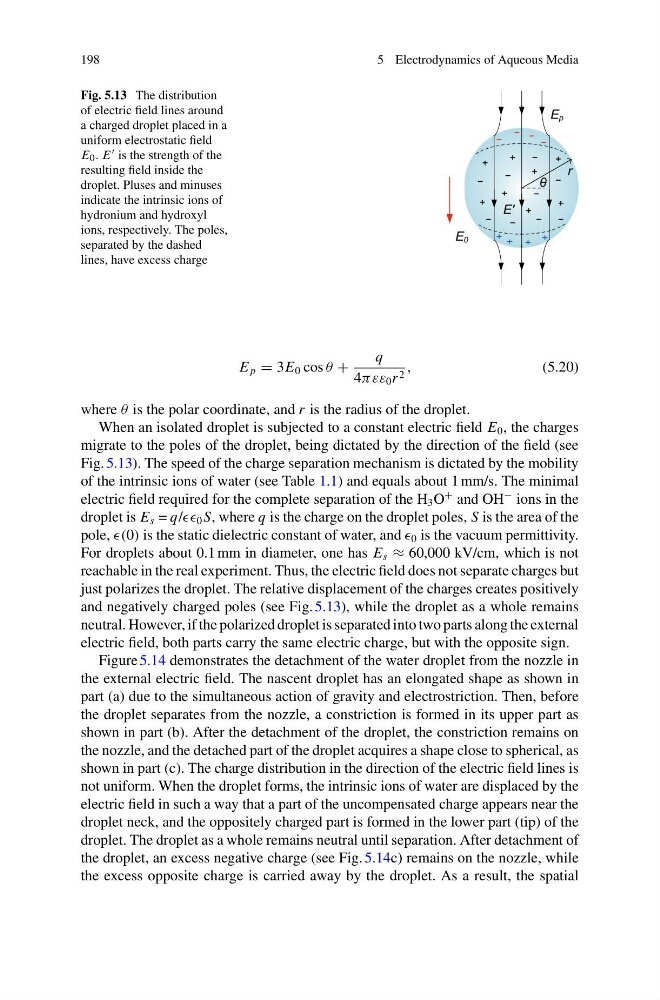
Fig. 5.13 The distribution
of electric field lines around
a charged droplet placed in a
uniform electrostatic field
E 0 . E is the strength of the
resulting field inside the
droplet. Pluses and minuses
indicate the intrinsic ions of
hydronium and hydroxyl
ions, respectively. The poles,
separated by the dashed
lines, have excess charge
E 0
E'
r
E p
θ
E p = 3E 0 cos θ +
q
4πεε 0 r 2 ,
(5.20)
where θ is the polar coordinate, and r is the radius of the droplet.
When an isolated droplet is subjected to a constant electric field E 0 , the charges
migrate to the poles of the droplet, being dictated by the direction of the field (see
Fig. 5.13). The speed of the charge separation mechanism is dictated by the mobility
of the intrinsic ions of water (see Table 1.1) and equals about 1 mm/s. The minimal
electric field required for the complete separation of the H 3 O
+ and OH
− ions in the
droplet is E s = q/ 0 S, where q is the charge on the droplet poles, S is the area of the
pole, is the static dielectric constant of water, and 0 is the vacuum permittivity.
For droplets about 0.1 mm in diameter, one has E s ≈ 60,000 kV/cm, which is not
reachable in the real experiment. Thus, the electric field does not separate charges but
just polarizes the droplet. The relative displacement of the charges creates positively
and negatively charged poles (see Fig. 5.13), while the droplet as a whole remains
neutral. However, if the polarized droplet is separated into two parts along the external
electric field, both parts carry the same electric charge, but with the opposite sign.
Figure 5.14 demonstrates the detachment of the water droplet from the nozzle in
the external electric field. The nascent droplet has an elongated shape as shown in
part (a) due to the simultaneous action of gravity and electrostriction. Then, before
the droplet separates from the nozzle, a constriction is formed in its upper part as
shown in part (b). After the detachment of the droplet, the constriction remains on
the nozzle, and the detached part of the droplet acquires a shape close to spherical, as
shown in part (c). The charge distribution in the direction of the electric field lines is
not uniform. When the droplet forms, the intrinsic ions of water are displaced by the
electric field in such a way that a part of the uncompensated charge appears near the
droplet neck, and the oppositely charged part is formed in the lower part (tip) of the
droplet. The droplet as a whole remains neutral until separation. After detachment of
the droplet, an excess negative charge (see Fig. 5.14c) remains on the nozzle, while
the excess opposite charge is carried away by the droplet. As a result, the spatial
5 Electrodynamics of Aqueous Media
Fig. 5.13 The distribution
of electric field lines around
a charged droplet placed in a
uniform electrostatic field
E 0 . E is the strength of the
resulting field inside the
droplet. Pluses and minuses
indicate the intrinsic ions of
hydronium and hydroxyl
ions, respectively. The poles,
separated by the dashed
lines, have excess charge
E 0
E'
r
E p
θ
E p = 3E 0 cos θ +
q
4πεε 0 r 2 ,
(5.20)
where θ is the polar coordinate, and r is the radius of the droplet.
When an isolated droplet is subjected to a constant electric field E 0 , the charges
migrate to the poles of the droplet, being dictated by the direction of the field (see
Fig. 5.13). The speed of the charge separation mechanism is dictated by the mobility
of the intrinsic ions of water (see Table 1.1) and equals about 1 mm/s. The minimal
electric field required for the complete separation of the H 3 O
+ and OH
− ions in the
droplet is E s = q/ 0 S, where q is the charge on the droplet poles, S is the area of the
pole, is the static dielectric constant of water, and 0 is the vacuum permittivity.
For droplets about 0.1 mm in diameter, one has E s ≈ 60,000 kV/cm, which is not
reachable in the real experiment. Thus, the electric field does not separate charges but
just polarizes the droplet. The relative displacement of the charges creates positively
and negatively charged poles (see Fig. 5.13), while the droplet as a whole remains
neutral. However, if the polarized droplet is separated into two parts along the external
electric field, both parts carry the same electric charge, but with the opposite sign.
Figure 5.14 demonstrates the detachment of the water droplet from the nozzle in
the external electric field. The nascent droplet has an elongated shape as shown in
part (a) due to the simultaneous action of gravity and electrostriction. Then, before
the droplet separates from the nozzle, a constriction is formed in its upper part as
shown in part (b). After the detachment of the droplet, the constriction remains on
the nozzle, and the detached part of the droplet acquires a shape close to spherical, as
shown in part (c). The charge distribution in the direction of the electric field lines is
not uniform. When the droplet forms, the intrinsic ions of water are displaced by the
electric field in such a way that a part of the uncompensated charge appears near the
droplet neck, and the oppositely charged part is formed in the lower part (tip) of the
droplet. The droplet as a whole remains neutral until separation. After detachment of
the droplet, an excess negative charge (see Fig. 5.14c) remains on the nozzle, while
the excess opposite charge is carried away by the droplet. As a result, the spatial