

200
5 Electrodynamics of Aqueous Media
5.5 Water in a Strong Electric Field
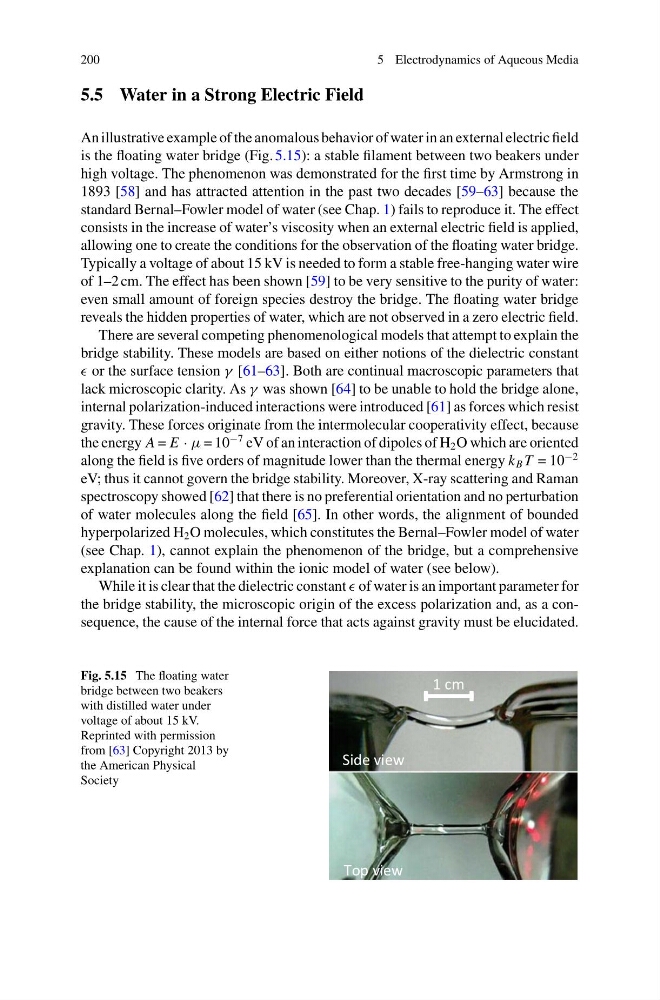
An illustrative example of the anomalous behavior of water in an external electric field
is the floating water bridge (Fig. 5.15): a stable filament between two beakers under
high voltage. The phenomenon was demonstrated for the first time by Armstrong in
1893 [58] and has attracted attention in the past two decades [59–63] because the
standard Bernal–Fowler model of water (see Chap. 1) fails to reproduce it. The effect
consists in the increase of water’s viscosity when an external electric field is applied,
allowing one to create the conditions for the observation of the floating water bridge.
Typically a voltage of about 15 kV is needed to form a stable free-hanging water wire
of 1–2 cm. The effect has been shown [59] to be very sensitive to the purity of water:
even small amount of foreign species destroy the bridge. The floating water bridge
reveals the hidden properties of water, which are not observed in a zero electric field.
There are several competing phenomenological models that attempt to explain the
bridge stability. These models are based on either notions of the dielectric constant
or the surface tension γ [61–63]. Both are continual macroscopic parameters that
lack microscopic clarity. As γ was shown [64] to be unable to hold the bridge alone,
internal polarization-induced interactions were introduced [61] as forces which resist
gravity. These forces originate from the intermolecular cooperativity effect, because
the energy A = E · μ = 10
−7 eV of an interaction of dipoles of H 2 O which are oriented
along the field is five orders of magnitude lower than the thermal energy k B T = 10
−2
eV; thus it cannot govern the bridge stability. Moreover, X-ray scattering and Raman
spectroscopy showed [62] that there is no preferential orientation and no perturbation
of water molecules along the field [65]. In other words, the alignment of bounded
hyperpolarized H 2 O molecules, which constitutes the Bernal–Fowler model of water
(see Chap. 1), cannot explain the phenomenon of the bridge, but a comprehensive
explanation can be found within the ionic model of water (see below).
While it is clear that the dielectric constant of water is an important parameter for
the bridge stability, the microscopic origin of the excess polarization and, as a consequence, the cause of the internal force that acts against gravity must be elucidated.
Fig. 5.15 The floating water
bridge between two beakers
with distilled water under
voltage of about 15 kV.
Reprinted with permission
from [63] Copyright 2013 by
the American Physical
Society
1 cm
Side view
Top view
5 Electrodynamics of Aqueous Media
5.5 Water in a Strong Electric Field
An illustrative example of the anomalous behavior of water in an external electric field
is the floating water bridge (Fig. 5.15): a stable filament between two beakers under
high voltage. The phenomenon was demonstrated for the first time by Armstrong in
1893 [58] and has attracted attention in the past two decades [59–63] because the
standard Bernal–Fowler model of water (see Chap. 1) fails to reproduce it. The effect
consists in the increase of water’s viscosity when an external electric field is applied,
allowing one to create the conditions for the observation of the floating water bridge.
Typically a voltage of about 15 kV is needed to form a stable free-hanging water wire
of 1–2 cm. The effect has been shown [59] to be very sensitive to the purity of water:
even small amount of foreign species destroy the bridge. The floating water bridge
reveals the hidden properties of water, which are not observed in a zero electric field.
There are several competing phenomenological models that attempt to explain the
bridge stability. These models are based on either notions of the dielectric constant
or the surface tension γ [61–63]. Both are continual macroscopic parameters that
lack microscopic clarity. As γ was shown [64] to be unable to hold the bridge alone,
internal polarization-induced interactions were introduced [61] as forces which resist
gravity. These forces originate from the intermolecular cooperativity effect, because
the energy A = E · μ = 10
−7 eV of an interaction of dipoles of H 2 O which are oriented
along the field is five orders of magnitude lower than the thermal energy k B T = 10
−2
eV; thus it cannot govern the bridge stability. Moreover, X-ray scattering and Raman
spectroscopy showed [62] that there is no preferential orientation and no perturbation
of water molecules along the field [65]. In other words, the alignment of bounded
hyperpolarized H 2 O molecules, which constitutes the Bernal–Fowler model of water
(see Chap. 1), cannot explain the phenomenon of the bridge, but a comprehensive
explanation can be found within the ionic model of water (see below).
While it is clear that the dielectric constant of water is an important parameter for
the bridge stability, the microscopic origin of the excess polarization and, as a consequence, the cause of the internal force that acts against gravity must be elucidated.
Fig. 5.15 The floating water
bridge between two beakers
with distilled water under
voltage of about 15 kV.
Reprinted with permission
from [63] Copyright 2013 by
the American Physical
Society
1 cm
Side view
Top view