

5.3 Atmospheric Electrodynamics and Aqueous Interfaces
195
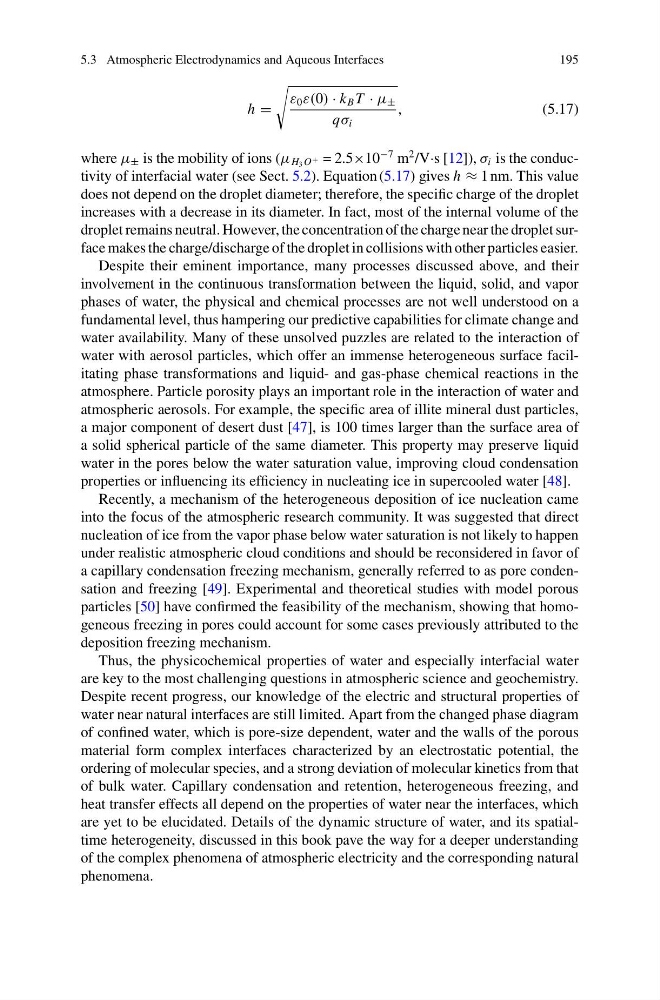
h =
ε 0 ε(0) · k B T · μ ±
qσ i
,
(5.17)
where μ ± is the mobility of ions (μ H 3 O + = 2.5×10
−7 m
2 /V·s [12]), σ i is the conductivity of interfacial water (see Sect. 5.2). Equation (5.17) gives h ≈ 1 nm. This value
does not depend on the droplet diameter; therefore, the specific charge of the droplet
increases with a decrease in its diameter. In fact, most of the internal volume of the
droplet remains neutral. However, the concentration of the charge near the droplet surface makes the charge/discharge of the droplet in collisions with other particles easier.
Despite their eminent importance, many processes discussed above, and their
involvement in the continuous transformation between the liquid, solid, and vapor
phases of water, the physical and chemical processes are not well understood on a
fundamental level, thus hampering our predictive capabilities for climate change and
water availability. Many of these unsolved puzzles are related to the interaction of
water with aerosol particles, which offer an immense heterogeneous surface facilitating phase transformations and liquid- and gas-phase chemical reactions in the
atmosphere. Particle porosity plays an important role in the interaction of water and
atmospheric aerosols. For example, the specific area of illite mineral dust particles,
a major component of desert dust [47], is 100 times larger than the surface area of
a solid spherical particle of the same diameter. This property may preserve liquid
water in the pores below the water saturation value, improving cloud condensation
properties or influencing its efficiency in nucleating ice in supercooled water [48].
Recently, a mechanism of the heterogeneous deposition of ice nucleation came
into the focus of the atmospheric research community. It was suggested that direct
nucleation of ice from the vapor phase below water saturation is not likely to happen
under realistic atmospheric cloud conditions and should be reconsidered in favor of
a capillary condensation freezing mechanism, generally referred to as pore condensation and freezing [49]. Experimental and theoretical studies with model porous
particles [50] have confirmed the feasibility of the mechanism, showing that homogeneous freezing in pores could account for some cases previously attributed to the
deposition freezing mechanism.
Thus, the physicochemical properties of water and especially interfacial water
are key to the most challenging questions in atmospheric science and geochemistry.
Despite recent progress, our knowledge of the electric and structural properties of
water near natural interfaces are still limited. Apart from the changed phase diagram
of confined water, which is pore-size dependent, water and the walls of the porous
material form complex interfaces characterized by an electrostatic potential, the
ordering of molecular species, and a strong deviation of molecular kinetics from that
of bulk water. Capillary condensation and retention, heterogeneous freezing, and
heat transfer effects all depend on the properties of water near the interfaces, which
are yet to be elucidated. Details of the dynamic structure of water, and its spatialtime heterogeneity, discussed in this book pave the way for a deeper understanding
of the complex phenomena of atmospheric electricity and the corresponding natural
phenomena.
195
h =
ε 0 ε(0) · k B T · μ ±
qσ i
,
(5.17)
where μ ± is the mobility of ions (μ H 3 O + = 2.5×10
−7 m
2 /V·s [12]), σ i is the conductivity of interfacial water (see Sect. 5.2). Equation (5.17) gives h ≈ 1 nm. This value
does not depend on the droplet diameter; therefore, the specific charge of the droplet
increases with a decrease in its diameter. In fact, most of the internal volume of the
droplet remains neutral. However, the concentration of the charge near the droplet surface makes the charge/discharge of the droplet in collisions with other particles easier.
Despite their eminent importance, many processes discussed above, and their
involvement in the continuous transformation between the liquid, solid, and vapor
phases of water, the physical and chemical processes are not well understood on a
fundamental level, thus hampering our predictive capabilities for climate change and
water availability. Many of these unsolved puzzles are related to the interaction of
water with aerosol particles, which offer an immense heterogeneous surface facilitating phase transformations and liquid- and gas-phase chemical reactions in the
atmosphere. Particle porosity plays an important role in the interaction of water and
atmospheric aerosols. For example, the specific area of illite mineral dust particles,
a major component of desert dust [47], is 100 times larger than the surface area of
a solid spherical particle of the same diameter. This property may preserve liquid
water in the pores below the water saturation value, improving cloud condensation
properties or influencing its efficiency in nucleating ice in supercooled water [48].
Recently, a mechanism of the heterogeneous deposition of ice nucleation came
into the focus of the atmospheric research community. It was suggested that direct
nucleation of ice from the vapor phase below water saturation is not likely to happen
under realistic atmospheric cloud conditions and should be reconsidered in favor of
a capillary condensation freezing mechanism, generally referred to as pore condensation and freezing [49]. Experimental and theoretical studies with model porous
particles [50] have confirmed the feasibility of the mechanism, showing that homogeneous freezing in pores could account for some cases previously attributed to the
deposition freezing mechanism.
Thus, the physicochemical properties of water and especially interfacial water
are key to the most challenging questions in atmospheric science and geochemistry.
Despite recent progress, our knowledge of the electric and structural properties of
water near natural interfaces are still limited. Apart from the changed phase diagram
of confined water, which is pore-size dependent, water and the walls of the porous
material form complex interfaces characterized by an electrostatic potential, the
ordering of molecular species, and a strong deviation of molecular kinetics from that
of bulk water. Capillary condensation and retention, heterogeneous freezing, and
heat transfer effects all depend on the properties of water near the interfaces, which
are yet to be elucidated. Details of the dynamic structure of water, and its spatialtime heterogeneity, discussed in this book pave the way for a deeper understanding
of the complex phenomena of atmospheric electricity and the corresponding natural
phenomena.