

194
5 Electrodynamics of Aqueous Media
the conductivity [45]. The difference in conductivity between clear air and a cloud
causes a layer of space charge to form on the boundary between the cloud and clear
air if electric currents flow through that boundary. This surface charge produces a
discontinuity in the electric field at the boundary. Thus, lightning discharges act like
short circuits inside the clouds.
As mentioned above, the neutral water particle can polarize, but also needs a
mechanism of charge separation to charge the global battery (see Fig. 5.10). There
are several theories of the charge separation mechanism in the atmosphere [45], most
of these theories are based on precipitation as the power mechanism of electrification.
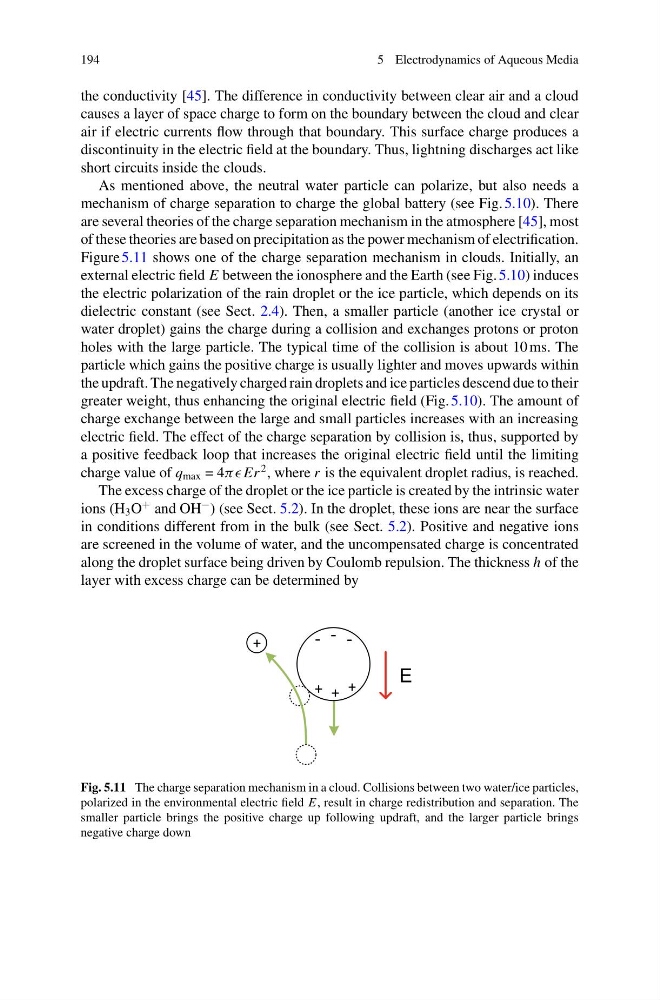
Figure 5.11 shows one of the charge separation mechanism in clouds. Initially, an
external electric field E between the ionosphere and the Earth (see Fig. 5.10) induces
the electric polarization of the rain droplet or the ice particle, which depends on its
dielectric constant (see Sect. 2.4). Then, a smaller particle (another ice crystal or
water droplet) gains the charge during a collision and exchanges protons or proton
holes with the large particle. The typical time of the collision is about 10 ms. The
particle which gains the positive charge is usually lighter and moves upwards within
the updraft. The negatively charged rain droplets and ice particles descend due to their
greater weight, thus enhancing the original electric field (Fig. 5.10). The amount of
charge exchange between the large and small particles increases with an increasing
electric field. The effect of the charge separation by collision is, thus, supported by
a positive feedback loop that increases the original electric field until the limiting
charge value of q max = 4ππ Er
2 , where r is the equivalent droplet radius, is reached.
The excess charge of the droplet or the ice particle is created by the intrinsic water
ions (H 3 O
+ and OH
− ) (see Sect. 5.2). In the droplet, these ions are near the surface
in conditions different from in the bulk (see Sect. 5.2). Positive and negative ions
are screened in the volume of water, and the uncompensated charge is concentrated
along the droplet surface being driven by Coulomb repulsion. The thickness h of the
layer with excess charge can be determined by
-
+
-
-
+
+
E
+
Fig. 5.11 The charge separation mechanism in a cloud. Collisions between two water/ice particles,
polarized in the environmental electric field E, result in charge redistribution and separation. The
smaller particle brings the positive charge up following updraft, and the larger particle brings
negative charge down
5 Electrodynamics of Aqueous Media
the conductivity [45]. The difference in conductivity between clear air and a cloud
causes a layer of space charge to form on the boundary between the cloud and clear
air if electric currents flow through that boundary. This surface charge produces a
discontinuity in the electric field at the boundary. Thus, lightning discharges act like
short circuits inside the clouds.
As mentioned above, the neutral water particle can polarize, but also needs a
mechanism of charge separation to charge the global battery (see Fig. 5.10). There
are several theories of the charge separation mechanism in the atmosphere [45], most
of these theories are based on precipitation as the power mechanism of electrification.
Figure 5.11 shows one of the charge separation mechanism in clouds. Initially, an
external electric field E between the ionosphere and the Earth (see Fig. 5.10) induces
the electric polarization of the rain droplet or the ice particle, which depends on its
dielectric constant (see Sect. 2.4). Then, a smaller particle (another ice crystal or
water droplet) gains the charge during a collision and exchanges protons or proton
holes with the large particle. The typical time of the collision is about 10 ms. The
particle which gains the positive charge is usually lighter and moves upwards within
the updraft. The negatively charged rain droplets and ice particles descend due to their
greater weight, thus enhancing the original electric field (Fig. 5.10). The amount of
charge exchange between the large and small particles increases with an increasing
electric field. The effect of the charge separation by collision is, thus, supported by
a positive feedback loop that increases the original electric field until the limiting
charge value of q max = 4ππ Er
2 , where r is the equivalent droplet radius, is reached.
The excess charge of the droplet or the ice particle is created by the intrinsic water
ions (H 3 O
+ and OH
− ) (see Sect. 5.2). In the droplet, these ions are near the surface
in conditions different from in the bulk (see Sect. 5.2). Positive and negative ions
are screened in the volume of water, and the uncompensated charge is concentrated
along the droplet surface being driven by Coulomb repulsion. The thickness h of the
layer with excess charge can be determined by
-
+
-
-
+
+
E
+
Fig. 5.11 The charge separation mechanism in a cloud. Collisions between two water/ice particles,
polarized in the environmental electric field E, result in charge redistribution and separation. The
smaller particle brings the positive charge up following updraft, and the larger particle brings
negative charge down