

5.3 Atmospheric Electrodynamics and Aqueous Interfaces
193
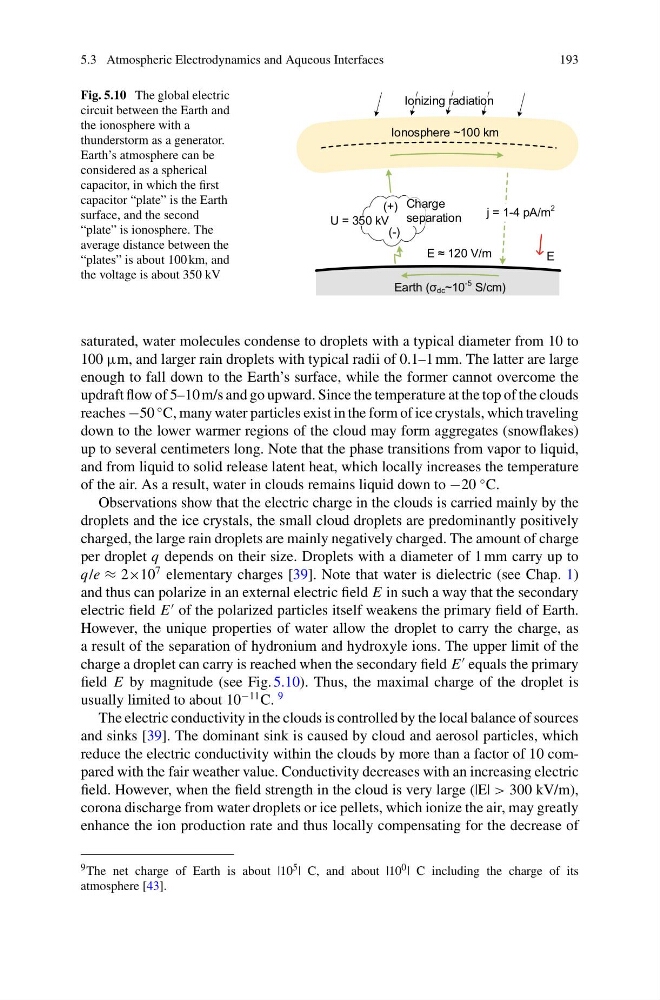
Fig. 5.10 The global electric
circuit between the Earth and
the ionosphere with a
thunderstorm as a generator.
Earth’s atmosphere can be
considered as a spherical
capacitor, in which the first
capacitor “plate” is the Earth
surface, and the second
“plate” is ionosphere. The
average distance between the
“plates” is about 100 km, and
the voltage is about 350 kV
Ionosphere ~100 km
(-)
(+)
Earth (σ dc ~10
-5 S/cm)
j = 1-4 pA/m
2
E ≈ 120 V/m
Ionizing radiation
Charge
separation
U = 350 kV
E
saturated, water molecules condense to droplets with a typical diameter from 10 to
100 µm, and larger rain droplets with typical radii of 0.1–1 mm. The latter are large
enough to fall down to the Earth’s surface, while the former cannot overcome the
updraft flow of 5–10 m/s and go upward. Since the temperature at the top of the clouds
reaches −50
◦ C, many water particles exist in the form of ice crystals, which traveling
down to the lower warmer regions of the cloud may form aggregates (snowflakes)
up to several centimeters long. Note that the phase transitions from vapor to liquid,
and from liquid to solid release latent heat, which locally increases the temperature
of the air. As a result, water in clouds remains liquid down to −20
◦ C.
Observations show that the electric charge in the clouds is carried mainly by the
droplets and the ice crystals, the small cloud droplets are predominantly positively
charged, the large rain droplets are mainly negatively charged. The amount of charge
per droplet q depends on their size. Droplets with a diameter of 1 mm carry up to
q/e ≈ 2×10
7 elementary charges [39]. Note that water is dielectric (see Chap. 1)
and thus can polarize in an external electric field E in such a way that the secondary
electric field E
of the polarized particles itself weakens the primary field of Earth.
However, the unique properties of water allow the droplet to carry the charge, as
a result of the separation of hydronium and hydroxyle ions. The upper limit of the
charge a droplet can carry is reached when the secondary field E
equals the primary
field E by magnitude (see Fig. 5.10). Thus, the maximal charge of the droplet is
usually limited to about 10
−11 C.
9
The electric conductivity in the clouds is controlled by the local balance of sources
and sinks [39]. The dominant sink is caused by cloud and aerosol particles, which
reduce the electric conductivity within the clouds by more than a factor of 10 compared with the fair weather value. Conductivity decreases with an increasing electric
field. However, when the field strength in the cloud is very large (|E| > 300 kV/m),
corona discharge from water droplets or ice pellets, which ionize the air, may greatly
enhance the ion production rate and thus locally compensating for the decrease of
9 The net charge of Earth is about |10 5 | C, and about |10 0 | C including the charge of its
atmosphere [43].
193
Fig. 5.10 The global electric
circuit between the Earth and
the ionosphere with a
thunderstorm as a generator.
Earth’s atmosphere can be
considered as a spherical
capacitor, in which the first
capacitor “plate” is the Earth
surface, and the second
“plate” is ionosphere. The
average distance between the
“plates” is about 100 km, and
the voltage is about 350 kV
Ionosphere ~100 km
(-)
(+)
Earth (σ dc ~10
-5 S/cm)
j = 1-4 pA/m
2
E ≈ 120 V/m
Ionizing radiation
Charge
separation
U = 350 kV
E
saturated, water molecules condense to droplets with a typical diameter from 10 to
100 µm, and larger rain droplets with typical radii of 0.1–1 mm. The latter are large
enough to fall down to the Earth’s surface, while the former cannot overcome the
updraft flow of 5–10 m/s and go upward. Since the temperature at the top of the clouds
reaches −50
◦ C, many water particles exist in the form of ice crystals, which traveling
down to the lower warmer regions of the cloud may form aggregates (snowflakes)
up to several centimeters long. Note that the phase transitions from vapor to liquid,
and from liquid to solid release latent heat, which locally increases the temperature
of the air. As a result, water in clouds remains liquid down to −20
◦ C.
Observations show that the electric charge in the clouds is carried mainly by the
droplets and the ice crystals, the small cloud droplets are predominantly positively
charged, the large rain droplets are mainly negatively charged. The amount of charge
per droplet q depends on their size. Droplets with a diameter of 1 mm carry up to
q/e ≈ 2×10
7 elementary charges [39]. Note that water is dielectric (see Chap. 1)
and thus can polarize in an external electric field E in such a way that the secondary
electric field E
of the polarized particles itself weakens the primary field of Earth.
However, the unique properties of water allow the droplet to carry the charge, as
a result of the separation of hydronium and hydroxyle ions. The upper limit of the
charge a droplet can carry is reached when the secondary field E
equals the primary
field E by magnitude (see Fig. 5.10). Thus, the maximal charge of the droplet is
usually limited to about 10
−11 C.
9
The electric conductivity in the clouds is controlled by the local balance of sources
and sinks [39]. The dominant sink is caused by cloud and aerosol particles, which
reduce the electric conductivity within the clouds by more than a factor of 10 compared with the fair weather value. Conductivity decreases with an increasing electric
field. However, when the field strength in the cloud is very large (|E| > 300 kV/m),
corona discharge from water droplets or ice pellets, which ionize the air, may greatly
enhance the ion production rate and thus locally compensating for the decrease of
9 The net charge of Earth is about |10 5 | C, and about |10 0 | C including the charge of its
atmosphere [43].