

196
5 Electrodynamics of Aqueous Media
5.4 Kelvin Water Dropper: Converting Gravity
to Electricity
The interaction of droplets with electric fields was at the very beginning of the branch
of science which we currently know as electrohydrodynamics. The pioneering works
on this front were made by Rayleigh [51], and later by Taylor [52] and Melcher [53].
These works describe the basics of the complex phenomenon of the interaction of
water with an external (static) electric field. In spite of the long history of study, the
topic is still hot, and interesting engineering systems have continued to develop, utilizing the action of electric field on liquids in mass spectrometry, analytical chemistry,
printing, coating, colloids propulsion, and even air purification.
An interesting effect of interaction of water with an electric field was demonstrated
by Lord Kelvin, who described in 1867 a simple device that elegantly converts
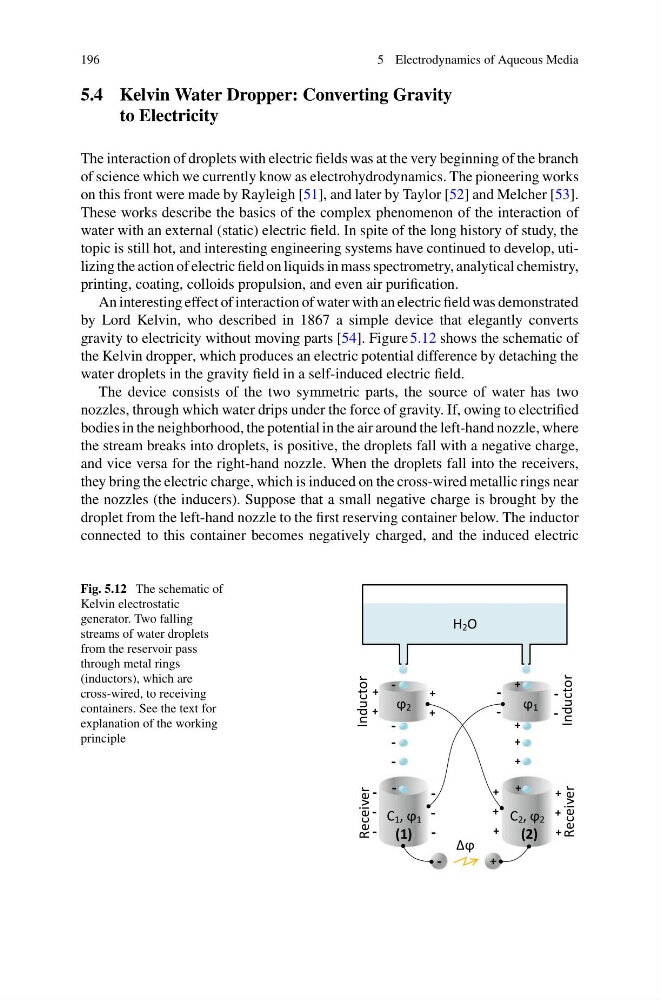
gravity to electricity without moving parts [54]. Figure 5.12 shows the schematic of
the Kelvin dropper, which produces an electric potential difference by detaching the
water droplets in the gravity field in a self-induced electric field.
The device consists of the two symmetric parts, the source of water has two
nozzles, through which water drips under the force of gravity. If, owing to electrified
bodies in the neighborhood, the potential in the air around the left-hand nozzle, where
the stream breaks into droplets, is positive, the droplets fall with a negative charge,
and vice versa for the right-hand nozzle. When the droplets fall into the receivers,
they bring the electric charge, which is induced on the cross-wired metallic rings near
the nozzles (the inducers). Suppose that a small negative charge is brought by the
droplet from the left-hand nozzle to the first reserving container below. The inductor
connected to this container becomes negatively charged, and the induced electric
Fig. 5.12 The schematic of
Kelvin electrostatic
generator. Two falling
streams of water droplets
from the reservoir pass
through metal rings
(inductors), which are
cross-wired, to receiving
containers. See the text for
explanation of the working
principle
H 2 O
C 1 , ϕ 1
C 2 , ϕ 2
-
+
-
-
-
-
-
-
+
+
+
+
+
+
-
-
-
-
+
+
+
+
-
-
-
-
-
+
+
+
+
+
Δϕ
ϕ 2
ϕ 1
Inductor
Inductor
Receiver
Receiver
(1)
(2)
5 Electrodynamics of Aqueous Media
5.4 Kelvin Water Dropper: Converting Gravity
to Electricity
The interaction of droplets with electric fields was at the very beginning of the branch
of science which we currently know as electrohydrodynamics. The pioneering works
on this front were made by Rayleigh [51], and later by Taylor [52] and Melcher [53].
These works describe the basics of the complex phenomenon of the interaction of
water with an external (static) electric field. In spite of the long history of study, the
topic is still hot, and interesting engineering systems have continued to develop, utilizing the action of electric field on liquids in mass spectrometry, analytical chemistry,
printing, coating, colloids propulsion, and even air purification.
An interesting effect of interaction of water with an electric field was demonstrated
by Lord Kelvin, who described in 1867 a simple device that elegantly converts
gravity to electricity without moving parts [54]. Figure 5.12 shows the schematic of
the Kelvin dropper, which produces an electric potential difference by detaching the
water droplets in the gravity field in a self-induced electric field.
The device consists of the two symmetric parts, the source of water has two
nozzles, through which water drips under the force of gravity. If, owing to electrified
bodies in the neighborhood, the potential in the air around the left-hand nozzle, where
the stream breaks into droplets, is positive, the droplets fall with a negative charge,
and vice versa for the right-hand nozzle. When the droplets fall into the receivers,
they bring the electric charge, which is induced on the cross-wired metallic rings near
the nozzles (the inducers). Suppose that a small negative charge is brought by the
droplet from the left-hand nozzle to the first reserving container below. The inductor
connected to this container becomes negatively charged, and the induced electric
Fig. 5.12 The schematic of
Kelvin electrostatic
generator. Two falling
streams of water droplets
from the reservoir pass
through metal rings
(inductors), which are
cross-wired, to receiving
containers. See the text for
explanation of the working
principle
H 2 O
C 1 , ϕ 1
C 2 , ϕ 2
-
+
-
-
-
-
-
-
+
+
+
+
+
+
-
-
-
-
+
+
+
+
-
-
-
-
-
+
+
+
+
+
Δϕ
ϕ 2
ϕ 1
Inductor
Inductor
Receiver
Receiver
(1)
(2)