

184
5 Electrodynamics of Aqueous Media
transforms to the expression for the equivalent conductivity at infinite dilution
0
x ,
similar to the empirical (5.1) derived by Kohlrauch:
e
0 = σ
e
dc /c
e
0 =
q
2
/k B T · D
√
K 1 c 0
K 2
.
(5.9)
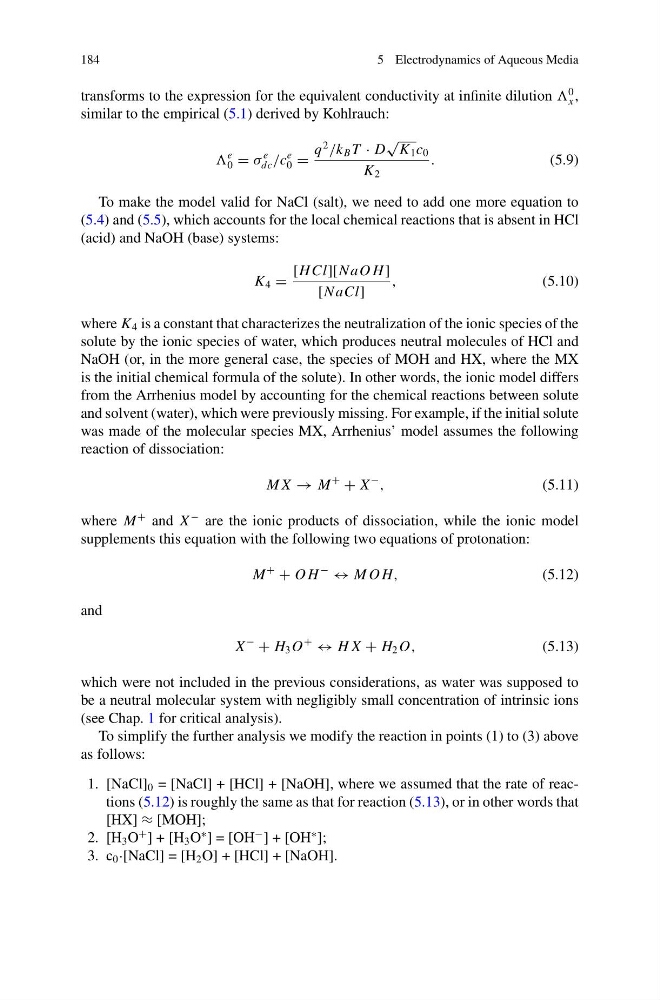
To make the model valid for NaCl (salt), we need to add one more equation to
(5.4) and (5.5), which accounts for the local chemical reactions that is absent in HCl
(acid) and NaOH (base) systems:
K 4 =
[HCl][N a O H]
[N aCl]
,
(5.10)
where K 4 is a constant that characterizes the neutralization of the ionic species of the
solute by the ionic species of water, which produces neutral molecules of HCl and
NaOH (or, in the more general case, the species of MOH and HX, where the MX
is the initial chemical formula of the solute). In other words, the ionic model differs
from the Arrhenius model by accounting for the chemical reactions between solute
and solvent (water), which were previously missing. For example, if the initial solute
was made of the molecular species MX, Arrhenius’ model assumes the following
reaction of dissociation:
M X → M
+
+ X
−
,
(5.11)
where M
+ and X
− are the ionic products of dissociation, while the ionic model
supplements this equation with the following two equations of protonation:
M
+
+ O H
−
↔ M O H,
(5.12)
and
X
−
+ H 3 O
+
↔ H X + H 2 O,
(5.13)
which were not included in the previous considerations, as water was supposed to
be a neutral molecular system with negligibly small concentration of intrinsic ions
(see Chap. 1 for critical analysis).
To simplify the further analysis we modify the reaction in points (1) to (3) above
as follows:
1. [NaCl] 0 = [NaCl] + [HCl] + [NaOH], where we assumed that the rate of reactions (5.12) is roughly the same as that for reaction (5.13), or in other words that
[HX] ≈ [MOH];
2. [H 3 O
+ ] + [H 3 O
∗ ] = [OH
− ] + [OH
∗ ];
3. c 0 ·[NaCl] = [H 2 O] + [HCl] + [NaOH].
5 Electrodynamics of Aqueous Media
transforms to the expression for the equivalent conductivity at infinite dilution
0
x ,
similar to the empirical (5.1) derived by Kohlrauch:
e
0 = σ
e
dc /c
e
0 =
q
2
/k B T · D
√
K 1 c 0
K 2
.
(5.9)
To make the model valid for NaCl (salt), we need to add one more equation to
(5.4) and (5.5), which accounts for the local chemical reactions that is absent in HCl
(acid) and NaOH (base) systems:
K 4 =
[HCl][N a O H]
[N aCl]
,
(5.10)
where K 4 is a constant that characterizes the neutralization of the ionic species of the
solute by the ionic species of water, which produces neutral molecules of HCl and
NaOH (or, in the more general case, the species of MOH and HX, where the MX
is the initial chemical formula of the solute). In other words, the ionic model differs
from the Arrhenius model by accounting for the chemical reactions between solute
and solvent (water), which were previously missing. For example, if the initial solute
was made of the molecular species MX, Arrhenius’ model assumes the following
reaction of dissociation:
M X → M
+
+ X
−
,
(5.11)
where M
+ and X
− are the ionic products of dissociation, while the ionic model
supplements this equation with the following two equations of protonation:
M
+
+ O H
−
↔ M O H,
(5.12)
and
X
−
+ H 3 O
+
↔ H X + H 2 O,
(5.13)
which were not included in the previous considerations, as water was supposed to
be a neutral molecular system with negligibly small concentration of intrinsic ions
(see Chap. 1 for critical analysis).
To simplify the further analysis we modify the reaction in points (1) to (3) above
as follows:
1. [NaCl] 0 = [NaCl] + [HCl] + [NaOH], where we assumed that the rate of reactions (5.12) is roughly the same as that for reaction (5.13), or in other words that
[HX] ≈ [MOH];
2. [H 3 O
+ ] + [H 3 O
∗ ] = [OH
− ] + [OH
∗ ];
3. c 0 ·[NaCl] = [H 2 O] + [HCl] + [NaOH].