

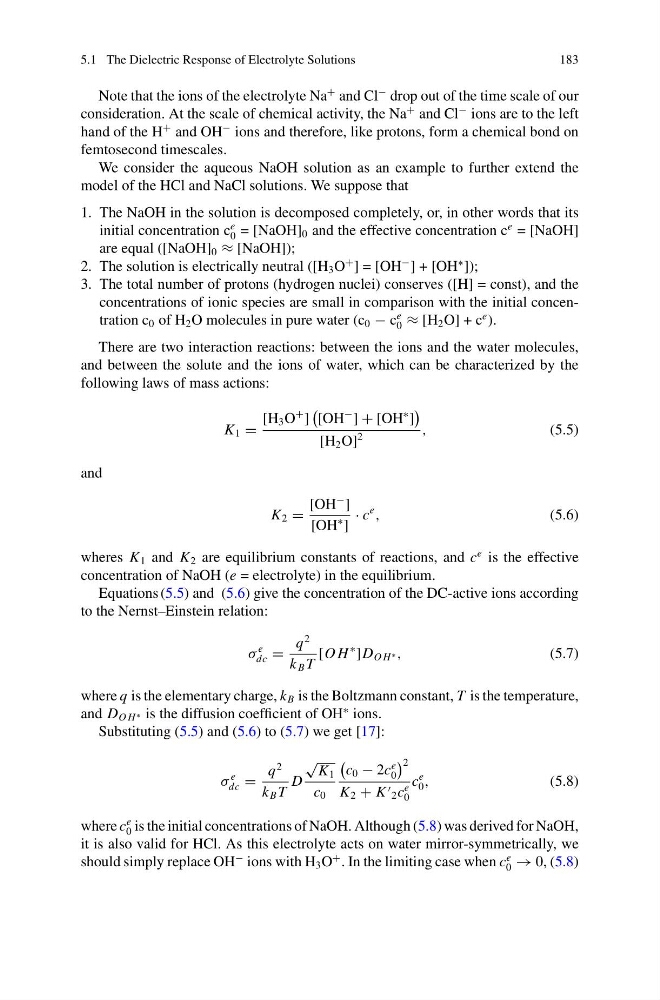
5.1 The Dielectric Response of Electrolyte Solutions
183
Note that the ions of the electrolyte Na
+ and Cl
− drop out of the time scale of our
consideration. At the scale of chemical activity, the Na
+ and Cl
− ions are to the left
hand of the H
+ and OH
− ions and therefore, like protons, form a chemical bond on
femtosecond timescales.
We consider the aqueous NaOH solution as an example to further extend the
model of the HCl and NaCl solutions. We suppose that
1. The NaOH in the solution is decomposed completely, or, in other words that its
initial concentration c
e
0 = [NaOH] 0 and the effective concentration c
e = [NaOH]
are equal ([NaOH] 0 ≈ [NaOH]);
2. The solution is electrically neutral ([H 3 O
+ ] = [OH
− ] + [OH
∗ ]);
3. The total number of protons (hydrogen nuclei) conserves ([H] = const), and the
concentrations of ionic species are small in comparison with the initial concentration c 0 of H 2 O molecules in pure water (c 0 − c
e
0 ≈ [H 2 O] + c
e ).
There are two interaction reactions: between the ions and the water molecules,
and between the solute and the ions of water, which can be characterized by the
following laws of mass actions:
K 1 =
[H 3 O
+
]
[OH
−
] + [OH
∗
]
[H 2 O]
2
,
(5.5)
and
K 2 =
[OH
−
]
[OH
∗
]
· c
e
,
(5.6)
wheres K 1 and K 2 are equilibrium constants of reactions, and c
e is the effective
concentration of NaOH (e = electrolyte) in the equilibrium.
Equations (5.5) and (5.6) give the concentration of the DC-active ions according
to the Nernst–Einstein relation:
σ
e
dc =
q
2
k B T
[O H
∗
]D O H ∗ ,
(5.7)
where q is the elementary charge, k B is the Boltzmann constant, T is the temperature,
and D O H ∗ is the diffusion coefficient of OH
∗ ions.
Substituting (5.5) and (5.6) to (5.7) we get [17]:
σ
e
dc =
q
2
k B T
D
√
K 1
c 0
c 0 − 2c
e
0
2
K 2 + K 2 c
e
0
c
e
0 ,
(5.8)
where c
e
0 is the initial concentrations of NaOH. Although (5.8) was derived for NaOH,
it is also valid for HCl. As this electrolyte acts on water mirror-symmetrically, we
should simply replace OH
− ions with H 3 O
+ . In the limiting case when c
e
0 → 0, (5.8)
183
Note that the ions of the electrolyte Na
+ and Cl
− drop out of the time scale of our
consideration. At the scale of chemical activity, the Na
+ and Cl
− ions are to the left
hand of the H
+ and OH
− ions and therefore, like protons, form a chemical bond on
femtosecond timescales.
We consider the aqueous NaOH solution as an example to further extend the
model of the HCl and NaCl solutions. We suppose that
1. The NaOH in the solution is decomposed completely, or, in other words that its
initial concentration c
e
0 = [NaOH] 0 and the effective concentration c
e = [NaOH]
are equal ([NaOH] 0 ≈ [NaOH]);
2. The solution is electrically neutral ([H 3 O
+ ] = [OH
− ] + [OH
∗ ]);
3. The total number of protons (hydrogen nuclei) conserves ([H] = const), and the
concentrations of ionic species are small in comparison with the initial concentration c 0 of H 2 O molecules in pure water (c 0 − c
e
0 ≈ [H 2 O] + c
e ).
There are two interaction reactions: between the ions and the water molecules,
and between the solute and the ions of water, which can be characterized by the
following laws of mass actions:
K 1 =
[H 3 O
+
]
[OH
−
] + [OH
∗
]
[H 2 O]
2
,
(5.5)
and
K 2 =
[OH
−
]
[OH
∗
]
· c
e
,
(5.6)
wheres K 1 and K 2 are equilibrium constants of reactions, and c
e is the effective
concentration of NaOH (e = electrolyte) in the equilibrium.
Equations (5.5) and (5.6) give the concentration of the DC-active ions according
to the Nernst–Einstein relation:
σ
e
dc =
q
2
k B T
[O H
∗
]D O H ∗ ,
(5.7)
where q is the elementary charge, k B is the Boltzmann constant, T is the temperature,
and D O H ∗ is the diffusion coefficient of OH
∗ ions.
Substituting (5.5) and (5.6) to (5.7) we get [17]:
σ
e
dc =
q
2
k B T
D
√
K 1
c 0
c 0 − 2c
e
0
2
K 2 + K 2 c
e
0
c
e
0 ,
(5.8)
where c
e
0 is the initial concentrations of NaOH. Although (5.8) was derived for NaOH,
it is also valid for HCl. As this electrolyte acts on water mirror-symmetrically, we
should simply replace OH
− ions with H 3 O
+ . In the limiting case when c
e
0 → 0, (5.8)