

5.1 The Dielectric Response of Electrolyte Solutions
185
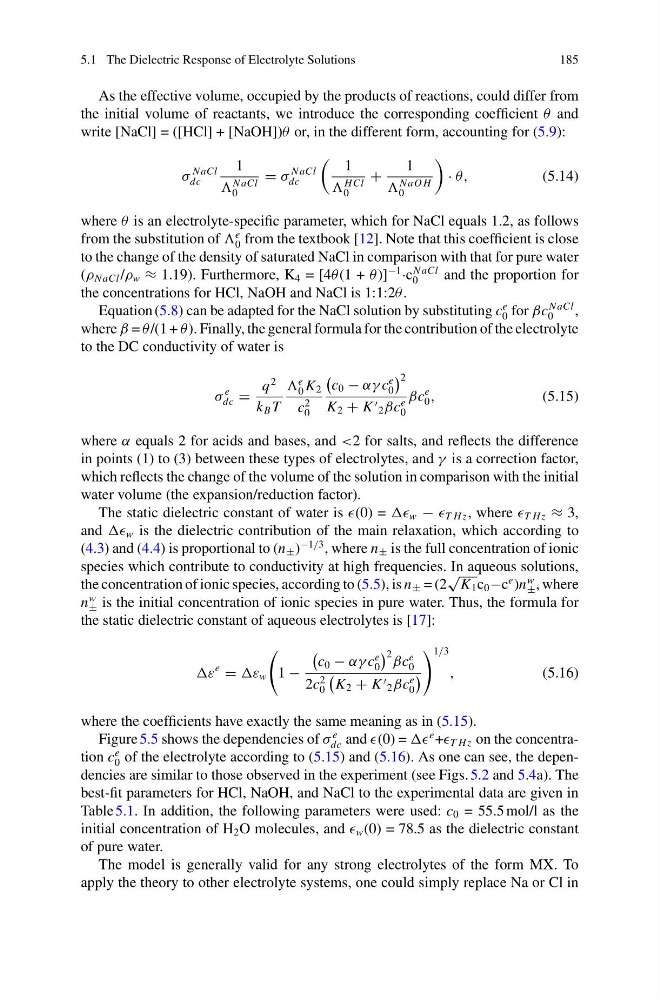
As the effective volume, occupied by the products of reactions, could differ from
the initial volume of reactants, we introduce the corresponding coefficient θ and
write [NaCl] = ([HCl] + [NaOH])θ or, in the different form, accounting for (5.9):
σ
NaCl
dc
1
NaCl
0
= σ
NaCl
dc
1
HCl
0
+
1
NaO H
0
· θ,
(5.14)
where θ is an electrolyte-specific parameter, which for NaCl equals 1.2, as follows
from the substitution of
e
0 from the textbook [12]. Note that this coefficient is close
to the change of the density of saturated NaCl in comparison with that for pure water
(ρ NaCl /ρ w ≈ 1.19). Furthermore, K 4 = [4θ (1 + θ )]
−1
·c
NaCl
0
and the proportion for
the concentrations for HCl, NaOH and NaCl is 1:1:2θ .
Equation (5.8) can be adapted for the NaCl solution by substituting c
e
0 for βc
NaCl
0
,
where β = θ /(1 + θ ). Finally, the general formula for the contribution of the electrolyte
to the DC conductivity of water is
σ
e
dc =
q
2
k B T
e
0 K 2
c
2
0
c 0 − αγ c
e
0
2
K 2 + K 2 βc
e
0
βc
e
0 ,
(5.15)
where α equals 2 for acids and bases, and <2 for salts, and reflects the difference
in points (1) to (3) between these types of electrolytes, and γ is a correction factor,
which reflects the change of the volume of the solution in comparison with the initial
water volume (the expansion/reduction factor).
The static dielectric constant of water is (0) = w − T Hz , where T Hz ≈ 3,
and w is the dielectric contribution of the main relaxation, which according to
(4.3) and (4.4) is proportional to (n ± )
−1/3 , where n ± is the full concentration of ionic
species which contribute to conductivity at high frequencies. In aqueous solutions,
the concentration of ionic species, according to (5.5), is n ± = (2
√
K 1 c 0 −c
e )n
w
± , where
n
w
± is the initial concentration of ionic species in pure water. Thus, the formula for
the static dielectric constant of aqueous electrolytes is [17]:
ε
e
= ε w
1 −
c 0 − αγ c
e
0
2 βc
e
0
2c
2
0
K 2 + K 2 βc
e
0
1/3
,
(5.16)
where the coefficients have exactly the same meaning as in (5.15).
Figure 5.5 shows the dependencies of σ
e
dc and (0) =
e + T Hz on the concentration c
e
0 of the electrolyte according to (5.15) and (5.16). As one can see, the dependencies are similar to those observed in the experiment (see Figs. 5.2 and 5.4a). The
best-fit parameters for HCl, NaOH, and NaCl to the experimental data are given in
Table 5.1. In addition, the following parameters were used: c 0 = 55.5 mol/l as the
initial concentration of H 2 O molecules, and w (0) = 78.5 as the dielectric constant
of pure water.
The model is generally valid for any strong electrolytes of the form MX. To
apply the theory to other electrolyte systems, one could simply replace Na or Cl in
185
As the effective volume, occupied by the products of reactions, could differ from
the initial volume of reactants, we introduce the corresponding coefficient θ and
write [NaCl] = ([HCl] + [NaOH])θ or, in the different form, accounting for (5.9):
σ
NaCl
dc
1
NaCl
0
= σ
NaCl
dc
1
HCl
0
+
1
NaO H
0
· θ,
(5.14)
where θ is an electrolyte-specific parameter, which for NaCl equals 1.2, as follows
from the substitution of
e
0 from the textbook [12]. Note that this coefficient is close
to the change of the density of saturated NaCl in comparison with that for pure water
(ρ NaCl /ρ w ≈ 1.19). Furthermore, K 4 = [4θ (1 + θ )]
−1
·c
NaCl
0
and the proportion for
the concentrations for HCl, NaOH and NaCl is 1:1:2θ .
Equation (5.8) can be adapted for the NaCl solution by substituting c
e
0 for βc
NaCl
0
,
where β = θ /(1 + θ ). Finally, the general formula for the contribution of the electrolyte
to the DC conductivity of water is
σ
e
dc =
q
2
k B T
e
0 K 2
c
2
0
c 0 − αγ c
e
0
2
K 2 + K 2 βc
e
0
βc
e
0 ,
(5.15)
where α equals 2 for acids and bases, and <2 for salts, and reflects the difference
in points (1) to (3) between these types of electrolytes, and γ is a correction factor,
which reflects the change of the volume of the solution in comparison with the initial
water volume (the expansion/reduction factor).
The static dielectric constant of water is (0) = w − T Hz , where T Hz ≈ 3,
and w is the dielectric contribution of the main relaxation, which according to
(4.3) and (4.4) is proportional to (n ± )
−1/3 , where n ± is the full concentration of ionic
species which contribute to conductivity at high frequencies. In aqueous solutions,
the concentration of ionic species, according to (5.5), is n ± = (2
√
K 1 c 0 −c
e )n
w
± , where
n
w
± is the initial concentration of ionic species in pure water. Thus, the formula for
the static dielectric constant of aqueous electrolytes is [17]:
ε
e
= ε w
1 −
c 0 − αγ c
e
0
2 βc
e
0
2c
2
0
K 2 + K 2 βc
e
0
1/3
,
(5.16)
where the coefficients have exactly the same meaning as in (5.15).
Figure 5.5 shows the dependencies of σ
e
dc and (0) =
e + T Hz on the concentration c
e
0 of the electrolyte according to (5.15) and (5.16). As one can see, the dependencies are similar to those observed in the experiment (see Figs. 5.2 and 5.4a). The
best-fit parameters for HCl, NaOH, and NaCl to the experimental data are given in
Table 5.1. In addition, the following parameters were used: c 0 = 55.5 mol/l as the
initial concentration of H 2 O molecules, and w (0) = 78.5 as the dielectric constant
of pure water.
The model is generally valid for any strong electrolytes of the form MX. To
apply the theory to other electrolyte systems, one could simply replace Na or Cl in