

5.1 The Dielectric Response of Electrolyte Solutions
173
words, metals were initially considered as solvents with a high dissociation rate by
analogy with aqueous electrolytes. The modern understanding of metals came much
later, with the advent of quantum theory.
In the historical context, it is also interesting to note other ideas [2], which significantly determined our understanding of electrolytes, but have also misled researchers
for decades. It was assumed that if the electrolyte consisted only of charged particles,
then their separation under the influence of an electric field would lead to their scattering in space. Since this was not observed, only complex substances (not elements)
were endowed with the ability to conduct electricity. It was found that ions in the
solutions and in the melts of a homogeneous substance have the same electric charge,
thus, both contain similar species of the same nature. Finally, the conductivity of salt
melts was found proportional to the degree of dissociation, but inversely proportional
to the friction, and the separation of these two factors by the measurements of the
conductivity only was found to be impossible.
Kohlraush was probably one of the most productive experimentalists of that
period. In 1874, he demonstrated [4] that each electrolyte has a definite solutespecific electrical resistance. By measuring the conductivity of different aqueous
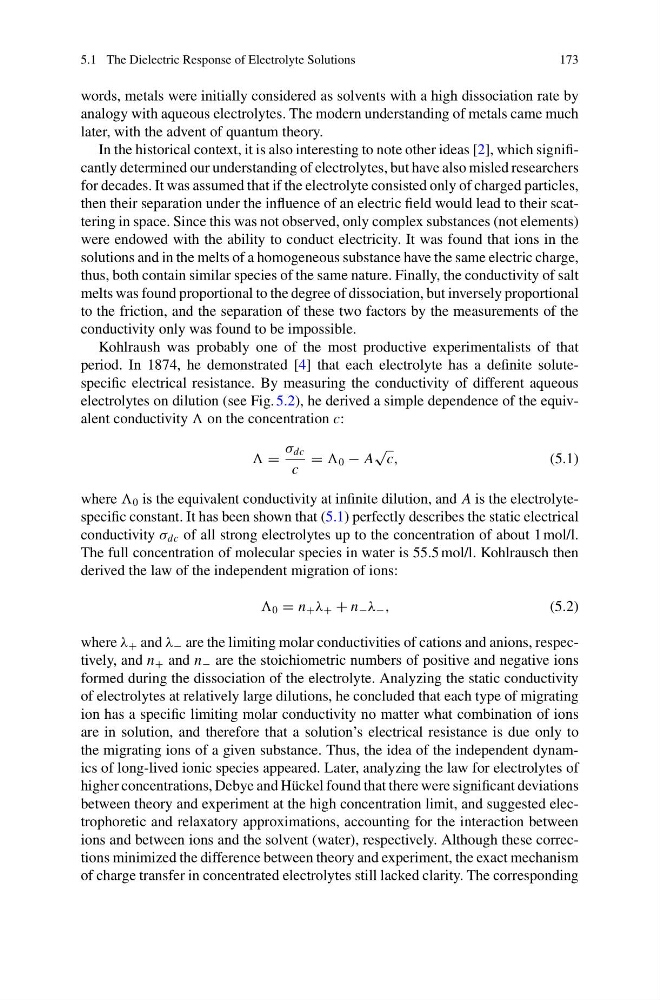
electrolytes on dilution (see Fig. 5.2), he derived a simple dependence of the equivalent conductivity on the concentration c:
=
σ dc
c
= 0 − A
√
c,
(5.1)
where 0 is the equivalent conductivity at infinite dilution, and A is the electrolytespecific constant. It has been shown that (5.1) perfectly describes the static electrical
conductivity σ dc of all strong electrolytes up to the concentration of about 1 mol/l.
The full concentration of molecular species in water is 55.5 mol/l. Kohlrausch then
derived the law of the independent migration of ions:
0 = n + λ + + n − λ − ,
(5.2)
where λ + and λ − are the limiting molar conductivities of cations and anions, respectively, and n + and n − are the stoichiometric numbers of positive and negative ions
formed during the dissociation of the electrolyte. Analyzing the static conductivity
of electrolytes at relatively large dilutions, he concluded that each type of migrating
ion has a specific limiting molar conductivity no matter what combination of ions
are in solution, and therefore that a solution’s electrical resistance is due only to
the migrating ions of a given substance. Thus, the idea of the independent dynamics of long-lived ionic species appeared. Later, analyzing the law for electrolytes of
higher concentrations, Debye and Hückel found that there were significant deviations
between theory and experiment at the high concentration limit, and suggested electrophoretic and relaxatory approximations, accounting for the interaction between
ions and between ions and the solvent (water), respectively. Although these corrections minimized the difference between theory and experiment, the exact mechanism
of charge transfer in concentrated electrolytes still lacked clarity. The corresponding
173
words, metals were initially considered as solvents with a high dissociation rate by
analogy with aqueous electrolytes. The modern understanding of metals came much
later, with the advent of quantum theory.
In the historical context, it is also interesting to note other ideas [2], which significantly determined our understanding of electrolytes, but have also misled researchers
for decades. It was assumed that if the electrolyte consisted only of charged particles,
then their separation under the influence of an electric field would lead to their scattering in space. Since this was not observed, only complex substances (not elements)
were endowed with the ability to conduct electricity. It was found that ions in the
solutions and in the melts of a homogeneous substance have the same electric charge,
thus, both contain similar species of the same nature. Finally, the conductivity of salt
melts was found proportional to the degree of dissociation, but inversely proportional
to the friction, and the separation of these two factors by the measurements of the
conductivity only was found to be impossible.
Kohlraush was probably one of the most productive experimentalists of that
period. In 1874, he demonstrated [4] that each electrolyte has a definite solutespecific electrical resistance. By measuring the conductivity of different aqueous
electrolytes on dilution (see Fig. 5.2), he derived a simple dependence of the equivalent conductivity on the concentration c:
=
σ dc
c
= 0 − A
√
c,
(5.1)
where 0 is the equivalent conductivity at infinite dilution, and A is the electrolytespecific constant. It has been shown that (5.1) perfectly describes the static electrical
conductivity σ dc of all strong electrolytes up to the concentration of about 1 mol/l.
The full concentration of molecular species in water is 55.5 mol/l. Kohlrausch then
derived the law of the independent migration of ions:
0 = n + λ + + n − λ − ,
(5.2)
where λ + and λ − are the limiting molar conductivities of cations and anions, respectively, and n + and n − are the stoichiometric numbers of positive and negative ions
formed during the dissociation of the electrolyte. Analyzing the static conductivity
of electrolytes at relatively large dilutions, he concluded that each type of migrating
ion has a specific limiting molar conductivity no matter what combination of ions
are in solution, and therefore that a solution’s electrical resistance is due only to
the migrating ions of a given substance. Thus, the idea of the independent dynamics of long-lived ionic species appeared. Later, analyzing the law for electrolytes of
higher concentrations, Debye and Hückel found that there were significant deviations
between theory and experiment at the high concentration limit, and suggested electrophoretic and relaxatory approximations, accounting for the interaction between
ions and between ions and the solvent (water), respectively. Although these corrections minimized the difference between theory and experiment, the exact mechanism
of charge transfer in concentrated electrolytes still lacked clarity. The corresponding