

174
5 Electrodynamics of Aqueous Media
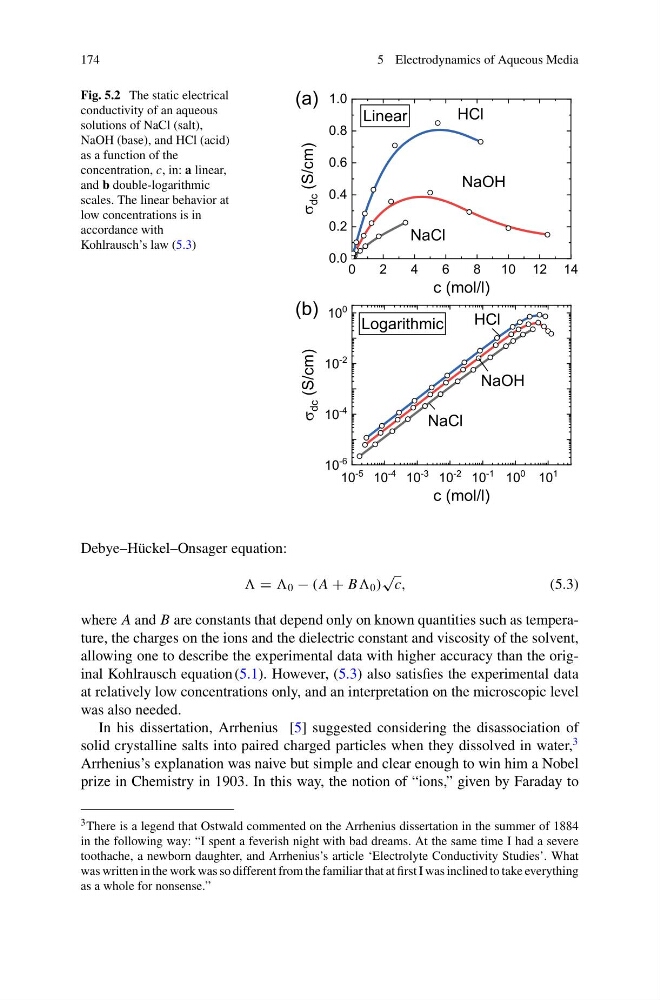
Fig. 5.2 The static electrical
conductivity of an aqueous
solutions of NaCl (salt),
NaOH (base), and HCl (acid)
as a function of the
concentration, c, in: a linear,
and b double-logarithmic
scales. The linear behavior at
low concentrations is in
accordance with
Kohlrausch’s law (5.3)
Debye–Hückel–Onsager equation:
= 0 − (A + B 0 )
√
c,
(5.3)
where A and B are constants that depend only on known quantities such as temperature, the charges on the ions and the dielectric constant and viscosity of the solvent,
allowing one to describe the experimental data with higher accuracy than the original Kohlrausch equation (5.1). However, (5.3) also satisfies the experimental data
at relatively low concentrations only, and an interpretation on the microscopic level
was also needed.
In his dissertation, Arrhenius [5] suggested considering the disassociation of
solid crystalline salts into paired charged particles when they dissolved in water,
3
Arrhenius’s explanation was naive but simple and clear enough to win him a Nobel
prize in Chemistry in 1903. In this way, the notion of “ions,” given by Faraday to
3 There is a legend that Ostwald commented on the Arrhenius dissertation in the summer of 1884
in the following way: “I spent a feverish night with bad dreams. At the same time I had a severe
toothache, a newborn daughter, and Arrhenius’s article ‘Electrolyte Conductivity Studies’. What
was written in the work was so different from the familiar that at first I was inclined to take everything
as a whole for nonsense.”
5 Electrodynamics of Aqueous Media
Fig. 5.2 The static electrical
conductivity of an aqueous
solutions of NaCl (salt),
NaOH (base), and HCl (acid)
as a function of the
concentration, c, in: a linear,
and b double-logarithmic
scales. The linear behavior at
low concentrations is in
accordance with
Kohlrausch’s law (5.3)
Debye–Hückel–Onsager equation:
= 0 − (A + B 0 )
√
c,
(5.3)
where A and B are constants that depend only on known quantities such as temperature, the charges on the ions and the dielectric constant and viscosity of the solvent,
allowing one to describe the experimental data with higher accuracy than the original Kohlrausch equation (5.1). However, (5.3) also satisfies the experimental data
at relatively low concentrations only, and an interpretation on the microscopic level
was also needed.
In his dissertation, Arrhenius [5] suggested considering the disassociation of
solid crystalline salts into paired charged particles when they dissolved in water,
3
Arrhenius’s explanation was naive but simple and clear enough to win him a Nobel
prize in Chemistry in 1903. In this way, the notion of “ions,” given by Faraday to
3 There is a legend that Ostwald commented on the Arrhenius dissertation in the summer of 1884
in the following way: “I spent a feverish night with bad dreams. At the same time I had a severe
toothache, a newborn daughter, and Arrhenius’s article ‘Electrolyte Conductivity Studies’. What
was written in the work was so different from the familiar that at first I was inclined to take everything
as a whole for nonsense.”