

172
5 Electrodynamics of Aqueous Media
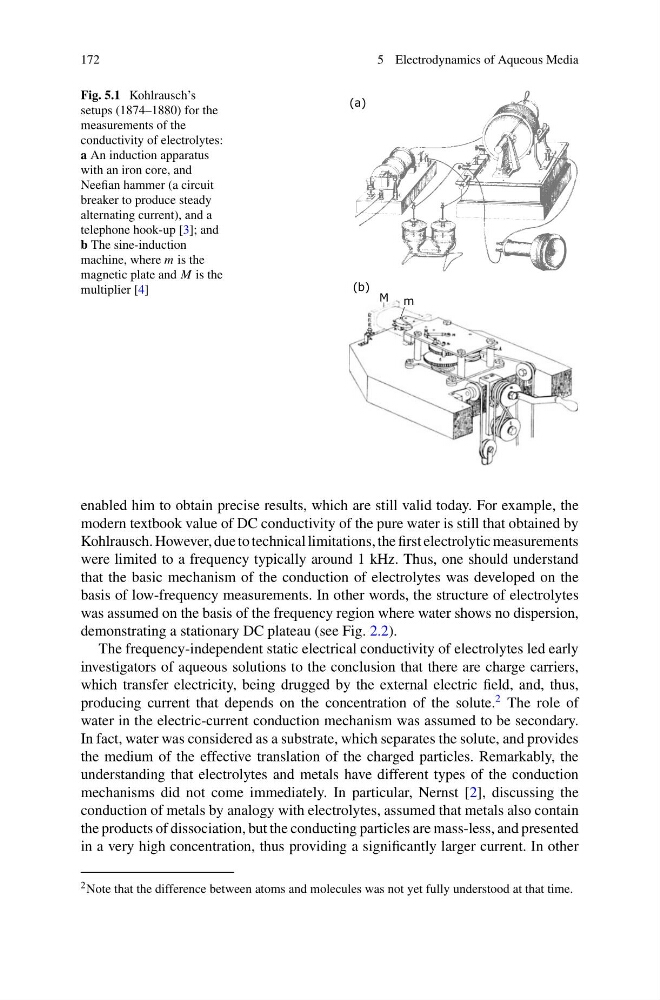
Fig. 5.1 Kohlrausch’s
setups (1874–1880) for the
measurements of the
conductivity of electrolytes:
a An induction apparatus
with an iron core, and
Neefian hammer (a circuit
breaker to produce steady
alternating current), and a
telephone hook-up [3]; and
b The sine-induction
machine, where m is the
magnetic plate and M is the
multiplier [4]
(a)
(b)
m
M
enabled him to obtain precise results, which are still valid today. For example, the
modern textbook value of DC conductivity of the pure water is still that obtained by
Kohlrausch. However, due to technical limitations, the first electrolytic measurements
were limited to a frequency typically around 1 kHz. Thus, one should understand
that the basic mechanism of the conduction of electrolytes was developed on the
basis of low-frequency measurements. In other words, the structure of electrolytes
was assumed on the basis of the frequency region where water shows no dispersion,
demonstrating a stationary DC plateau (see Fig. 2.2).
The frequency-independent static electrical conductivity of electrolytes led early
investigators of aqueous solutions to the conclusion that there are charge carriers,
which transfer electricity, being drugged by the external electric field, and, thus,
producing current that depends on the concentration of the solute.
2 The role of
water in the electric-current conduction mechanism was assumed to be secondary.
In fact, water was considered as a substrate, which separates the solute, and provides
the medium of the effective translation of the charged particles. Remarkably, the
understanding that electrolytes and metals have different types of the conduction
mechanisms did not come immediately. In particular, Nernst [2], discussing the
conduction of metals by analogy with electrolytes, assumed that metals also contain
the products of dissociation, but the conducting particles are mass-less, and presented
in a very high concentration, thus providing a significantly larger current. In other
2 Note that the difference between atoms and molecules was not yet fully understood at that time.
5 Electrodynamics of Aqueous Media
Fig. 5.1 Kohlrausch’s
setups (1874–1880) for the
measurements of the
conductivity of electrolytes:
a An induction apparatus
with an iron core, and
Neefian hammer (a circuit
breaker to produce steady
alternating current), and a
telephone hook-up [3]; and
b The sine-induction
machine, where m is the
magnetic plate and M is the
multiplier [4]
(a)
(b)
m
M
enabled him to obtain precise results, which are still valid today. For example, the
modern textbook value of DC conductivity of the pure water is still that obtained by
Kohlrausch. However, due to technical limitations, the first electrolytic measurements
were limited to a frequency typically around 1 kHz. Thus, one should understand
that the basic mechanism of the conduction of electrolytes was developed on the
basis of low-frequency measurements. In other words, the structure of electrolytes
was assumed on the basis of the frequency region where water shows no dispersion,
demonstrating a stationary DC plateau (see Fig. 2.2).
The frequency-independent static electrical conductivity of electrolytes led early
investigators of aqueous solutions to the conclusion that there are charge carriers,
which transfer electricity, being drugged by the external electric field, and, thus,
producing current that depends on the concentration of the solute.
2 The role of
water in the electric-current conduction mechanism was assumed to be secondary.
In fact, water was considered as a substrate, which separates the solute, and provides
the medium of the effective translation of the charged particles. Remarkably, the
understanding that electrolytes and metals have different types of the conduction
mechanisms did not come immediately. In particular, Nernst [2], discussing the
conduction of metals by analogy with electrolytes, assumed that metals also contain
the products of dissociation, but the conducting particles are mass-less, and presented
in a very high concentration, thus providing a significantly larger current. In other
2 Note that the difference between atoms and molecules was not yet fully understood at that time.