

3.5 Protonic Transport as a Fundamental Mechanism of the Dielectric…
123
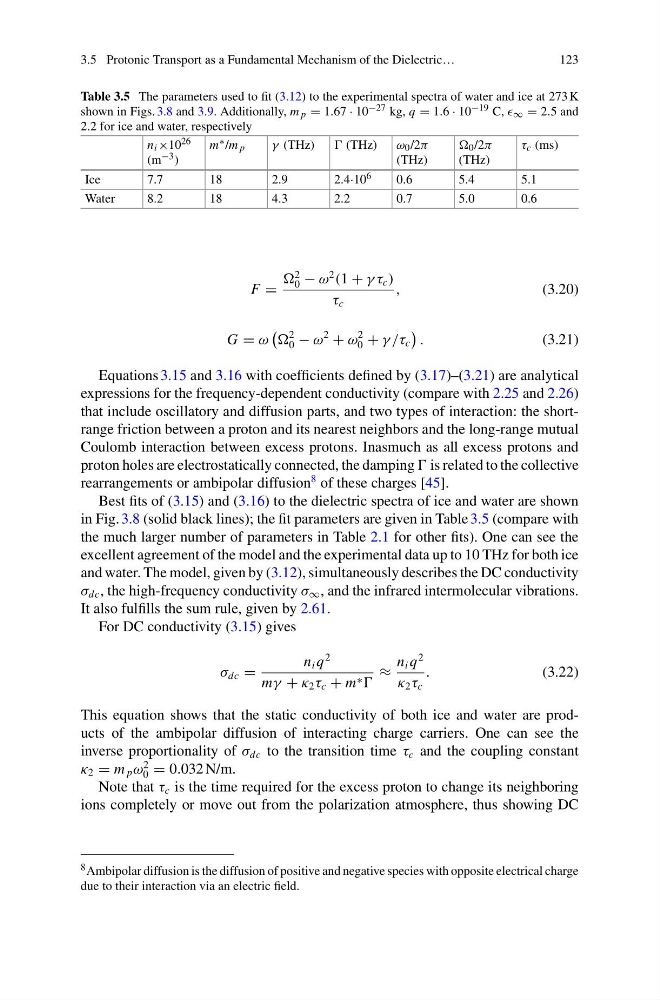
Table 3.5 The parameters used to fit (3.12) to the experimental spectra of water and ice at 273 K
shown in Figs. 3.8 and 3.9. Additionally, m p = 1.67 · 10 −27 kg, q = 1.6 · 10 −19 C, ∞ = 2.5 and
2.2 for ice and water, respectively
n i ×10 26
(m −3 )
m ∗ /m p
γ (THz)
(THz)
ω 0 /2π
(THz)
0 /2π
(THz)
τ c (ms)
Ice
7.7
18
2.9
2.4·10 6
0.6
5.4
5.1
Water
8.2
18
4.3
2.2
0.7
5.0
0.6
F =
2
0 − ω
2
(1 + γ τ c )
τ c
,
(3.20)
G = ω
2
0 − ω
2
+ ω
2
0 + γ /τ c
.
(3.21)
Equations 3.15 and 3.16 with coefficients defined by (3.17)–(3.21) are analytical
expressions for the frequency-dependent conductivity (compare with 2.25 and 2.26)
that include oscillatory and diffusion parts, and two types of interaction: the shortrange friction between a proton and its nearest neighbors and the long-range mutual
Coulomb interaction between excess protons. Inasmuch as all excess protons and
proton holes are electrostatically connected, the damping is related to the collective
rearrangements or ambipolar diffusion
8 of these charges [45].
Best fits of (3.15) and (3.16) to the dielectric spectra of ice and water are shown
in Fig. 3.8 (solid black lines); the fit parameters are given in Table 3.5 (compare with
the much larger number of parameters in Table 2.1 for other fits). One can see the
excellent agreement of the model and the experimental data up to 10 THz for both ice
and water. The model, given by (3.12), simultaneously describes the DC conductivity
σ dc , the high-frequency conductivity σ ∞ , and the infrared intermolecular vibrations.
It also fulfills the sum rule, given by 2.61.
For DC conductivity (3.15) gives
σ dc =
n i q
2
mγ + κ 2 τ c + m ∗
≈
n i q
2
κ 2 τ c
.
(3.22)
This equation shows that the static conductivity of both ice and water are products of the ambipolar diffusion of interacting charge carriers. One can see the
inverse proportionality of σ dc to the transition time τ c and the coupling constant
κ 2 = m p ω
2
0 = 0.032 N/m.
Note that τ c is the time required for the excess proton to change its neighboring
ions completely or move out from the polarization atmosphere, thus showing DC
8 Ambipolar diffusion is the diffusion of positive and negative species with opposite electrical charge
due to their interaction via an electric field.
123
Table 3.5 The parameters used to fit (3.12) to the experimental spectra of water and ice at 273 K
shown in Figs. 3.8 and 3.9. Additionally, m p = 1.67 · 10 −27 kg, q = 1.6 · 10 −19 C, ∞ = 2.5 and
2.2 for ice and water, respectively
n i ×10 26
(m −3 )
m ∗ /m p
γ (THz)
(THz)
ω 0 /2π
(THz)
0 /2π
(THz)
τ c (ms)
Ice
7.7
18
2.9
2.4·10 6
0.6
5.4
5.1
Water
8.2
18
4.3
2.2
0.7
5.0
0.6
F =
2
0 − ω
2
(1 + γ τ c )
τ c
,
(3.20)
G = ω
2
0 − ω
2
+ ω
2
0 + γ /τ c
.
(3.21)
Equations 3.15 and 3.16 with coefficients defined by (3.17)–(3.21) are analytical
expressions for the frequency-dependent conductivity (compare with 2.25 and 2.26)
that include oscillatory and diffusion parts, and two types of interaction: the shortrange friction between a proton and its nearest neighbors and the long-range mutual
Coulomb interaction between excess protons. Inasmuch as all excess protons and
proton holes are electrostatically connected, the damping is related to the collective
rearrangements or ambipolar diffusion
8 of these charges [45].
Best fits of (3.15) and (3.16) to the dielectric spectra of ice and water are shown
in Fig. 3.8 (solid black lines); the fit parameters are given in Table 3.5 (compare with
the much larger number of parameters in Table 2.1 for other fits). One can see the
excellent agreement of the model and the experimental data up to 10 THz for both ice
and water. The model, given by (3.12), simultaneously describes the DC conductivity
σ dc , the high-frequency conductivity σ ∞ , and the infrared intermolecular vibrations.
It also fulfills the sum rule, given by 2.61.
For DC conductivity (3.15) gives
σ dc =
n i q
2
mγ + κ 2 τ c + m ∗
≈
n i q
2
κ 2 τ c
.
(3.22)
This equation shows that the static conductivity of both ice and water are products of the ambipolar diffusion of interacting charge carriers. One can see the
inverse proportionality of σ dc to the transition time τ c and the coupling constant
κ 2 = m p ω
2
0 = 0.032 N/m.
Note that τ c is the time required for the excess proton to change its neighboring
ions completely or move out from the polarization atmosphere, thus showing DC
8 Ambipolar diffusion is the diffusion of positive and negative species with opposite electrical charge
due to their interaction via an electric field.