

124
3 The Interaction of Electromagnetic Waves with Ice
conductivity. The corresponding barrier as evident from the analysis of the temperature dependencies of conductivity and dielectric relaxation in water [25] is a fraction
of an eV. With this barrier E, the time τ c is equal to
τ c =
1
ν 0
exp
E
k B T
.
(3.23)
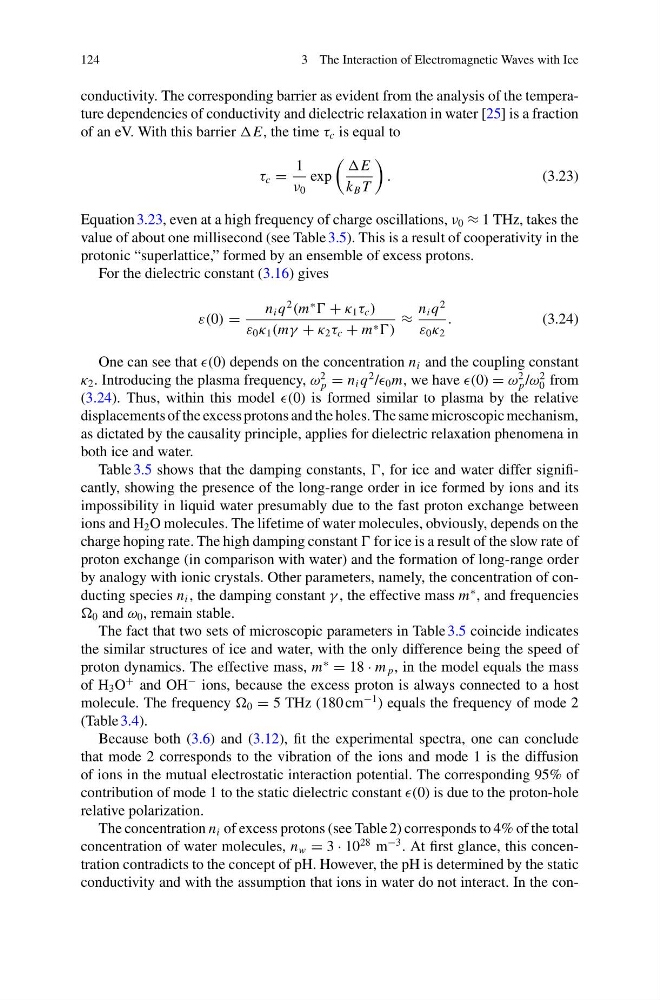
Equation 3.23, even at a high frequency of charge oscillations, ν 0 ≈ 1 THz, takes the
value of about one millisecond (see Table 3.5). This is a result of cooperativity in the
protonic “superlattice,” formed by an ensemble of excess protons.
For the dielectric constant (3.16) gives
ε(0) =
n i q
2
(m
∗
+ κ 1 τ c )
ε 0 κ 1 (mγ + κ 2 τ c + m ∗ )
≈
n i q
2
ε 0 κ 2
.
(3.24)
One can see that (0) depends on the concentration n i and the coupling constant
κ 2 . Introducing the plasma frequency, ω
2
p = n i q
2 / 0 m, we have (0) = ω
2
p /ω
2
0 from
(3.24). Thus, within this model (0) is formed similar to plasma by the relative
displacements of the excess protons and the holes. The same microscopic mechanism,
as dictated by the causality principle, applies for dielectric relaxation phenomena in
both ice and water.
Table 3.5 shows that the damping constants, , for ice and water differ significantly, showing the presence of the long-range order in ice formed by ions and its
impossibility in liquid water presumably due to the fast proton exchange between
ions and H 2 O molecules. The lifetime of water molecules, obviously, depends on the
charge hoping rate. The high damping constant for ice is a result of the slow rate of
proton exchange (in comparison with water) and the formation of long-range order
by analogy with ionic crystals. Other parameters, namely, the concentration of conducting species n i , the damping constant γ , the effective mass m
∗ , and frequencies
0 and ω 0 , remain stable.
The fact that two sets of microscopic parameters in Table 3.5 coincide indicates
the similar structures of ice and water, with the only difference being the speed of
proton dynamics. The effective mass, m
∗
= 18 · m p , in the model equals the mass
of H 3 O
+ and OH
− ions, because the excess proton is always connected to a host
molecule. The frequency 0 = 5 THz (180 cm
−1 ) equals the frequency of mode 2
(Table 3.4).
Because both (3.6) and (3.12), fit the experimental spectra, one can conclude
that mode 2 corresponds to the vibration of the ions and mode 1 is the diffusion
of ions in the mutual electrostatic interaction potential. The corresponding 95% of
contribution of mode 1 to the static dielectric constant (0) is due to the proton-hole
relative polarization.
The concentration n i of excess protons (see Table 2) corresponds to 4% of the total
concentration of water molecules, n w = 3 · 10
28 m
−3 . At first glance, this concentration contradicts to the concept of pH. However, the pH is determined by the static
conductivity and with the assumption that ions in water do not interact. In the con-
3 The Interaction of Electromagnetic Waves with Ice
conductivity. The corresponding barrier as evident from the analysis of the temperature dependencies of conductivity and dielectric relaxation in water [25] is a fraction
of an eV. With this barrier E, the time τ c is equal to
τ c =
1
ν 0
exp
E
k B T
.
(3.23)
Equation 3.23, even at a high frequency of charge oscillations, ν 0 ≈ 1 THz, takes the
value of about one millisecond (see Table 3.5). This is a result of cooperativity in the
protonic “superlattice,” formed by an ensemble of excess protons.
For the dielectric constant (3.16) gives
ε(0) =
n i q
2
(m
∗
+ κ 1 τ c )
ε 0 κ 1 (mγ + κ 2 τ c + m ∗ )
≈
n i q
2
ε 0 κ 2
.
(3.24)
One can see that (0) depends on the concentration n i and the coupling constant
κ 2 . Introducing the plasma frequency, ω
2
p = n i q
2 / 0 m, we have (0) = ω
2
p /ω
2
0 from
(3.24). Thus, within this model (0) is formed similar to plasma by the relative
displacements of the excess protons and the holes. The same microscopic mechanism,
as dictated by the causality principle, applies for dielectric relaxation phenomena in
both ice and water.
Table 3.5 shows that the damping constants, , for ice and water differ significantly, showing the presence of the long-range order in ice formed by ions and its
impossibility in liquid water presumably due to the fast proton exchange between
ions and H 2 O molecules. The lifetime of water molecules, obviously, depends on the
charge hoping rate. The high damping constant for ice is a result of the slow rate of
proton exchange (in comparison with water) and the formation of long-range order
by analogy with ionic crystals. Other parameters, namely, the concentration of conducting species n i , the damping constant γ , the effective mass m
∗ , and frequencies
0 and ω 0 , remain stable.
The fact that two sets of microscopic parameters in Table 3.5 coincide indicates
the similar structures of ice and water, with the only difference being the speed of
proton dynamics. The effective mass, m
∗
= 18 · m p , in the model equals the mass
of H 3 O
+ and OH
− ions, because the excess proton is always connected to a host
molecule. The frequency 0 = 5 THz (180 cm
−1 ) equals the frequency of mode 2
(Table 3.4).
Because both (3.6) and (3.12), fit the experimental spectra, one can conclude
that mode 2 corresponds to the vibration of the ions and mode 1 is the diffusion
of ions in the mutual electrostatic interaction potential. The corresponding 95% of
contribution of mode 1 to the static dielectric constant (0) is due to the proton-hole
relative polarization.
The concentration n i of excess protons (see Table 2) corresponds to 4% of the total
concentration of water molecules, n w = 3 · 10
28 m
−3 . At first glance, this concentration contradicts to the concept of pH. However, the pH is determined by the static
conductivity and with the assumption that ions in water do not interact. In the con-