

3.4 Similarities Between Water and Ice
117
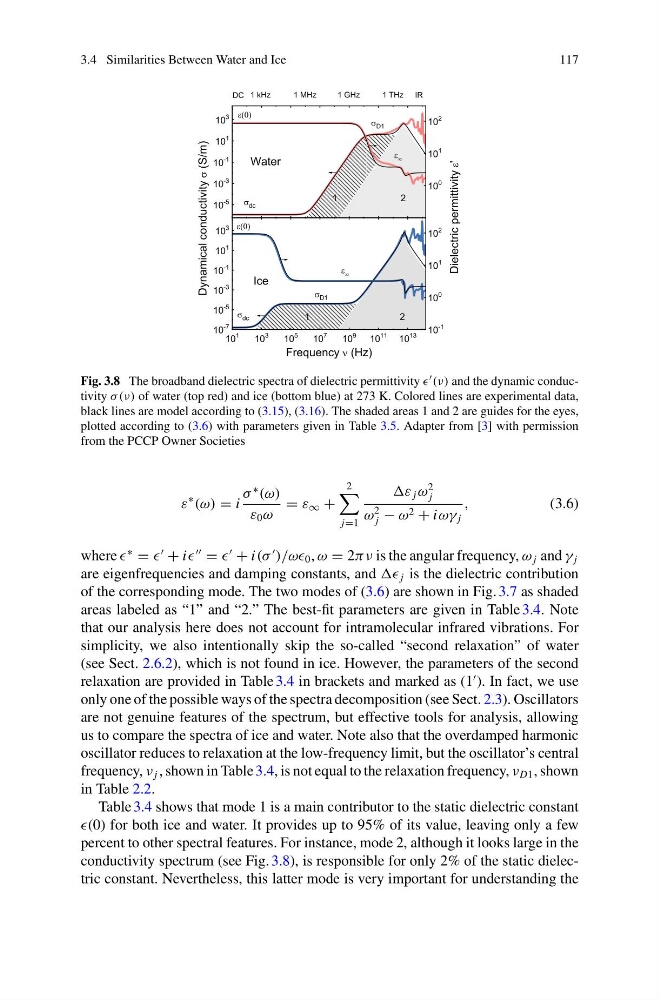
Fig. 3.8 The broadband dielectric spectra of dielectric permittivity (ν) and the dynamic conductivity σ (ν) of water (top red) and ice (bottom blue) at 273 K. Colored lines are experimental data,
black lines are model according to (3.15), (3.16). The shaded areas 1 and 2 are guides for the eyes,
plotted according to (3.6) with parameters given in Table 3.5. Adapter from [3] with permission
from the PCCP Owner Societies
ε
∗
(ω) = i
σ
∗
(ω)
ε 0 ω
= ε ∞ +
2
j=1
j ω
2
j
ω
2
j − ω 2 + iωγ j
,
(3.6)
where
∗
=
+ i
=
+ i(σ
)/ωω 0 , ω = 2πν is the angular frequency, ω j and γ j
are eigenfrequencies and damping constants, and j is the dielectric contribution
of the corresponding mode. The two modes of (3.6) are shown in Fig. 3.7 as shaded
areas labeled as “1” and “2.” The best-fit parameters are given in Table 3.4. Note
that our analysis here does not account for intramolecular infrared vibrations. For
simplicity, we also intentionally skip the so-called “second relaxation” of water
(see Sect. 2.6.2), which is not found in ice. However, the parameters of the second
relaxation are provided in Table 3.4 in brackets and marked as (1
). In fact, we use
only one of the possible ways of the spectra decomposition (see Sect. 2.3). Oscillators
are not genuine features of the spectrum, but effective tools for analysis, allowing
us to compare the spectra of ice and water. Note also that the overdamped harmonic
oscillator reduces to relaxation at the low-frequency limit, but the oscillator’s central
frequency, ν j , shown in Table 3.4, is not equal to the relaxation frequency, ν D1 , shown
in Table 2.2.
Table 3.4 shows that mode 1 is a main contributor to the static dielectric constant
(0) for both ice and water. It provides up to 95% of its value, leaving only a few
percent to other spectral features. For instance, mode 2, although it looks large in the
conductivity spectrum (see Fig. 3.8), is responsible for only 2% of the static dielectric constant. Nevertheless, this latter mode is very important for understanding the
117
Fig. 3.8 The broadband dielectric spectra of dielectric permittivity (ν) and the dynamic conductivity σ (ν) of water (top red) and ice (bottom blue) at 273 K. Colored lines are experimental data,
black lines are model according to (3.15), (3.16). The shaded areas 1 and 2 are guides for the eyes,
plotted according to (3.6) with parameters given in Table 3.5. Adapter from [3] with permission
from the PCCP Owner Societies
ε
∗
(ω) = i
σ
∗
(ω)
ε 0 ω
= ε ∞ +
2
j=1
j ω
2
j
ω
2
j − ω 2 + iωγ j
,
(3.6)
where
∗
=
+ i
=
+ i(σ
)/ωω 0 , ω = 2πν is the angular frequency, ω j and γ j
are eigenfrequencies and damping constants, and j is the dielectric contribution
of the corresponding mode. The two modes of (3.6) are shown in Fig. 3.7 as shaded
areas labeled as “1” and “2.” The best-fit parameters are given in Table 3.4. Note
that our analysis here does not account for intramolecular infrared vibrations. For
simplicity, we also intentionally skip the so-called “second relaxation” of water
(see Sect. 2.6.2), which is not found in ice. However, the parameters of the second
relaxation are provided in Table 3.4 in brackets and marked as (1
). In fact, we use
only one of the possible ways of the spectra decomposition (see Sect. 2.3). Oscillators
are not genuine features of the spectrum, but effective tools for analysis, allowing
us to compare the spectra of ice and water. Note also that the overdamped harmonic
oscillator reduces to relaxation at the low-frequency limit, but the oscillator’s central
frequency, ν j , shown in Table 3.4, is not equal to the relaxation frequency, ν D1 , shown
in Table 2.2.
Table 3.4 shows that mode 1 is a main contributor to the static dielectric constant
(0) for both ice and water. It provides up to 95% of its value, leaving only a few
percent to other spectral features. For instance, mode 2, although it looks large in the
conductivity spectrum (see Fig. 3.8), is responsible for only 2% of the static dielectric constant. Nevertheless, this latter mode is very important for understanding the