

116
3 The Interaction of Electromagnetic Waves with Ice
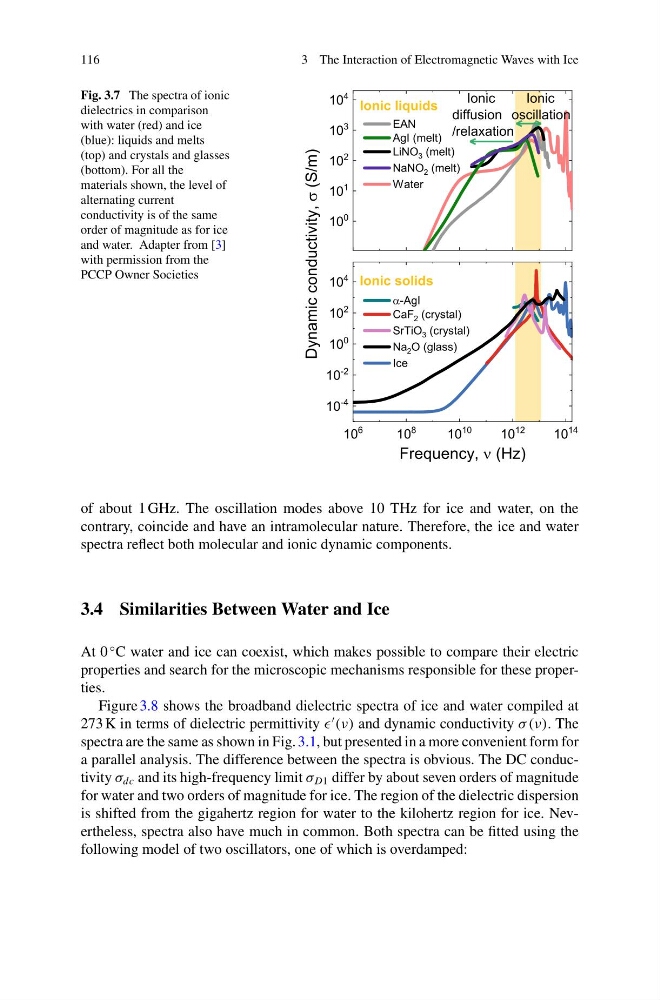
Fig. 3.7 The spectra of ionic
dielectrics in comparison
with water (red) and ice
(blue): liquids and melts
(top) and crystals and glasses
(bottom). For all the
materials shown, the level of
alternating current
conductivity is of the same
order of magnitude as for ice
and water. Adapter from [3]
with permission from the
PCCP Owner Societies
of about 1 GHz. The oscillation modes above 10 THz for ice and water, on the
contrary, coincide and have an intramolecular nature. Therefore, the ice and water
spectra reflect both molecular and ionic dynamic components.
3.4 Similarities Between Water and Ice
At 0
◦ C water and ice can coexist, which makes possible to compare their electric
properties and search for the microscopic mechanisms responsible for these properties.
Figure 3.8 shows the broadband dielectric spectra of ice and water compiled at
273 K in terms of dielectric permittivity
(ν) and dynamic conductivity σ (ν). The
spectra are the same as shown in Fig. 3.1, but presented in a more convenient form for
a parallel analysis. The difference between the spectra is obvious. The DC conductivity σ dc and its high-frequency limit σ D1 differ by about seven orders of magnitude
for water and two orders of magnitude for ice. The region of the dielectric dispersion
is shifted from the gigahertz region for water to the kilohertz region for ice. Nevertheless, spectra also have much in common. Both spectra can be fitted using the
following model of two oscillators, one of which is overdamped:
3 The Interaction of Electromagnetic Waves with Ice
Fig. 3.7 The spectra of ionic
dielectrics in comparison
with water (red) and ice
(blue): liquids and melts
(top) and crystals and glasses
(bottom). For all the
materials shown, the level of
alternating current
conductivity is of the same
order of magnitude as for ice
and water. Adapter from [3]
with permission from the
PCCP Owner Societies
of about 1 GHz. The oscillation modes above 10 THz for ice and water, on the
contrary, coincide and have an intramolecular nature. Therefore, the ice and water
spectra reflect both molecular and ionic dynamic components.
3.4 Similarities Between Water and Ice
At 0
◦ C water and ice can coexist, which makes possible to compare their electric
properties and search for the microscopic mechanisms responsible for these properties.
Figure 3.8 shows the broadband dielectric spectra of ice and water compiled at
273 K in terms of dielectric permittivity
(ν) and dynamic conductivity σ (ν). The
spectra are the same as shown in Fig. 3.1, but presented in a more convenient form for
a parallel analysis. The difference between the spectra is obvious. The DC conductivity σ dc and its high-frequency limit σ D1 differ by about seven orders of magnitude
for water and two orders of magnitude for ice. The region of the dielectric dispersion
is shifted from the gigahertz region for water to the kilohertz region for ice. Nevertheless, spectra also have much in common. Both spectra can be fitted using the
following model of two oscillators, one of which is overdamped: