

2.7 Heavy Water: H/D Isotope Effect
93
16
O
1
H
1
H
16
O
2
H
2
H
O
2
H
O
2
D
a
b
c
a
b
c
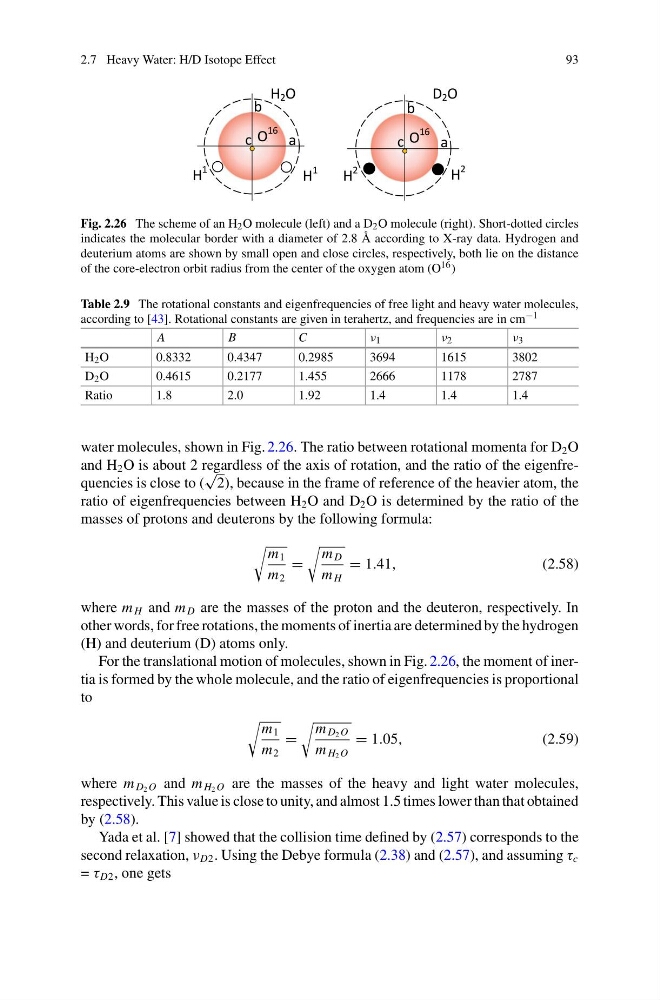
Fig. 2.26 The scheme of an H 2 O molecule (left) and a D 2 O molecule (right). Short-dotted circles
indicates the molecular border with a diameter of 2.8 Å according to X-ray data. Hydrogen and
deuterium atoms are shown by small open and close circles, respectively, both lie on the distance
of the core-electron orbit radius from the center of the oxygen atom (O 16 )
Table 2.9 The rotational constants and eigenfrequencies of free light and heavy water molecules,
according to [43]. Rotational constants are given in terahertz, and frequencies are in cm −1
A
B
C
ν 1
ν 2
ν 3
H 2 O
0.8332
0.4347
0.2985
3694
1615
3802
D 2 O
0.4615
0.2177
1.455
2666
1178
2787
Ratio
1.8
2.0
1.92
1.4
1.4
1.4
water molecules, shown in Fig. 2.26. The ratio between rotational momenta for D 2 O
and H 2 O is about 2 regardless of the axis of rotation, and the ratio of the eigenfrequencies is close to (
√
2), because in the frame of reference of the heavier atom, the
ratio of eigenfrequencies between H 2 O and D 2 O is determined by the ratio of the
masses of protons and deuterons by the following formula:
m 1
m 2
=
m D
m H
= 1.41,
(2.58)
where m H and m D are the masses of the proton and the deuteron, respectively. In
other words, for free rotations, the moments of inertia are determined by the hydrogen
(H) and deuterium (D) atoms only.
For the translational motion of molecules, shown in Fig. 2.26, the moment of inertia is formed by the whole molecule, and the ratio of eigenfrequencies is proportional
to
m 1
m 2
=
m D 2 O
m H 2 O
= 1.05,
(2.59)
where m D 2 O and m H 2 O are the masses of the heavy and light water molecules,
respectively. This value is close to unity, and almost 1.5 times lower than that obtained
by (2.58).
Yada et al. [7] showed that the collision time defined by (2.57) corresponds to the
second relaxation, ν D2 . Using the Debye formula (2.38) and (2.57), and assuming τ c
= τ D2 , one gets
93
16
O
1
H
1
H
16
O
2
H
2
H
O
2
H
O
2
D
a
b
c
a
b
c
Fig. 2.26 The scheme of an H 2 O molecule (left) and a D 2 O molecule (right). Short-dotted circles
indicates the molecular border with a diameter of 2.8 Å according to X-ray data. Hydrogen and
deuterium atoms are shown by small open and close circles, respectively, both lie on the distance
of the core-electron orbit radius from the center of the oxygen atom (O 16 )
Table 2.9 The rotational constants and eigenfrequencies of free light and heavy water molecules,
according to [43]. Rotational constants are given in terahertz, and frequencies are in cm −1
A
B
C
ν 1
ν 2
ν 3
H 2 O
0.8332
0.4347
0.2985
3694
1615
3802
D 2 O
0.4615
0.2177
1.455
2666
1178
2787
Ratio
1.8
2.0
1.92
1.4
1.4
1.4
water molecules, shown in Fig. 2.26. The ratio between rotational momenta for D 2 O
and H 2 O is about 2 regardless of the axis of rotation, and the ratio of the eigenfrequencies is close to (
√
2), because in the frame of reference of the heavier atom, the
ratio of eigenfrequencies between H 2 O and D 2 O is determined by the ratio of the
masses of protons and deuterons by the following formula:
m 1
m 2
=
m D
m H
= 1.41,
(2.58)
where m H and m D are the masses of the proton and the deuteron, respectively. In
other words, for free rotations, the moments of inertia are determined by the hydrogen
(H) and deuterium (D) atoms only.
For the translational motion of molecules, shown in Fig. 2.26, the moment of inertia is formed by the whole molecule, and the ratio of eigenfrequencies is proportional
to
m 1
m 2
=
m D 2 O
m H 2 O
= 1.05,
(2.59)
where m D 2 O and m H 2 O are the masses of the heavy and light water molecules,
respectively. This value is close to unity, and almost 1.5 times lower than that obtained
by (2.58).
Yada et al. [7] showed that the collision time defined by (2.57) corresponds to the
second relaxation, ν D2 . Using the Debye formula (2.38) and (2.57), and assuming τ c
= τ D2 , one gets