

92
2 The Interaction of Electromagnetic Waves with Water
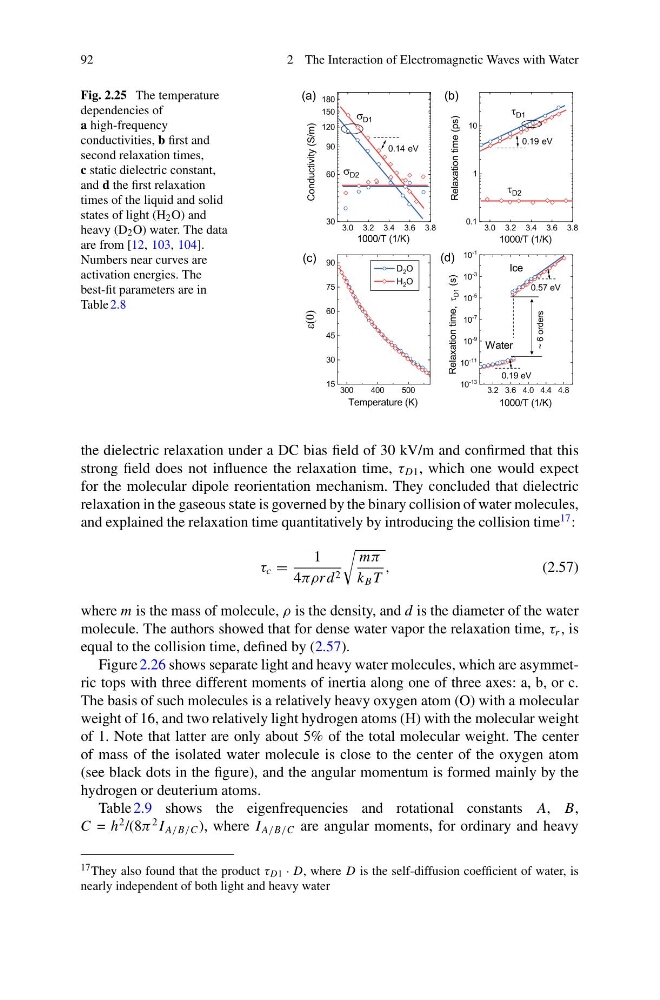
Fig. 2.25 The temperature
dependencies of
a high-frequency
conductivities, b first and
second relaxation times,
c static dielectric constant,
and d the first relaxation
times of the liquid and solid
states of light (H 2 O) and
heavy (D 2 O) water. The data
are from [12, 103, 104].
Numbers near curves are
activation energies. The
best-fit parameters are in
Table 2.8
the dielectric relaxation under a DC bias field of 30 kV/m and confirmed that this
strong field does not influence the relaxation time, τ D1 , which one would expect
for the molecular dipole reorientation mechanism. They concluded that dielectric
relaxation in the gaseous state is governed by the binary collision of water molecules,
and explained the relaxation time quantitatively by introducing the collision time
17 :
τ c =
1
4πρrd 2
mπ
k B T
,
(2.57)
where m is the mass of molecule, ρ is the density, and d is the diameter of the water
molecule. The authors showed that for dense water vapor the relaxation time, τ r , is
equal to the collision time, defined by (2.57).
Figure 2.26 shows separate light and heavy water molecules, which are asymmetric tops with three different moments of inertia along one of three axes: a, b, or c.
The basis of such molecules is a relatively heavy oxygen atom (O) with a molecular
weight of 16, and two relatively light hydrogen atoms (H) with the molecular weight
of 1. Note that latter are only about 5% of the total molecular weight. The center
of mass of the isolated water molecule is close to the center of the oxygen atom
(see black dots in the figure), and the angular momentum is formed mainly by the
hydrogen or deuterium atoms.
Table 2.9 shows the eigenfrequencies and rotational constants A, B,
C = h
2 /(8π
2 I A/B/C ), where I A/B/C are angular moments, for ordinary and heavy
17 They also found that the product τ D1 · D, where D is the self-diffusion coefficient of water, is
nearly independent of both light and heavy water
2 The Interaction of Electromagnetic Waves with Water
Fig. 2.25 The temperature
dependencies of
a high-frequency
conductivities, b first and
second relaxation times,
c static dielectric constant,
and d the first relaxation
times of the liquid and solid
states of light (H 2 O) and
heavy (D 2 O) water. The data
are from [12, 103, 104].
Numbers near curves are
activation energies. The
best-fit parameters are in
Table 2.8
the dielectric relaxation under a DC bias field of 30 kV/m and confirmed that this
strong field does not influence the relaxation time, τ D1 , which one would expect
for the molecular dipole reorientation mechanism. They concluded that dielectric
relaxation in the gaseous state is governed by the binary collision of water molecules,
and explained the relaxation time quantitatively by introducing the collision time
17 :
τ c =
1
4πρrd 2
mπ
k B T
,
(2.57)
where m is the mass of molecule, ρ is the density, and d is the diameter of the water
molecule. The authors showed that for dense water vapor the relaxation time, τ r , is
equal to the collision time, defined by (2.57).
Figure 2.26 shows separate light and heavy water molecules, which are asymmetric tops with three different moments of inertia along one of three axes: a, b, or c.
The basis of such molecules is a relatively heavy oxygen atom (O) with a molecular
weight of 16, and two relatively light hydrogen atoms (H) with the molecular weight
of 1. Note that latter are only about 5% of the total molecular weight. The center
of mass of the isolated water molecule is close to the center of the oxygen atom
(see black dots in the figure), and the angular momentum is formed mainly by the
hydrogen or deuterium atoms.
Table 2.9 shows the eigenfrequencies and rotational constants A, B,
C = h
2 /(8π
2 I A/B/C ), where I A/B/C are angular moments, for ordinary and heavy
17 They also found that the product τ D1 · D, where D is the self-diffusion coefficient of water, is
nearly independent of both light and heavy water