

2.7 Heavy Water: H/D Isotope Effect
91
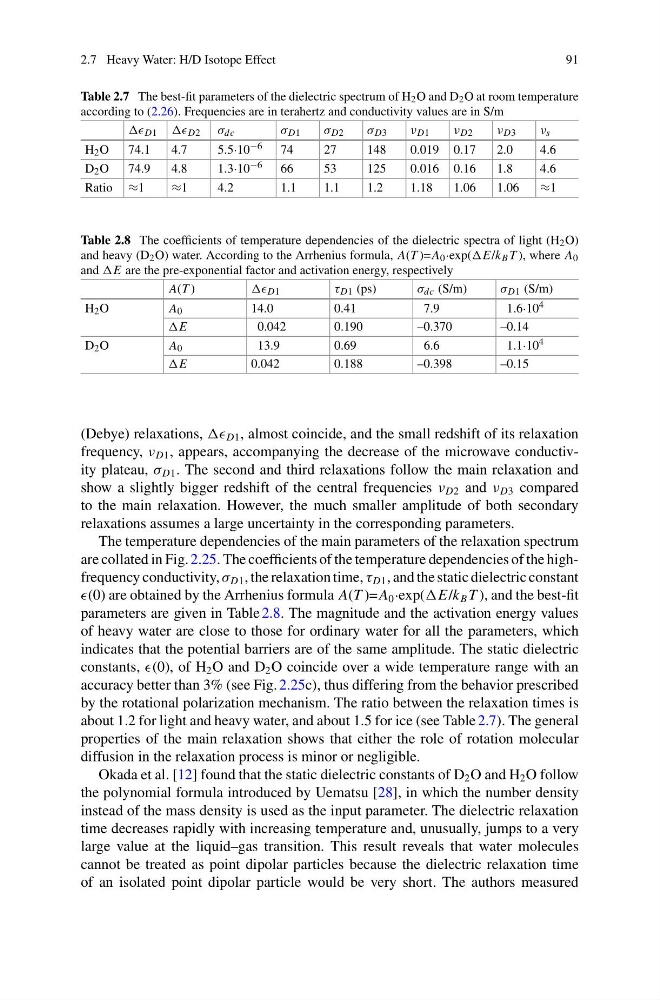
Table 2.7 The best-fit parameters of the dielectric spectrum of H 2 O and D 2 O at room temperature
according to (2.26). Frequencies are in terahertz and conductivity values are in S/m
D1 D2 σ dc
σ D1
σ D2
σ D3
ν D1
ν D2
ν D3
ν s
H 2 O
74.1
4.7
5.5·10 −6 74
27
148
0.019 0.17
2.0
4.6
D 2 O
74.9
4.8
1.3·10 −6 66
53
125
0.016 0.16
1.8
4.6
Ratio ≈1
≈1
4.2
1.1
1.1
1.2
1.18
1.06
1.06
≈1
Table 2.8 The coefficients of temperature dependencies of the dielectric spectra of light (H 2 O)
and heavy (D 2 O) water. According to the Arrhenius formula, A(T )=A 0 ·exp(E/k B T ), where A 0
and E are the pre-exponential factor and activation energy, respectively
A(T )
D1
τ D1 (ps)
σ dc (S/m)
σ D1 (S/m)
H 2 O
A 0
14.0
0.41
7.9
1.6·10 4
E
0.042
0.190
–0.370
–0.14
D 2 O
A 0
13.9
0.69
6.6
1.1·10 4
E
0.042
0.188
–0.398
–0.15
(Debye) relaxations, D1 , almost coincide, and the small redshift of its relaxation
frequency, ν D1 , appears, accompanying the decrease of the microwave conductivity plateau, σ D1 . The second and third relaxations follow the main relaxation and
show a slightly bigger redshift of the central frequencies ν D2 and ν D3 compared
to the main relaxation. However, the much smaller amplitude of both secondary
relaxations assumes a large uncertainty in the corresponding parameters.
The temperature dependencies of the main parameters of the relaxation spectrum
are collated in Fig. 2.25. The coefficients of the temperature dependencies of the highfrequency conductivity, σ D1 , the relaxation time, τ D1 , and the static dielectric constant
(0) are obtained by the Arrhenius formula A(T )=A 0 ·exp(E/k B T ), and the best-fit
parameters are given in Table 2.8. The magnitude and the activation energy values
of heavy water are close to those for ordinary water for all the parameters, which
indicates that the potential barriers are of the same amplitude. The static dielectric
constants, (0), of H 2 O and D 2 O coincide over a wide temperature range with an
accuracy better than 3% (see Fig. 2.25c), thus differing from the behavior prescribed
by the rotational polarization mechanism. The ratio between the relaxation times is
about 1.2 for light and heavy water, and about 1.5 for ice (see Table 2.7). The general
properties of the main relaxation shows that either the role of rotation molecular
diffusion in the relaxation process is minor or negligible.
Okada et al. [12] found that the static dielectric constants of D 2 O and H 2 O follow
the polynomial formula introduced by Uematsu [28], in which the number density
instead of the mass density is used as the input parameter. The dielectric relaxation
time decreases rapidly with increasing temperature and, unusually, jumps to a very
large value at the liquid–gas transition. This result reveals that water molecules
cannot be treated as point dipolar particles because the dielectric relaxation time
of an isolated point dipolar particle would be very short. The authors measured
91
Table 2.7 The best-fit parameters of the dielectric spectrum of H 2 O and D 2 O at room temperature
according to (2.26). Frequencies are in terahertz and conductivity values are in S/m
D1 D2 σ dc
σ D1
σ D2
σ D3
ν D1
ν D2
ν D3
ν s
H 2 O
74.1
4.7
5.5·10 −6 74
27
148
0.019 0.17
2.0
4.6
D 2 O
74.9
4.8
1.3·10 −6 66
53
125
0.016 0.16
1.8
4.6
Ratio ≈1
≈1
4.2
1.1
1.1
1.2
1.18
1.06
1.06
≈1
Table 2.8 The coefficients of temperature dependencies of the dielectric spectra of light (H 2 O)
and heavy (D 2 O) water. According to the Arrhenius formula, A(T )=A 0 ·exp(E/k B T ), where A 0
and E are the pre-exponential factor and activation energy, respectively
A(T )
D1
τ D1 (ps)
σ dc (S/m)
σ D1 (S/m)
H 2 O
A 0
14.0
0.41
7.9
1.6·10 4
E
0.042
0.190
–0.370
–0.14
D 2 O
A 0
13.9
0.69
6.6
1.1·10 4
E
0.042
0.188
–0.398
–0.15
(Debye) relaxations, D1 , almost coincide, and the small redshift of its relaxation
frequency, ν D1 , appears, accompanying the decrease of the microwave conductivity plateau, σ D1 . The second and third relaxations follow the main relaxation and
show a slightly bigger redshift of the central frequencies ν D2 and ν D3 compared
to the main relaxation. However, the much smaller amplitude of both secondary
relaxations assumes a large uncertainty in the corresponding parameters.
The temperature dependencies of the main parameters of the relaxation spectrum
are collated in Fig. 2.25. The coefficients of the temperature dependencies of the highfrequency conductivity, σ D1 , the relaxation time, τ D1 , and the static dielectric constant
(0) are obtained by the Arrhenius formula A(T )=A 0 ·exp(E/k B T ), and the best-fit
parameters are given in Table 2.8. The magnitude and the activation energy values
of heavy water are close to those for ordinary water for all the parameters, which
indicates that the potential barriers are of the same amplitude. The static dielectric
constants, (0), of H 2 O and D 2 O coincide over a wide temperature range with an
accuracy better than 3% (see Fig. 2.25c), thus differing from the behavior prescribed
by the rotational polarization mechanism. The ratio between the relaxation times is
about 1.2 for light and heavy water, and about 1.5 for ice (see Table 2.7). The general
properties of the main relaxation shows that either the role of rotation molecular
diffusion in the relaxation process is minor or negligible.
Okada et al. [12] found that the static dielectric constants of D 2 O and H 2 O follow
the polynomial formula introduced by Uematsu [28], in which the number density
instead of the mass density is used as the input parameter. The dielectric relaxation
time decreases rapidly with increasing temperature and, unusually, jumps to a very
large value at the liquid–gas transition. This result reveals that water molecules
cannot be treated as point dipolar particles because the dielectric relaxation time
of an isolated point dipolar particle would be very short. The authors measured