

59
Image Filtering, Enhancement, and Restoration
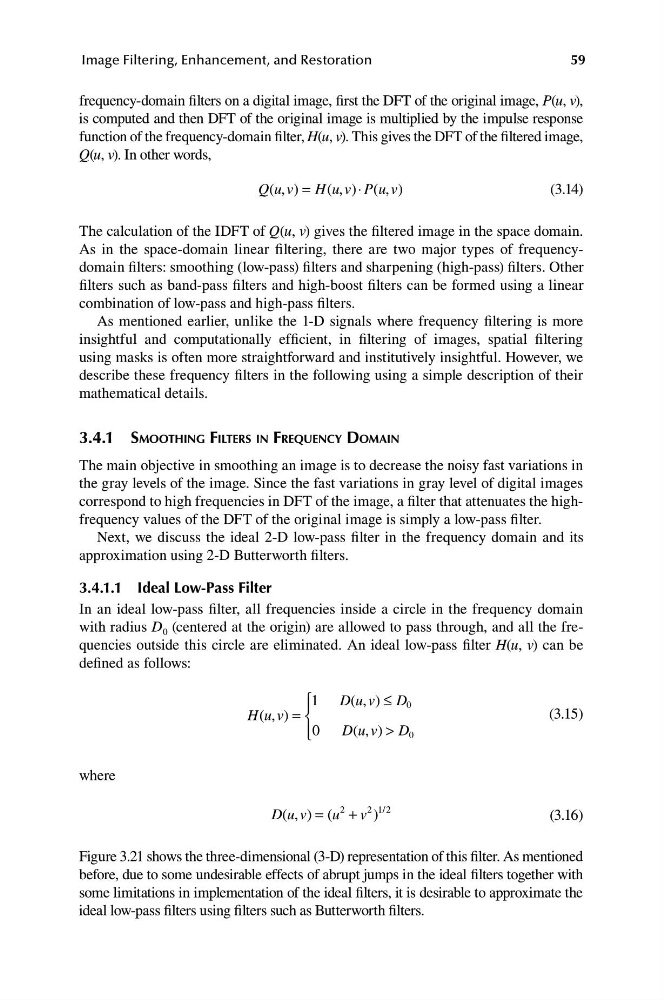
frequency-domain filters on a digital image, first the DFT of the original image, P(u, v),
is computed and then DFT of the original image is multiplied by the impulse response
function of the frequency-domain filter, H(u, v). This gives the DFT of the filtered image,
Q(u, v). In other words,
Q u v = H u v ⋅ P u v
( , )
(3.14)
( , )
( , )
The calculation of the IDFT of Q(u, v) gives the filtered image in the space domain.
As in the space-domain linear filtering, there are two major types of frequencydomain filters: smoothing (low-pass) filters and sharpening (high-pass) filters. Other
filters such as band-pass filters and high-boost filters can be formed using a linear
combination of low-pass and high-pass filters.
As mentioned earlier, unlike the 1-D signals where frequency filtering is more
insightful and computationally efficient, in filtering of images, spatial filtering
using masks is often more straightforward and institutively insightful. However, we
describe these frequency filters in the following using a simple description of their
mathematical details.
3.4.1 SMOOTHING FILTERS IN FREQUENCY DOMAIN
The main objective in smoothing an image is to decrease the noisy fast variations in
the gray levels of the image. Since the fast variations in gray level of digital images
correspond to high frequencies in DFT of the image, a filter that attenuates the highfrequency values of the DFT of the original image is simply a low-pass filter.
Next, we discuss the ideal 2-D low-pass filter in the frequency domain and its
approximation using 2-D Butterworth filters.
3.4.1.1 Ideal Low-Pass Filter
In an ideal low-pass filter, all frequencies inside a circle in the frequency domain
with radius D 0 (centered at the origin) are allowed to pass through, and all the frequencies outside this circle are eliminated. An ideal low-pass filter H(u, v) can be
defined as follows:
D u v ≤ D 0
⎧1
( , )
⎪
H u v =
(3.15)
( , ) ⎨
⎩
D u v > D 0
⎪0
( , )
where
2
2 1 / 2
D u v = (u
(3.16)
( , )
+ v )
Figure 3.21 shows the three-dimensional (3-D) representation of this filter. As mentioned
before, due to some undesirable effects of abrupt jumps in the ideal filters together with
some limitations in implementation of the ideal filters, it is desirable to approximate the
ideal low-pass filters using filters such as Butterworth filters.
Image Filtering, Enhancement, and Restoration
frequency-domain filters on a digital image, first the DFT of the original image, P(u, v),
is computed and then DFT of the original image is multiplied by the impulse response
function of the frequency-domain filter, H(u, v). This gives the DFT of the filtered image,
Q(u, v). In other words,
Q u v = H u v ⋅ P u v
( , )
(3.14)
( , )
( , )
The calculation of the IDFT of Q(u, v) gives the filtered image in the space domain.
As in the space-domain linear filtering, there are two major types of frequencydomain filters: smoothing (low-pass) filters and sharpening (high-pass) filters. Other
filters such as band-pass filters and high-boost filters can be formed using a linear
combination of low-pass and high-pass filters.
As mentioned earlier, unlike the 1-D signals where frequency filtering is more
insightful and computationally efficient, in filtering of images, spatial filtering
using masks is often more straightforward and institutively insightful. However, we
describe these frequency filters in the following using a simple description of their
mathematical details.
3.4.1 SMOOTHING FILTERS IN FREQUENCY DOMAIN
The main objective in smoothing an image is to decrease the noisy fast variations in
the gray levels of the image. Since the fast variations in gray level of digital images
correspond to high frequencies in DFT of the image, a filter that attenuates the highfrequency values of the DFT of the original image is simply a low-pass filter.
Next, we discuss the ideal 2-D low-pass filter in the frequency domain and its
approximation using 2-D Butterworth filters.
3.4.1.1 Ideal Low-Pass Filter
In an ideal low-pass filter, all frequencies inside a circle in the frequency domain
with radius D 0 (centered at the origin) are allowed to pass through, and all the frequencies outside this circle are eliminated. An ideal low-pass filter H(u, v) can be
defined as follows:
D u v ≤ D 0
⎧1
( , )
⎪
H u v =
(3.15)
( , ) ⎨
⎩
D u v > D 0
⎪0
( , )
where
2
2 1 / 2
D u v = (u
(3.16)
( , )
+ v )
Figure 3.21 shows the three-dimensional (3-D) representation of this filter. As mentioned
before, due to some undesirable effects of abrupt jumps in the ideal filters together with
some limitations in implementation of the ideal filters, it is desirable to approximate the
ideal low-pass filters using filters such as Butterworth filters.