

26
Biomedical Signal and Image Processing
This property of the impulse function is used in system identification and signal processing. Due to this observation, h(t) is often called “the impulse response function.”
2.2.1.4 Differentiation
Another interesting property of the FT is the conversion of derivative in time domain
into a simple multiplication process in the frequency domain. This property is used
to convert differential equations in time into a set of simple linear equations in frequency domain and solve multidimensional differential equations using simple linear algebra.
2.2.1.5 Scaling Property
An extremely useful property of the FT is the way time and frequency domains are
inversely scaled. Specifically, assume that the FT of a signal g(t) is given as G(f). The
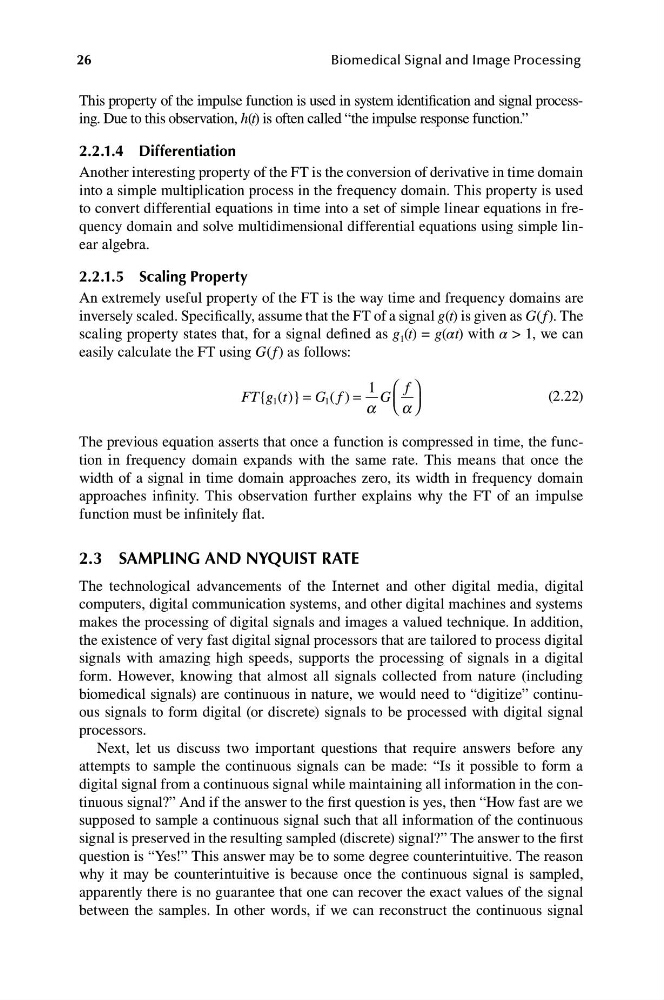
scaling property states that, for a signal defined as g 1 (t) = g(αt) with α > 1, we can
easily calculate the FT using G(f) as follows:
1 ⎛ f ⎞
1
(2.22)
FT g
{ ( )}
t = G 1 ( )
f = G ⎝ ⎜ ⎠ ⎟
a
a
The previous equation asserts that once a function is compressed in time, the function in frequency domain expands with the same rate. This means that once the
width of a signal in time domain approaches zero, its width in frequency domain
approaches infinity. This observation further explains why the FT of an impulse
function must be infinitely flat.
2.3 SAMPLING AND NYQUIST RATE
The technological advancements of the Internet and other digital media, digital
computers, digital communication systems, and other digital machines and systems
makes the processing of digital signals and images a valued technique. In addition,
the existence of very fast digital signal processors that are tailored to process digital
signals with amazing high speeds, supports the processing of signals in a digital
form. However, knowing that almost all signals collected from nature (including
biomedical signals) are continuous in nature, we would need to “digitize” continuous signals to form digital (or discrete) signals to be processed with digital signal
processors.
Next, let us discuss two important questions that require answers before any
attempts to sample the continuous signals can be made: “Is it possible to form a
digital signal from a continuous signal while maintaining all information in the continuous signal?” And if the answer to the first question is yes, then “How fast are we
supposed to sample a continuous signal such that all information of the continuous
signal is preserved in the resulting sampled (discrete) signal?” The answer to the first
question is “Yes!” This answer may be to some degree counterintuitive. The reason
why it may be counterintuitive is because once the continuous signal is sampled,
apparently there is no guarantee that one can recover the exact values of the signal
between the samples. In other words, if we can reconstruct the continuous signal
Biomedical Signal and Image Processing
This property of the impulse function is used in system identification and signal processing. Due to this observation, h(t) is often called “the impulse response function.”
2.2.1.4 Differentiation
Another interesting property of the FT is the conversion of derivative in time domain
into a simple multiplication process in the frequency domain. This property is used
to convert differential equations in time into a set of simple linear equations in frequency domain and solve multidimensional differential equations using simple linear algebra.
2.2.1.5 Scaling Property
An extremely useful property of the FT is the way time and frequency domains are
inversely scaled. Specifically, assume that the FT of a signal g(t) is given as G(f). The
scaling property states that, for a signal defined as g 1 (t) = g(αt) with α > 1, we can
easily calculate the FT using G(f) as follows:
1 ⎛ f ⎞
1
(2.22)
FT g
{ ( )}
t = G 1 ( )
f = G ⎝ ⎜ ⎠ ⎟
a
a
The previous equation asserts that once a function is compressed in time, the function in frequency domain expands with the same rate. This means that once the
width of a signal in time domain approaches zero, its width in frequency domain
approaches infinity. This observation further explains why the FT of an impulse
function must be infinitely flat.
2.3 SAMPLING AND NYQUIST RATE
The technological advancements of the Internet and other digital media, digital
computers, digital communication systems, and other digital machines and systems
makes the processing of digital signals and images a valued technique. In addition,
the existence of very fast digital signal processors that are tailored to process digital
signals with amazing high speeds, supports the processing of signals in a digital
form. However, knowing that almost all signals collected from nature (including
biomedical signals) are continuous in nature, we would need to “digitize” continuous signals to form digital (or discrete) signals to be processed with digital signal
processors.
Next, let us discuss two important questions that require answers before any
attempts to sample the continuous signals can be made: “Is it possible to form a
digital signal from a continuous signal while maintaining all information in the continuous signal?” And if the answer to the first question is yes, then “How fast are we
supposed to sample a continuous signal such that all information of the continuous
signal is preserved in the resulting sampled (discrete) signal?” The answer to the first
question is “Yes!” This answer may be to some degree counterintuitive. The reason
why it may be counterintuitive is because once the continuous signal is sampled,
apparently there is no guarantee that one can recover the exact values of the signal
between the samples. In other words, if we can reconstruct the continuous signal