

105
104
103
102
101
100
99
98
97
500 1000 1500 2000 2500 3000
Body temperature (°F)
3500 4000 4500 5000 5500 6000
Time (s)
6
Biomedical Signal and Image Processing
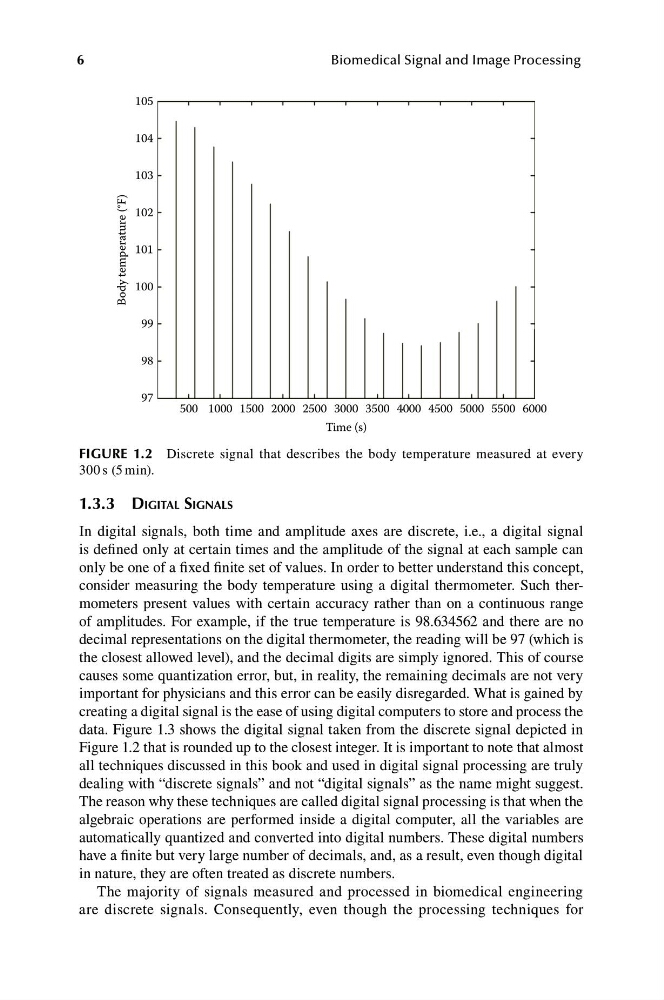
FIGURE 1.2 Discrete signal that describes the body temperature measured at every
300 s (5 min).
1.3.3 DIGITAL SIGNALS
In digital signals, both time and amplitude axes are discrete, i.e., a digital signal
is defined only at certain times and the amplitude of the signal at each sample can
only be one of a fixed finite set of values. In order to better understand this concept,
consider measuring the body temperature using a digital thermometer. Such thermometers present values with certain accuracy rather than on a continuous range
of amplitudes. For example, if the true temperature is 98.634562 and there are no
decimal representations on the digital thermometer, the reading will be 97 (which is
the closest allowed level), and the decimal digits are simply ignored. This of course
causes some quantization error, but, in reality, the remaining decimals are not very
important for physicians and this error can be easily disregarded. What is gained by
creating a digital signal is the ease of using digital computers to store and process the
data. Figure 1.3 shows the digital signal taken from the discrete signal depicted in
Figure 1.2 that is rounded up to the closest integer. It is important to note that almost
all techniques discussed in this book and used in digital signal processing are truly
dealing with “discrete signals” and not “digital signals” as the name might suggest.
The reason why these techniques are called digital signal processing is that when the
algebraic operations are performed inside a digital computer, all the variables are
automatically quantized and converted into digital numbers. These digital numbers
have a finite but very large number of decimals, and, as a result, even though digital
in nature, they are often treated as discrete numbers.
The majority of signals measured and processed in biomedical engineering
are discrete signals. Consequently, even though the processing techniques for
104
103
102
101
100
99
98
97
500 1000 1500 2000 2500 3000
Body temperature (°F)
3500 4000 4500 5000 5500 6000
Time (s)
6
Biomedical Signal and Image Processing
FIGURE 1.2 Discrete signal that describes the body temperature measured at every
300 s (5 min).
1.3.3 DIGITAL SIGNALS
In digital signals, both time and amplitude axes are discrete, i.e., a digital signal
is defined only at certain times and the amplitude of the signal at each sample can
only be one of a fixed finite set of values. In order to better understand this concept,
consider measuring the body temperature using a digital thermometer. Such thermometers present values with certain accuracy rather than on a continuous range
of amplitudes. For example, if the true temperature is 98.634562 and there are no
decimal representations on the digital thermometer, the reading will be 97 (which is
the closest allowed level), and the decimal digits are simply ignored. This of course
causes some quantization error, but, in reality, the remaining decimals are not very
important for physicians and this error can be easily disregarded. What is gained by
creating a digital signal is the ease of using digital computers to store and process the
data. Figure 1.3 shows the digital signal taken from the discrete signal depicted in
Figure 1.2 that is rounded up to the closest integer. It is important to note that almost
all techniques discussed in this book and used in digital signal processing are truly
dealing with “discrete signals” and not “digital signals” as the name might suggest.
The reason why these techniques are called digital signal processing is that when the
algebraic operations are performed inside a digital computer, all the variables are
automatically quantized and converted into digital numbers. These digital numbers
have a finite but very large number of decimals, and, as a result, even though digital
in nature, they are often treated as discrete numbers.
The majority of signals measured and processed in biomedical engineering
are discrete signals. Consequently, even though the processing techniques for