

105
104
103
102
101
100
99
98
97
500 1000 1500 2000 2500 3000
Body temperature (°F)
3500 4000 4500 5000 5500 6000
Time (s)
5
Signals and Biomedical Signal Processing
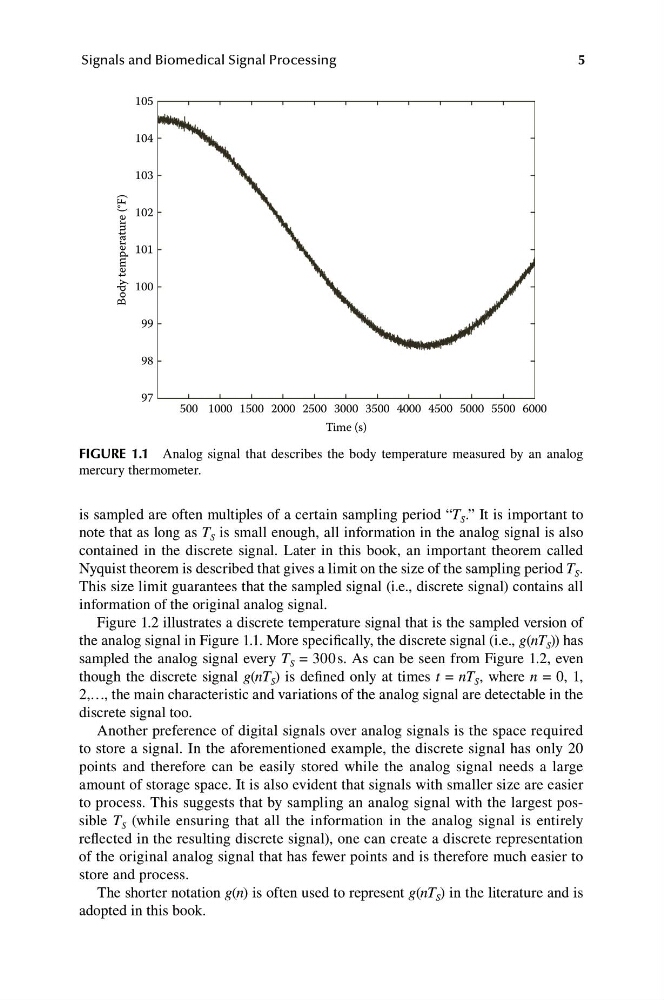
FIGURE 1.1 Analog signal that describes the body temperature measured by an analog
mercury thermometer.
is sampled are often multiples of a certain sampling period “T S .” It is important to
note that as long as T S is small enough, all information in the analog signal is also
contained in the discrete signal. Later in this book, an important theorem called
Nyquist theorem is described that gives a limit on the size of the sampling period T S .
This size limit guarantees that the sampled signal (i.e., discrete signal) contains all
information of the original analog signal.
Figure 1.2 illustrates a discrete temperature signal that is the sampled version of
the analog signal in Figure 1.1. More specifically, the discrete signal (i.e., g(nT S )) has
sampled the analog signal every T S = 300 s. As can be seen from Figure 1.2, even
though the discrete signal g(nT S ) is defined only at times t = nT S , where n = 0, 1,
2,…, the main characteristic and variations of the analog signal are detectable in the
discrete signal too.
Another preference of digital signals over analog signals is the space required
to store a signal. In the aforementioned example, the discrete signal has only 20
points and therefore can be easily stored while the analog signal needs a large
amount of storage space. It is also evident that signals with smaller size are easier
to process. This suggests that by sampling an analog signal with the largest possible T S (while ensuring that all the information in the analog signal is entirely
reflected in the resulting discrete signal), one can create a discrete representation
of the original analog signal that has fewer points and is therefore much easier to
store and process.
The shorter notation g(n) is often used to represent g(nT S ) in the literature and is
adopted in this book.
104
103
102
101
100
99
98
97
500 1000 1500 2000 2500 3000
Body temperature (°F)
3500 4000 4500 5000 5500 6000
Time (s)
5
Signals and Biomedical Signal Processing
FIGURE 1.1 Analog signal that describes the body temperature measured by an analog
mercury thermometer.
is sampled are often multiples of a certain sampling period “T S .” It is important to
note that as long as T S is small enough, all information in the analog signal is also
contained in the discrete signal. Later in this book, an important theorem called
Nyquist theorem is described that gives a limit on the size of the sampling period T S .
This size limit guarantees that the sampled signal (i.e., discrete signal) contains all
information of the original analog signal.
Figure 1.2 illustrates a discrete temperature signal that is the sampled version of
the analog signal in Figure 1.1. More specifically, the discrete signal (i.e., g(nT S )) has
sampled the analog signal every T S = 300 s. As can be seen from Figure 1.2, even
though the discrete signal g(nT S ) is defined only at times t = nT S , where n = 0, 1,
2,…, the main characteristic and variations of the analog signal are detectable in the
discrete signal too.
Another preference of digital signals over analog signals is the space required
to store a signal. In the aforementioned example, the discrete signal has only 20
points and therefore can be easily stored while the analog signal needs a large
amount of storage space. It is also evident that signals with smaller size are easier
to process. This suggests that by sampling an analog signal with the largest possible T S (while ensuring that all the information in the analog signal is entirely
reflected in the resulting discrete signal), one can create a discrete representation
of the original analog signal that has fewer points and is therefore much easier to
store and process.
The shorter notation g(n) is often used to represent g(nT S ) in the literature and is
adopted in this book.