

Magnetic Resonance Imaging
285
15.2 PHYSICAL AND PHYSIOLOGICAL PRINCIPLES OF MRI
While for the purpose of imaging, only the net result of a group of protons will be
sensed for NMR imaging, the principal mechanism of NMR imaging is based on
the spinning of a single neutron in the presence of an external magnetic field. The
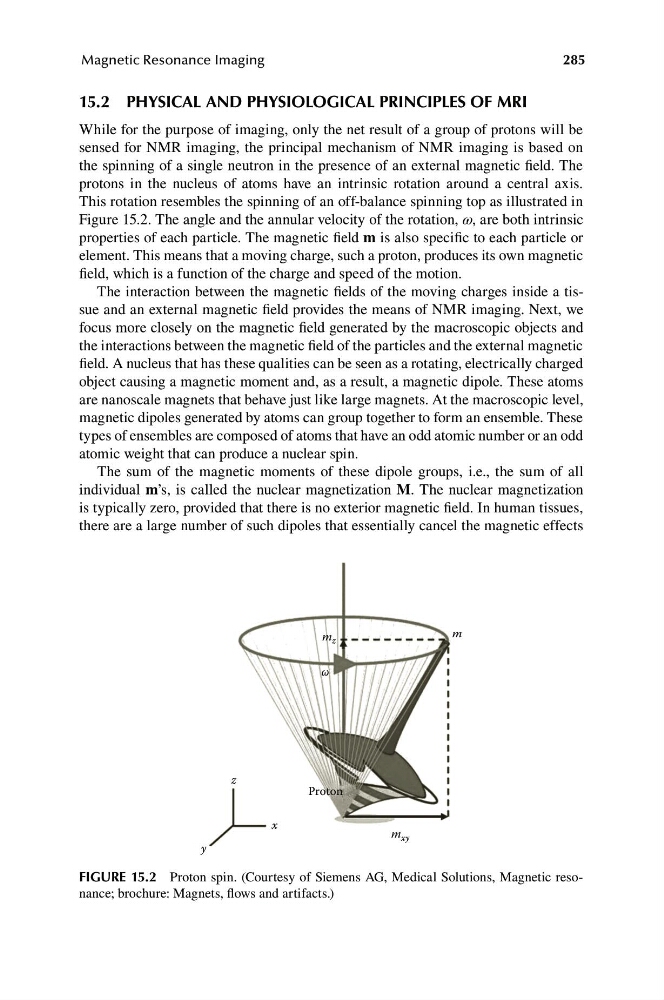
protons in the nucleus of atoms have an intrinsic rotation around a central axis.
This rotation resembles the spinning of an off-balance spinning top as illustrated in
Figure 15.2. The angle and the annular velocity of the rotation, ω, are both intrinsic
properties of each particle. The magnetic field m is also specific to each particle or
element. This means that a moving charge, such a proton, produces its own magnetic
field, which is a function of the charge and speed of the motion.
The interaction between the magnetic fields of the moving charges inside a tissue and an external magnetic field provides the means of NMR imaging. Next, we
focus more closely on the magnetic field generated by the macroscopic objects and
the interactions between the magnetic field of the particles and the external magnetic
field. A nucleus that has these qualities can be seen as a rotating, electrically charged
object causing a magnetic moment and, as a result, a magnetic dipole. These atoms
are nanoscale magnets that behave just like large magnets. At the macroscopic level,
magnetic dipoles generated by atoms can group together to form an ensemble. These
types of ensembles are composed of atoms that have an odd atomic number or an odd
atomic weight that can produce a nuclear spin.
The sum of the magnetic moments of these dipole groups, i.e., the sum of all
individual m’s, is called the nuclear magnetization M. The nuclear magnetization
is typically zero, provided that there is no exterior magnetic field. In human tissues,
there are a large number of such dipoles that essentially cancel the magnetic effects
ω
z
x
y
Proton
m xy
m z
m
FIGURE 15.2 Proton spin. (Courtesy of Siemens AG, Medical Solutions, Magnetic resonance; brochure: Magnets, flows and artifacts.)
285
15.2 PHYSICAL AND PHYSIOLOGICAL PRINCIPLES OF MRI
While for the purpose of imaging, only the net result of a group of protons will be
sensed for NMR imaging, the principal mechanism of NMR imaging is based on
the spinning of a single neutron in the presence of an external magnetic field. The
protons in the nucleus of atoms have an intrinsic rotation around a central axis.
This rotation resembles the spinning of an off-balance spinning top as illustrated in
Figure 15.2. The angle and the annular velocity of the rotation, ω, are both intrinsic
properties of each particle. The magnetic field m is also specific to each particle or
element. This means that a moving charge, such a proton, produces its own magnetic
field, which is a function of the charge and speed of the motion.
The interaction between the magnetic fields of the moving charges inside a tissue and an external magnetic field provides the means of NMR imaging. Next, we
focus more closely on the magnetic field generated by the macroscopic objects and
the interactions between the magnetic field of the particles and the external magnetic
field. A nucleus that has these qualities can be seen as a rotating, electrically charged
object causing a magnetic moment and, as a result, a magnetic dipole. These atoms
are nanoscale magnets that behave just like large magnets. At the macroscopic level,
magnetic dipoles generated by atoms can group together to form an ensemble. These
types of ensembles are composed of atoms that have an odd atomic number or an odd
atomic weight that can produce a nuclear spin.
The sum of the magnetic moments of these dipole groups, i.e., the sum of all
individual m’s, is called the nuclear magnetization M. The nuclear magnetization
is typically zero, provided that there is no exterior magnetic field. In human tissues,
there are a large number of such dipoles that essentially cancel the magnetic effects
ω
z
x
y
Proton
m xy
m z
m
FIGURE 15.2 Proton spin. (Courtesy of Siemens AG, Medical Solutions, Magnetic resonance; brochure: Magnets, flows and artifacts.)