

274
Biomedical Signal and Image Processing
The computational techniques in x-ray attenuation tomography, such as the ones
based on Fourier slice theorem, estimate α(x, y) and then use the discriminative
power of the attenuation coefficient to create an image of the body.
Next, we review some specific CT technologies used in biomedical imaging and
diagnostics.
14.7 BIOMEDICAL CT SCANNERS
Two general types of medical CT scanner technologies can be distinguished:
fan-beam and parallel scanning. These commercial technologies are often a
combination of the parallel and fan-beam scanning technologies described in
Chapter 13.
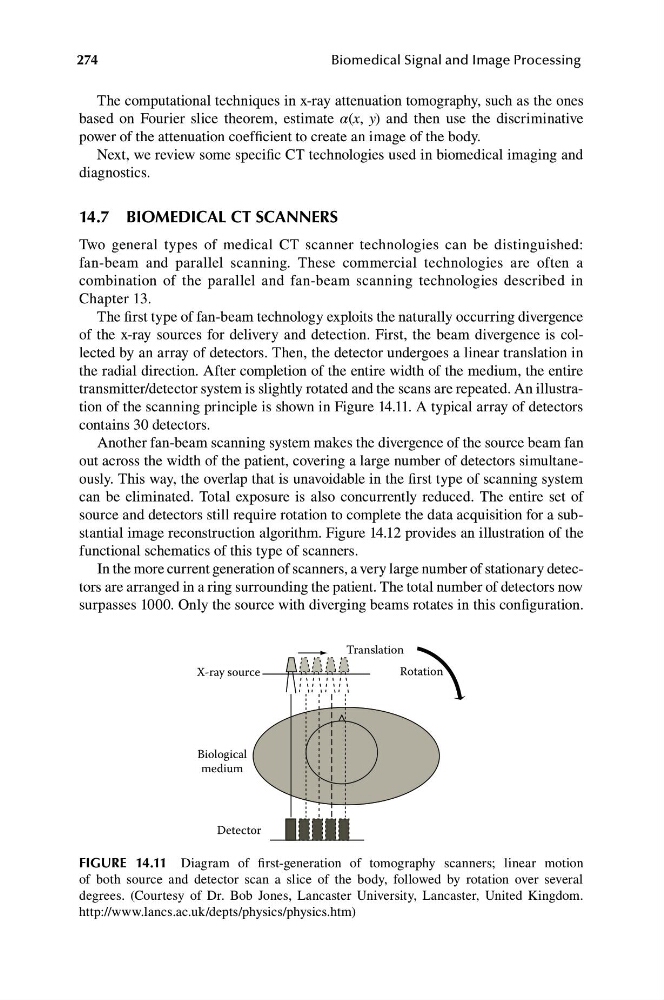
The first type of fan-beam technology exploits the naturally occurring divergence
of the x-ray sources for delivery and detection. First, the beam divergence is collected by an array of detectors. Then, the detector undergoes a linear translation in
the radial direction. After completion of the entire width of the medium, the entire
transmitter/detector system is slightly rotated and the scans are repeated. An illustration of the scanning principle is shown in Figure 14.11. A typical array of detectors
contains 30 detectors.
Another fan-beam scanning system makes the divergence of the source beam fan
out across the width of the patient, covering a large number of detectors simultaneously. This way, the overlap that is unavoidable in the first type of scanning system
can be eliminated. Total exposure is also concurrently reduced. The entire set of
source and detectors still require rotation to complete the data acquisition for a substantial image reconstruction algorithm. Figure 14.12 provides an illustration of the
functional schematics of this type of scanners.
In the more current generation of scanners, a very large number of stationary detectors are arranged in a ring surrounding the patient. The total number of detectors now
surpasses 1000. Only the source with diverging beams rotates in this configuration.
X-ray source
Rotation
Translation
Detector
Biological
medium
FIGURE 14.11 Diagram of first-generation of tomography scanners; linear motion
of both source and detector scan a slice of the body, followed by rotation over several
degrees. (Courtesy of Dr. Bob Jones, Lancaster University, Lancaster, United Kingdom.
http://www.lancs.ac.uk/depts/physics/physics.htm)
Biomedical Signal and Image Processing
The computational techniques in x-ray attenuation tomography, such as the ones
based on Fourier slice theorem, estimate α(x, y) and then use the discriminative
power of the attenuation coefficient to create an image of the body.
Next, we review some specific CT technologies used in biomedical imaging and
diagnostics.
14.7 BIOMEDICAL CT SCANNERS
Two general types of medical CT scanner technologies can be distinguished:
fan-beam and parallel scanning. These commercial technologies are often a
combination of the parallel and fan-beam scanning technologies described in
Chapter 13.
The first type of fan-beam technology exploits the naturally occurring divergence
of the x-ray sources for delivery and detection. First, the beam divergence is collected by an array of detectors. Then, the detector undergoes a linear translation in
the radial direction. After completion of the entire width of the medium, the entire
transmitter/detector system is slightly rotated and the scans are repeated. An illustration of the scanning principle is shown in Figure 14.11. A typical array of detectors
contains 30 detectors.
Another fan-beam scanning system makes the divergence of the source beam fan
out across the width of the patient, covering a large number of detectors simultaneously. This way, the overlap that is unavoidable in the first type of scanning system
can be eliminated. Total exposure is also concurrently reduced. The entire set of
source and detectors still require rotation to complete the data acquisition for a substantial image reconstruction algorithm. Figure 14.12 provides an illustration of the
functional schematics of this type of scanners.
In the more current generation of scanners, a very large number of stationary detectors are arranged in a ring surrounding the patient. The total number of detectors now
surpasses 1000. Only the source with diverging beams rotates in this configuration.
X-ray source
Rotation
Translation
Detector
Biological
medium
FIGURE 14.11 Diagram of first-generation of tomography scanners; linear motion
of both source and detector scan a slice of the body, followed by rotation over several
degrees. (Courtesy of Dr. Bob Jones, Lancaster University, Lancaster, United Kingdom.
http://www.lancs.ac.uk/depts/physics/physics.htm)