

243
Other Biomedical Signals
4
3
40
50
60
Thoracic excursion (V)
2
1
0
–1
–2
–3
–4
0
1 0
2 0
3 0
Time (s)
(a)
4
3
40
50
60
Abdominal excursion (V)
2
1
0
–1
–2
–3
–4
0
1 0
2 0
3 0
Time (s)
(b)
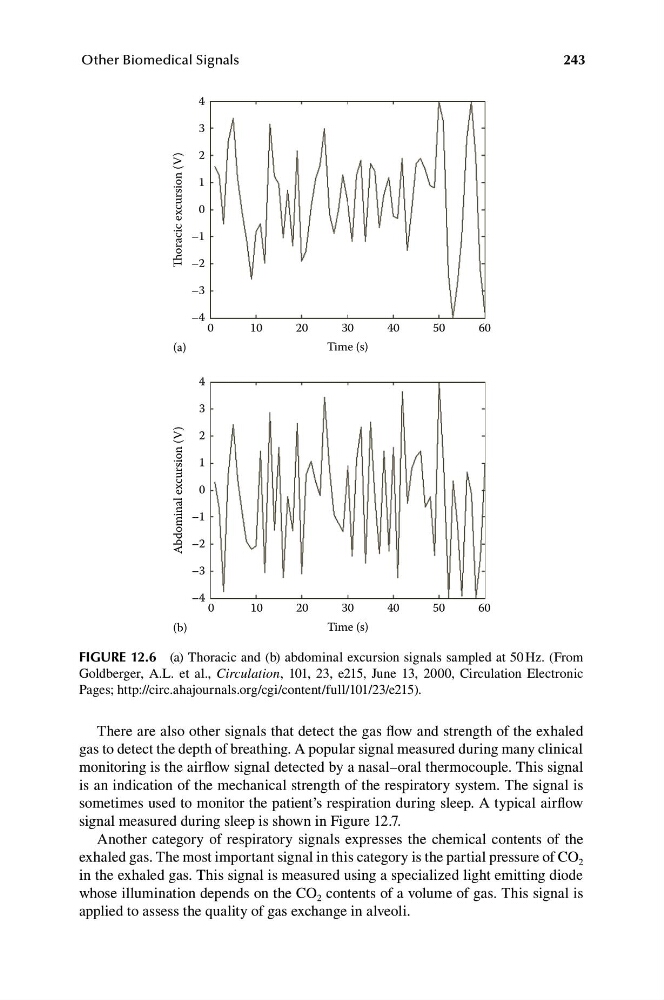
FIGURE 12.6 (a) Thoracic and (b) abdominal excursion signals sampled at 50 Hz. (From
Goldberger, A.L. et al., Circulation, 101, 23, e215, June 13, 2000, Circulation Electronic
Pages; http://circ.ahajournals.org/cgi/content/full/101/23/e215).
There are also other signals that detect the gas flow and strength of the exhaled
gas to detect the depth of breathing. A popular signal measured during many clinical
monitoring is the airflow signal detected by a nasal–oral thermocouple. This signal
is an indication of the mechanical strength of the respiratory system. The signal is
sometimes used to monitor the patient’s respiration during sleep. A typical airflow
signal measured during sleep is shown in Figure 12.7.
Another category of respiratory signals expresses the chemical contents of the
exhaled gas. The most important signal in this category is the partial pressure of CO 2
in the exhaled gas. This signal is measured using a specialized light emitting diode
whose illumination depends on the CO 2 contents of a volume of gas. This signal is
applied to assess the quality of gas exchange in alveoli.
Other Biomedical Signals
4
3
40
50
60
Thoracic excursion (V)
2
1
0
–1
–2
–3
–4
0
1 0
2 0
3 0
Time (s)
(a)
4
3
40
50
60
Abdominal excursion (V)
2
1
0
–1
–2
–3
–4
0
1 0
2 0
3 0
Time (s)
(b)
FIGURE 12.6 (a) Thoracic and (b) abdominal excursion signals sampled at 50 Hz. (From
Goldberger, A.L. et al., Circulation, 101, 23, e215, June 13, 2000, Circulation Electronic
Pages; http://circ.ahajournals.org/cgi/content/full/101/23/e215).
There are also other signals that detect the gas flow and strength of the exhaled
gas to detect the depth of breathing. A popular signal measured during many clinical
monitoring is the airflow signal detected by a nasal–oral thermocouple. This signal
is an indication of the mechanical strength of the respiratory system. The signal is
sometimes used to monitor the patient’s respiration during sleep. A typical airflow
signal measured during sleep is shown in Figure 12.7.
Another category of respiratory signals expresses the chemical contents of the
exhaled gas. The most important signal in this category is the partial pressure of CO 2
in the exhaled gas. This signal is measured using a specialized light emitting diode
whose illumination depends on the CO 2 contents of a volume of gas. This signal is
applied to assess the quality of gas exchange in alveoli.