

164
Biomedical Signal and Image Processing
the means of communication and messaging among the neighboring neurons forming a network. In other words, nerve cells are specialized to receive and transmit
these types of impulses (action potentials) to communicate information from one
location to the next by stimulating the train of neighboring cells. Transmission of
action potentials among the neurons provides complex functions such as the control
and cognitive capabilities of the human brain.
Now that we reviewed the process of action potential formation on the qualitative
level, next we use an electric model of the cell to describe action potentials using a
set of differential equations.
8.4 HODGKIN–HUXLEY MODEL
In 1952, A.L. Hodgkin and A.F. Huxley published their findings on the ion flow
through the giant squid axon membrane and described the theoretical principle of the
action potential. The Hodgkin–Huxley model is essentially a detailed version of the
circuit shown in Figure 8.3. We start describing this model from the steady-state condition. Under steady state, sodium ions (Na + ) act as the primary cation in the extracellular fluid, while the potassium ions (K + ) play the role of the primary cation in the
intracellular fluid, and chlorine can be considered as the primary extracellular anion.
This combination with the fixed concentration of the ions makes the cell maintain an
equilibrium potential. Additional anions and cations play rather insignificant roles
and are not included in the model. Table 8.1 shows the ion concentrations and the rest
potentials that are associated with the various equilibrium concentrations.
When, due to an external stimuli, a change occurs in the electric potential of the
membrane, V m , there will be a current associated with that change. Since the membrane
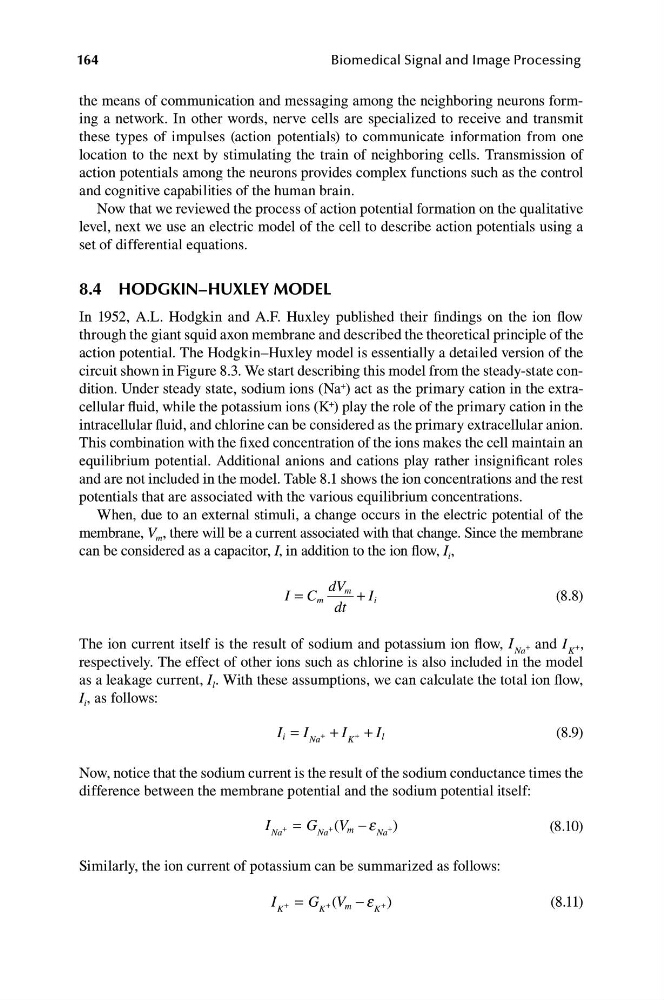
can be considered as a capacitor, I, in addition to the ion flow, I i ,
dV m
=
I C m
+ I i
(8.8)
dt
The ion current itself is the result of sodium and potassium ion flow, I and I K
+,
Na
+
respectively. The effect of other ions such as chlorine is also included in the model
as a leakage current, I l . With these assumptions, we can calculate the total ion flow,
I i , as follows:
I i = I Na
+ + I K
+ + I l
(8.9)
Now, notice that the sodium current is the result of the sodium conductance times the
difference between the membrane potential and the sodium potential itself:
I + = G + (V m − e +)
(8.10)
Na
Na
Na
Similarly, the ion current of potassium can be summarized as follows:
I + = G + (V m − e + )
(8.11)
K
K
K
Biomedical Signal and Image Processing
the means of communication and messaging among the neighboring neurons forming a network. In other words, nerve cells are specialized to receive and transmit
these types of impulses (action potentials) to communicate information from one
location to the next by stimulating the train of neighboring cells. Transmission of
action potentials among the neurons provides complex functions such as the control
and cognitive capabilities of the human brain.
Now that we reviewed the process of action potential formation on the qualitative
level, next we use an electric model of the cell to describe action potentials using a
set of differential equations.
8.4 HODGKIN–HUXLEY MODEL
In 1952, A.L. Hodgkin and A.F. Huxley published their findings on the ion flow
through the giant squid axon membrane and described the theoretical principle of the
action potential. The Hodgkin–Huxley model is essentially a detailed version of the
circuit shown in Figure 8.3. We start describing this model from the steady-state condition. Under steady state, sodium ions (Na + ) act as the primary cation in the extracellular fluid, while the potassium ions (K + ) play the role of the primary cation in the
intracellular fluid, and chlorine can be considered as the primary extracellular anion.
This combination with the fixed concentration of the ions makes the cell maintain an
equilibrium potential. Additional anions and cations play rather insignificant roles
and are not included in the model. Table 8.1 shows the ion concentrations and the rest
potentials that are associated with the various equilibrium concentrations.
When, due to an external stimuli, a change occurs in the electric potential of the
membrane, V m , there will be a current associated with that change. Since the membrane
can be considered as a capacitor, I, in addition to the ion flow, I i ,
dV m
=
I C m
+ I i
(8.8)
dt
The ion current itself is the result of sodium and potassium ion flow, I and I K
+,
Na
+
respectively. The effect of other ions such as chlorine is also included in the model
as a leakage current, I l . With these assumptions, we can calculate the total ion flow,
I i , as follows:
I i = I Na
+ + I K
+ + I l
(8.9)
Now, notice that the sodium current is the result of the sodium conductance times the
difference between the membrane potential and the sodium potential itself:
I + = G + (V m − e +)
(8.10)
Na
Na
Na
Similarly, the ion current of potassium can be summarized as follows:
I + = G + (V m − e + )
(8.11)
K
K
K