

0.10
0.05
Potential (V)
0.00
–0.05
–0.10
–0.15
0.05
0.10
0.15
0.20
0.25
Time (s)
163
Electric Activities of the Cell
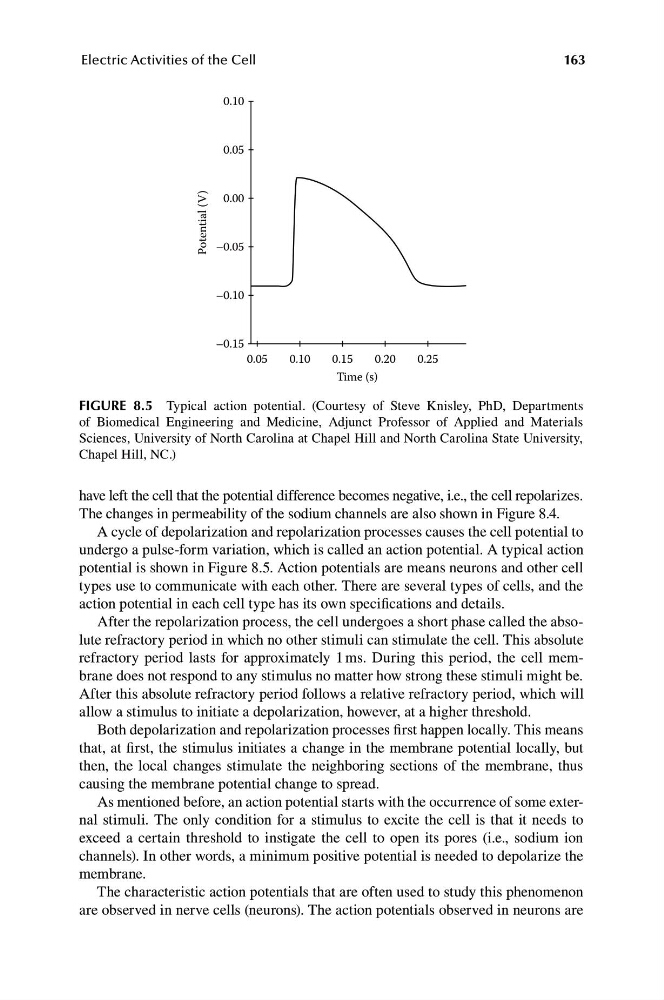
FIGURE 8.5 Typical action potential. (Courtesy of Steve Knisley, PhD, Departments
of Biomedical Engineering and Medicine, Adjunct Professor of Applied and Materials
Sciences, University of North Carolina at Chapel Hill and North Carolina State University,
Chapel Hill, NC.)
have left the cell that the potential difference becomes negative, i.e., the cell repolarizes.
The changes in permeability of the sodium channels are also shown in Figure 8.4.
A cycle of depolarization and repolarization processes causes the cell potential to
undergo a pulse-form variation, which is called an action potential. A typical action
potential is shown in Figure 8.5. Action potentials are means neurons and other cell
types use to communicate with each other. There are several types of cells, and the
action potential in each cell type has its own specifications and details.
After the repolarization process, the cell undergoes a short phase called the absolute refractory period in which no other stimuli can stimulate the cell. This absolute
refractory period lasts for approximately 1 ms. During this period, the cell membrane does not respond to any stimulus no matter how strong these stimuli might be.
After this absolute refractory period follows a relative refractory period, which will
allow a stimulus to initiate a depolarization, however, at a higher threshold.
Both depolarization and repolarization processes first happen locally. This means
that, at first, the stimulus initiates a change in the membrane potential locally, but
then, the local changes stimulate the neighboring sections of the membrane, thus
causing the membrane potential change to spread.
As mentioned before, an action potential starts with the occurrence of some external stimuli. The only condition for a stimulus to excite the cell is that it needs to
exceed a certain threshold to instigate the cell to open its pores (i.e., sodium ion
channels). In other words, a minimum positive potential is needed to depolarize the
membrane.
The characteristic action potentials that are often used to study this phenomenon
are observed in nerve cells (neurons). The action potentials observed in neurons are
0.05
Potential (V)
0.00
–0.05
–0.10
–0.15
0.05
0.10
0.15
0.20
0.25
Time (s)
163
Electric Activities of the Cell
FIGURE 8.5 Typical action potential. (Courtesy of Steve Knisley, PhD, Departments
of Biomedical Engineering and Medicine, Adjunct Professor of Applied and Materials
Sciences, University of North Carolina at Chapel Hill and North Carolina State University,
Chapel Hill, NC.)
have left the cell that the potential difference becomes negative, i.e., the cell repolarizes.
The changes in permeability of the sodium channels are also shown in Figure 8.4.
A cycle of depolarization and repolarization processes causes the cell potential to
undergo a pulse-form variation, which is called an action potential. A typical action
potential is shown in Figure 8.5. Action potentials are means neurons and other cell
types use to communicate with each other. There are several types of cells, and the
action potential in each cell type has its own specifications and details.
After the repolarization process, the cell undergoes a short phase called the absolute refractory period in which no other stimuli can stimulate the cell. This absolute
refractory period lasts for approximately 1 ms. During this period, the cell membrane does not respond to any stimulus no matter how strong these stimuli might be.
After this absolute refractory period follows a relative refractory period, which will
allow a stimulus to initiate a depolarization, however, at a higher threshold.
Both depolarization and repolarization processes first happen locally. This means
that, at first, the stimulus initiates a change in the membrane potential locally, but
then, the local changes stimulate the neighboring sections of the membrane, thus
causing the membrane potential change to spread.
As mentioned before, an action potential starts with the occurrence of some external stimuli. The only condition for a stimulus to excite the cell is that it needs to
exceed a certain threshold to instigate the cell to open its pores (i.e., sodium ion
channels). In other words, a minimum positive potential is needed to depolarize the
membrane.
The characteristic action potentials that are often used to study this phenomenon
are observed in nerve cells (neurons). The action potentials observed in neurons are