

162
Biomedical Signal and Image Processing
is at rest. Certain cells such as muscle and nerve cells are excitable cells in which
the permeability of the membrane can be altered under the influence of external
conditions. The permeability of the cell for chlorine ions has a relatively insignificant role in adjusting the cell potential due to the small size of these ions. On the
other hand, the pores in the membrane that let sodium and potassium ions through
can widen and/or change their polarity to allow a greater or smaller flow of these
ions through.
The external change in conditions that change the permeability of the membrane
is often referred to as a stimulus. In general, the stimulus can be an electric excitation
from another source, either a neighboring cell or an extremity of the cell itself that is
sensitive to a particular change in environment, for example, temperature, pressure,
or light.
The process of the formation of an action potential can be described in simple
words without any mathematical formulation. As the cell is stimulated by an external
factor, the rising potential difference across the cell membrane (due to the stimuli)
initially activates and opens a large number of sodium ion channels. The opening
of the sodium channels, or equivalently the sharp increase in the permeability or
conductance of the membrane for the sodium ions, causes an avalanche that sharply
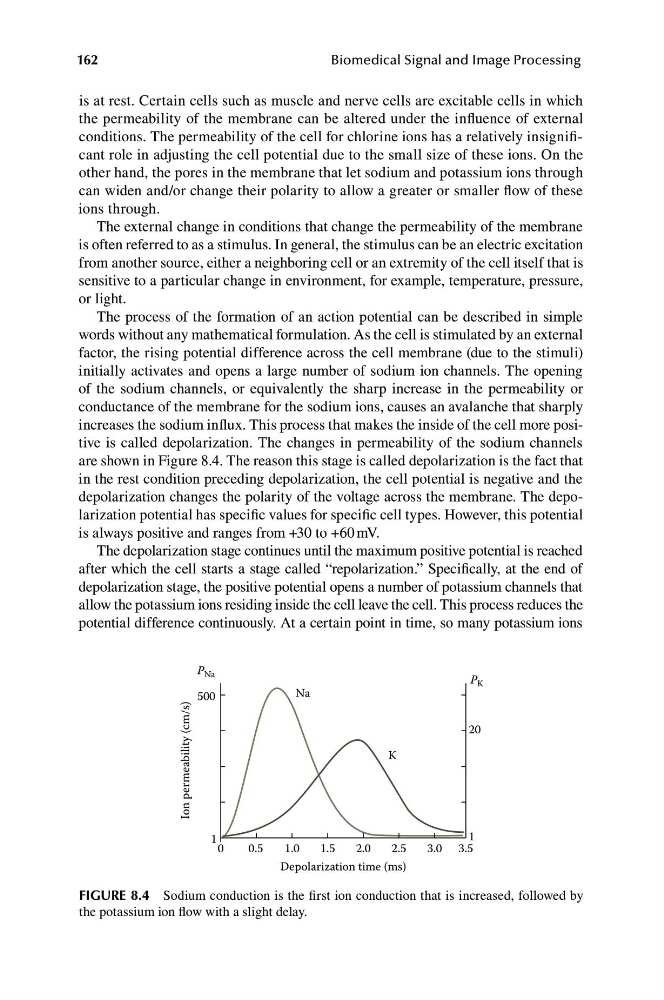
increases the sodium influx. This process that makes the inside of the cell more positive is called depolarization. The changes in permeability of the sodium channels
are shown in Figure 8.4. The reason this stage is called depolarization is the fact that
in the rest condition preceding depolarization, the cell potential is negative and the
depolarization changes the polarity of the voltage across the membrane. The depolarization potential has specific values for specific cell types. However, this potential
is always positive and ranges from +30 to +60 mV.
The depolarization stage continues until the maximum positive potential is reached
after which the cell starts a stage called “repolarization.” Specifically, at the end of
depolarization stage, the positive potential opens a number of potassium channels that
allow the potassium ions residing inside the cell leave the cell. This process reduces the
potential difference continuously. At a certain point in time, so many potassium ions
Ion permeability (cm/s)
P Na
P K
500
20
1
1
Depolarization time (ms)
Na
K
0
0.5
1.0
1.5
2.0
2.5
3.0 3.5
FIGURE 8.4 Sodium conduction is the first ion conduction that is increased, followed by
the potassium ion flow with a slight delay.
Biomedical Signal and Image Processing
is at rest. Certain cells such as muscle and nerve cells are excitable cells in which
the permeability of the membrane can be altered under the influence of external
conditions. The permeability of the cell for chlorine ions has a relatively insignificant role in adjusting the cell potential due to the small size of these ions. On the
other hand, the pores in the membrane that let sodium and potassium ions through
can widen and/or change their polarity to allow a greater or smaller flow of these
ions through.
The external change in conditions that change the permeability of the membrane
is often referred to as a stimulus. In general, the stimulus can be an electric excitation
from another source, either a neighboring cell or an extremity of the cell itself that is
sensitive to a particular change in environment, for example, temperature, pressure,
or light.
The process of the formation of an action potential can be described in simple
words without any mathematical formulation. As the cell is stimulated by an external
factor, the rising potential difference across the cell membrane (due to the stimuli)
initially activates and opens a large number of sodium ion channels. The opening
of the sodium channels, or equivalently the sharp increase in the permeability or
conductance of the membrane for the sodium ions, causes an avalanche that sharply
increases the sodium influx. This process that makes the inside of the cell more positive is called depolarization. The changes in permeability of the sodium channels
are shown in Figure 8.4. The reason this stage is called depolarization is the fact that
in the rest condition preceding depolarization, the cell potential is negative and the
depolarization changes the polarity of the voltage across the membrane. The depolarization potential has specific values for specific cell types. However, this potential
is always positive and ranges from +30 to +60 mV.
The depolarization stage continues until the maximum positive potential is reached
after which the cell starts a stage called “repolarization.” Specifically, at the end of
depolarization stage, the positive potential opens a number of potassium channels that
allow the potassium ions residing inside the cell leave the cell. This process reduces the
potential difference continuously. At a certain point in time, so many potassium ions
Ion permeability (cm/s)
P Na
P K
500
20
1
1
Depolarization time (ms)
Na
K
0
0.5
1.0
1.5
2.0
2.5
3.0 3.5
FIGURE 8.4 Sodium conduction is the first ion conduction that is increased, followed by
the potassium ion flow with a slight delay.