

161
Extracellular
R ax
R ax
R Na
R K
R Cl
I Na
I K
I Na
I K
V m
C m
–
–
–
ε Cl
Sodium
+
+
potassium
+
ε Na
ε K
pump
Intracellular
Electric Activities of the Cell
of the cell membrane is very small while the area of the membrane is relatively large.
For muscle cells and neurons, the capacitance is in the order of 1 μF/cm 2 , which is
indeed a large number per unit area.
With an electric potential of −90 mV, the field intensities are also relatively high.
The charges responsible for this potential are only the ions within 0.8 nm distance
from the membrane. Any ions removed farther than 0.8 nm from the membrane are
typically assumed to have no immediate impact on the potential.
8.3.3 CELL MEMBRANE’S EQUIVALENT ELECTRIC CIRCUIT
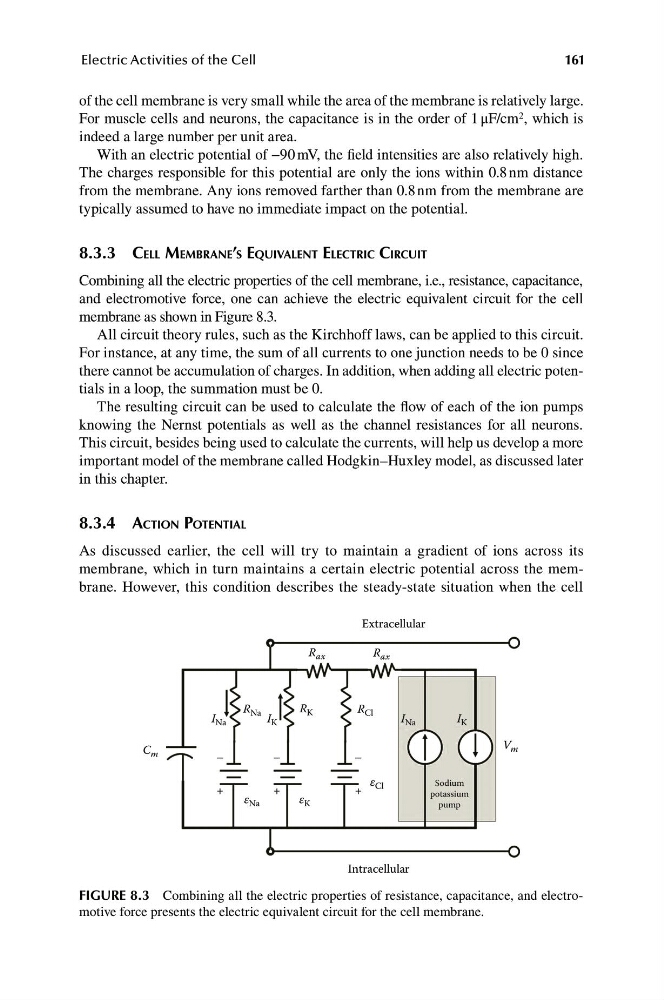
Combining all the electric properties of the cell membrane, i.e., resistance, capacitance,
and electromotive force, one can achieve the electric equivalent circuit for the cell
membrane as shown in Figure 8.3.
All circuit theory rules, such as the Kirchhoff laws, can be applied to this circuit.
For instance, at any time, the sum of all currents to one junction needs to be 0 since
there cannot be accumulation of charges. In addition, when adding all electric potentials in a loop, the summation must be 0.
The resulting circuit can be used to calculate the flow of each of the ion pumps
knowing the Nernst potentials as well as the channel resistances for all neurons.
This circuit, besides being used to calculate the currents, will help us develop a more
important model of the membrane called Hodgkin–Huxley model, as discussed later
in this chapter.
8.3.4 ACTION POTENTIAL
As discussed earlier, the cell will try to maintain a gradient of ions across its
membrane, which in turn maintains a certain electric potential across the membrane. However, this condition describes the steady-state situation when the cell
FIGURE 8.3 Combining all the electric properties of resistance, capacitance, and electromotive force presents the electric equivalent circuit for the cell membrane.
Extracellular
R ax
R ax
R Na
R K
R Cl
I Na
I K
I Na
I K
V m
C m
–
–
–
ε Cl
Sodium
+
+
potassium
+
ε Na
ε K
pump
Intracellular
Electric Activities of the Cell
of the cell membrane is very small while the area of the membrane is relatively large.
For muscle cells and neurons, the capacitance is in the order of 1 μF/cm 2 , which is
indeed a large number per unit area.
With an electric potential of −90 mV, the field intensities are also relatively high.
The charges responsible for this potential are only the ions within 0.8 nm distance
from the membrane. Any ions removed farther than 0.8 nm from the membrane are
typically assumed to have no immediate impact on the potential.
8.3.3 CELL MEMBRANE’S EQUIVALENT ELECTRIC CIRCUIT
Combining all the electric properties of the cell membrane, i.e., resistance, capacitance,
and electromotive force, one can achieve the electric equivalent circuit for the cell
membrane as shown in Figure 8.3.
All circuit theory rules, such as the Kirchhoff laws, can be applied to this circuit.
For instance, at any time, the sum of all currents to one junction needs to be 0 since
there cannot be accumulation of charges. In addition, when adding all electric potentials in a loop, the summation must be 0.
The resulting circuit can be used to calculate the flow of each of the ion pumps
knowing the Nernst potentials as well as the channel resistances for all neurons.
This circuit, besides being used to calculate the currents, will help us develop a more
important model of the membrane called Hodgkin–Huxley model, as discussed later
in this chapter.
8.3.4 ACTION POTENTIAL
As discussed earlier, the cell will try to maintain a gradient of ions across its
membrane, which in turn maintains a certain electric potential across the membrane. However, this condition describes the steady-state situation when the cell
FIGURE 8.3 Combining all the electric properties of resistance, capacitance, and electromotive force presents the electric equivalent circuit for the cell membrane.