

165
Electric Activities of the Cell
Since the leak current is the overall effect of various ions, no definite claims can
be made about the conductance. It is often more desirable to use the average leak
resistance instead:
(V m − e l )
l
l
m
l
I = G V
( − e ) =
(8.12)
R l
Combining all the aforementioned conditions for the depolarization and ion currents
gives
dV m
I G + V m − e + ) + G + V m − e +) + l ( m − e l ) + C m
(8.13)
=
(
(
G V
Na
Na
K
K
dt
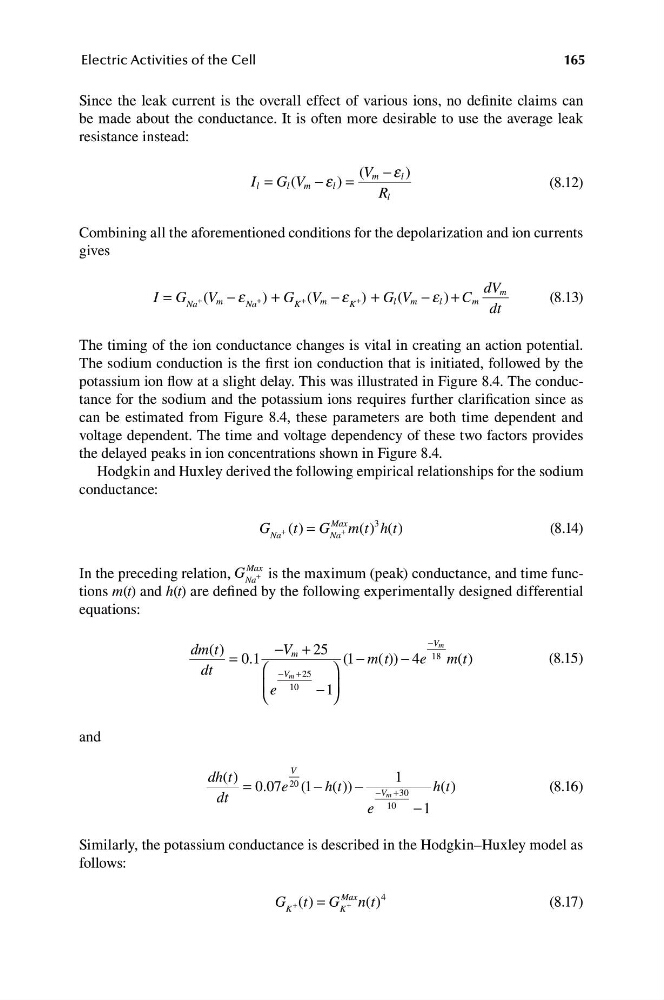
The timing of the ion conductance changes is vital in creating an action potential.
The sodium conduction is the first ion conduction that is initiated, followed by the
potassium ion flow at a slight delay. This was illustrated in Figure 8.4. The conductance for the sodium and the potassium ions requires further clarification since as
can be estimated from Figure 8.4, these parameters are both time dependent and
voltage dependent. The time and voltage dependency of these two factors provides
the delayed peaks in ion concentrations shown in Figure 8.4.
Hodgkin and Huxley derived the following empirical relationships for the sodium
conductance:
Max
3
G + ( )
t = G + m t
( ) h( )
t
(8.14)
Na
Na
In the preceding relation, G
Max
+ is the maximum (peak) conductance, and time funcNa
tions m(t) and h(t) are defined by the following experimentally designed differential
equations:
−V m
dm t
( )
−V + 25
= 0 1
.
m
(1 − m t
( ) ) − 4e 18 m t
( )
(8.15)
dt
⎛ −V m +25 ⎞
⎜ e 10 −1 ⎟
⎝
⎠
and
dh( )
t
V
1
= . e 20 (1 − h t
0 07
( )) −
h( )
t
(8.16)
−V m +30
dt
e 10 −1
Similarly, the potassium conductance is described in the Hodgkin–Huxley model as
follows:
Max
G t
+ ( ) = G + n t
( )
4
(8.17)
K
K
Electric Activities of the Cell
Since the leak current is the overall effect of various ions, no definite claims can
be made about the conductance. It is often more desirable to use the average leak
resistance instead:
(V m − e l )
l
l
m
l
I = G V
( − e ) =
(8.12)
R l
Combining all the aforementioned conditions for the depolarization and ion currents
gives
dV m
I G + V m − e + ) + G + V m − e +) + l ( m − e l ) + C m
(8.13)
=
(
(
G V
Na
Na
K
K
dt
The timing of the ion conductance changes is vital in creating an action potential.
The sodium conduction is the first ion conduction that is initiated, followed by the
potassium ion flow at a slight delay. This was illustrated in Figure 8.4. The conductance for the sodium and the potassium ions requires further clarification since as
can be estimated from Figure 8.4, these parameters are both time dependent and
voltage dependent. The time and voltage dependency of these two factors provides
the delayed peaks in ion concentrations shown in Figure 8.4.
Hodgkin and Huxley derived the following empirical relationships for the sodium
conductance:
Max
3
G + ( )
t = G + m t
( ) h( )
t
(8.14)
Na
Na
In the preceding relation, G
Max
+ is the maximum (peak) conductance, and time funcNa
tions m(t) and h(t) are defined by the following experimentally designed differential
equations:
−V m
dm t
( )
−V + 25
= 0 1
.
m
(1 − m t
( ) ) − 4e 18 m t
( )
(8.15)
dt
⎛ −V m +25 ⎞
⎜ e 10 −1 ⎟
⎝
⎠
and
dh( )
t
V
1
= . e 20 (1 − h t
0 07
( )) −
h( )
t
(8.16)
−V m +30
dt
e 10 −1
Similarly, the potassium conductance is described in the Hodgkin–Huxley model as
follows:
Max
G t
+ ( ) = G + n t
( )
4
(8.17)
K
K