

158
Biomedical Signal and Image Processing
In the preceding equation, the electron charge, e, is equal to −1.6022 × 10 −19 C. In the
equation, the only charges under consideration are within a cell-layer thickness distance from the cell membrane, approximately 1 μm thickness. The existence of these
charges will produce a diffuse current across the membrane that causes a secondary
electric potential across the membrane. In equilibrium, the electric potential, V, generated by the surplus of either the positive or negative ions on one side of the membrane
will produce an electric potential that will counteract the free diffusion, and a steady
state is formed with a constant voltage. In steady state, the ion potential resulting
from both the sodium and the chlorine gradients are equal to each other due to the
fact that there is no ion current under complete steady-state conditions, and there is a
full electrochemical balance in ion concentrations dictated by the individual electric
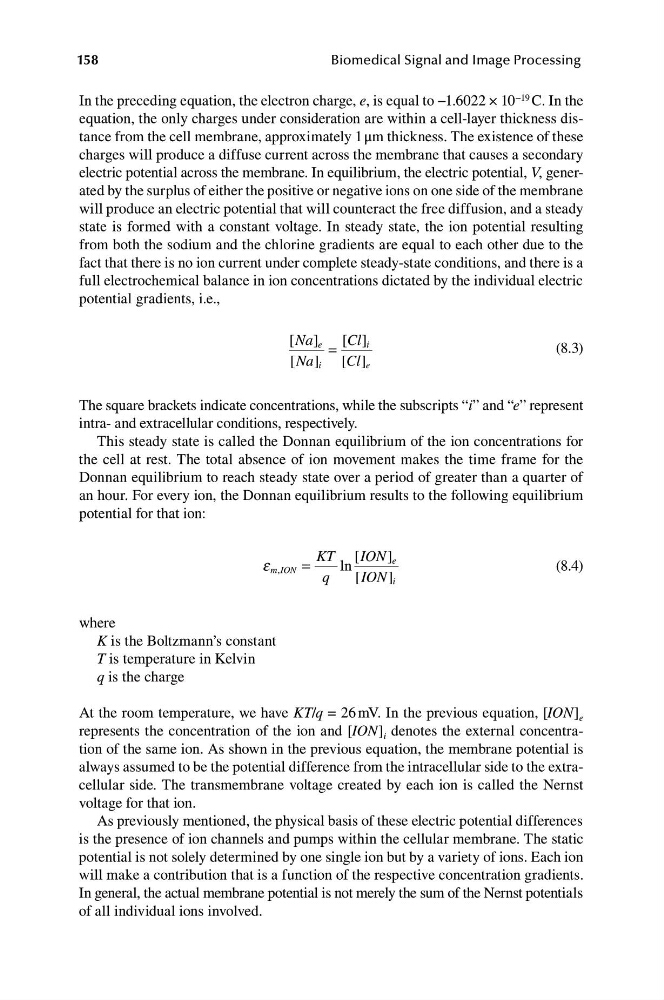
potential gradients, i.e.,
[Na] e
Cl
[ ] i
=
(8.3)
[Na] i
Cl
[ ] e
The square brackets indicate concentrations, while the subscripts “i” and “e” represent
intra- and extracellular conditions, respectively.
This steady state is called the Donnan equilibrium of the ion concentrations for
the cell at rest. The total absence of ion movement makes the time frame for the
Donnan equilibrium to reach steady state over a period of greater than a quarter of
an hour. For every ion, the Donnan equilibrium results to the following equilibrium
potential for that ion:
KT [ION] e
e m ION =
ln
(8.4)
,
q
[ION] i
where
K is the Boltzmann’s constant
T is temperature in Kelvin
q is the charge
At the room temperature, we have KT/q = 26 mV. In the previous equation, [ION] e
represents the concentration of the ion and [ION] i denotes the external concentration of the same ion. As shown in the previous equation, the membrane potential is
always assumed to be the potential difference from the intracellular side to the extracellular side. The transmembrane voltage created by each ion is called the Nernst
voltage for that ion.
As previously mentioned, the physical basis of these electric potential differences
is the presence of ion channels and pumps within the cellular membrane. The static
potential is not solely determined by one single ion but by a variety of ions. Each ion
will make a contribution that is a function of the respective concentration gradients.
In general, the actual membrane potential is not merely the sum of the Nernst potentials
of all individual ions involved.
Biomedical Signal and Image Processing
In the preceding equation, the electron charge, e, is equal to −1.6022 × 10 −19 C. In the
equation, the only charges under consideration are within a cell-layer thickness distance from the cell membrane, approximately 1 μm thickness. The existence of these
charges will produce a diffuse current across the membrane that causes a secondary
electric potential across the membrane. In equilibrium, the electric potential, V, generated by the surplus of either the positive or negative ions on one side of the membrane
will produce an electric potential that will counteract the free diffusion, and a steady
state is formed with a constant voltage. In steady state, the ion potential resulting
from both the sodium and the chlorine gradients are equal to each other due to the
fact that there is no ion current under complete steady-state conditions, and there is a
full electrochemical balance in ion concentrations dictated by the individual electric
potential gradients, i.e.,
[Na] e
Cl
[ ] i
=
(8.3)
[Na] i
Cl
[ ] e
The square brackets indicate concentrations, while the subscripts “i” and “e” represent
intra- and extracellular conditions, respectively.
This steady state is called the Donnan equilibrium of the ion concentrations for
the cell at rest. The total absence of ion movement makes the time frame for the
Donnan equilibrium to reach steady state over a period of greater than a quarter of
an hour. For every ion, the Donnan equilibrium results to the following equilibrium
potential for that ion:
KT [ION] e
e m ION =
ln
(8.4)
,
q
[ION] i
where
K is the Boltzmann’s constant
T is temperature in Kelvin
q is the charge
At the room temperature, we have KT/q = 26 mV. In the previous equation, [ION] e
represents the concentration of the ion and [ION] i denotes the external concentration of the same ion. As shown in the previous equation, the membrane potential is
always assumed to be the potential difference from the intracellular side to the extracellular side. The transmembrane voltage created by each ion is called the Nernst
voltage for that ion.
As previously mentioned, the physical basis of these electric potential differences
is the presence of ion channels and pumps within the cellular membrane. The static
potential is not solely determined by one single ion but by a variety of ions. Each ion
will make a contribution that is a function of the respective concentration gradients.
In general, the actual membrane potential is not merely the sum of the Nernst potentials
of all individual ions involved.