

Intracellular Ion
Extracellular Ion
Relative
Nernst Potential
Ion
Concentration [mM]
Concentration [nM]
Permeability [−]
[mV]
K +
155
4
1
−97.5
Na +
12
145
0.04
66.4
Cl −
4
120
0.45
−90.7
A − represents assorted cations and A + stands for assorted anions.
159
Electric Activities of the Cell
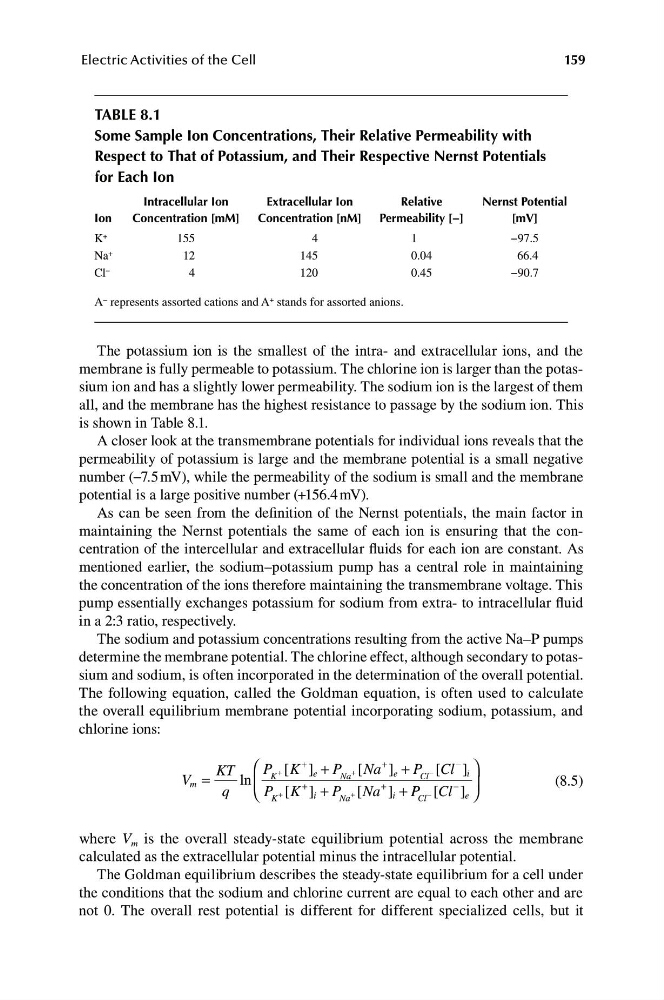
TABLE 8.1
Some Sample Ion Concentrations, Their Relative Permeability with
Respect to That of Potassium, and Their Respective Nernst Potentials
for Each Ion
The potassium ion is the smallest of the intra- and extracellular ions, and the
membrane is fully permeable to potassium. The chlorine ion is larger than the potassium ion and has a slightly lower permeability. The sodium ion is the largest of them
all, and the membrane has the highest resistance to passage by the sodium ion. This
is shown in Table 8.1.
A closer look at the transmembrane potentials for individual ions reveals that the
permeability of potassium is large and the membrane potential is a small negative
number (−7.5 mV), while the permeability of the sodium is small and the membrane
potential is a large positive number (+156.4 mV).
As can be seen from the definition of the Nernst potentials, the main factor in
maintaining the Nernst potentials the same of each ion is ensuring that the concentration of the intercellular and extracellular fluids for each ion are constant. As
mentioned earlier, the sodium–potassium pump has a central role in maintaining
the concentration of the ions therefore maintaining the transmembrane voltage. This
pump essentially exchanges potassium for sodium from extra- to intracellular fluid
in a 2:3 ratio, respectively.
The sodium and potassium concentrations resulting from the active Na–P pumps
determine the membrane potential. The chlorine effect, although secondary to potassium and sodium, is often incorporated in the determination of the overall potential.
The following equation, called the Goldman equation, is often used to calculate
the overall equilibrium membrane potential incorporating sodium, potassium, and
chlorine ions:
KT ⎛ P [
+
+
K
K
+
] e + P Na [Na
+ ]
−
V
e + P −
Cl
[Cl ] ⎞
m =
ln
i
⎜
⎟
(8.5)
q
⎝ P
+
+
−
i
i
l ]
+ [K ] + P + [Na ] + P P − [C e
K
Na
Cl
⎠
where V m is the overall steady-state equilibrium potential across the membrane
calculated as the extracellular potential minus the intracellular potential.
The Goldman equilibrium describes the steady-state equilibrium for a cell under
the conditions that the sodium and chlorine current are equal to each other and are
not 0. The overall rest potential is different for different specialized cells, but it
Extracellular Ion
Relative
Nernst Potential
Ion
Concentration [mM]
Concentration [nM]
Permeability [−]
[mV]
K +
155
4
1
−97.5
Na +
12
145
0.04
66.4
Cl −
4
120
0.45
−90.7
A − represents assorted cations and A + stands for assorted anions.
159
Electric Activities of the Cell
TABLE 8.1
Some Sample Ion Concentrations, Their Relative Permeability with
Respect to That of Potassium, and Their Respective Nernst Potentials
for Each Ion
The potassium ion is the smallest of the intra- and extracellular ions, and the
membrane is fully permeable to potassium. The chlorine ion is larger than the potassium ion and has a slightly lower permeability. The sodium ion is the largest of them
all, and the membrane has the highest resistance to passage by the sodium ion. This
is shown in Table 8.1.
A closer look at the transmembrane potentials for individual ions reveals that the
permeability of potassium is large and the membrane potential is a small negative
number (−7.5 mV), while the permeability of the sodium is small and the membrane
potential is a large positive number (+156.4 mV).
As can be seen from the definition of the Nernst potentials, the main factor in
maintaining the Nernst potentials the same of each ion is ensuring that the concentration of the intercellular and extracellular fluids for each ion are constant. As
mentioned earlier, the sodium–potassium pump has a central role in maintaining
the concentration of the ions therefore maintaining the transmembrane voltage. This
pump essentially exchanges potassium for sodium from extra- to intracellular fluid
in a 2:3 ratio, respectively.
The sodium and potassium concentrations resulting from the active Na–P pumps
determine the membrane potential. The chlorine effect, although secondary to potassium and sodium, is often incorporated in the determination of the overall potential.
The following equation, called the Goldman equation, is often used to calculate
the overall equilibrium membrane potential incorporating sodium, potassium, and
chlorine ions:
KT ⎛ P [
+
+
K
K
+
] e + P Na [Na
+ ]
−
V
e + P −
Cl
[Cl ] ⎞
m =
ln
i
⎜
⎟
(8.5)
q
⎝ P
+
+
−
i
i
l ]
+ [K ] + P + [Na ] + P P − [C e
K
Na
Cl
⎠
where V m is the overall steady-state equilibrium potential across the membrane
calculated as the extracellular potential minus the intracellular potential.
The Goldman equilibrium describes the steady-state equilibrium for a cell under
the conditions that the sodium and chlorine current are equal to each other and are
not 0. The overall rest potential is different for different specialized cells, but it