

120
Biomedical Signal and Image Processing
with other images, sometimes, certain markers (e.g., metal pins) are attached to the
head that can be traced in all imaging systems. The coordinates of these points are
then used to find c ij ’s, as described later.
As can be seen in Equation 6.35, the number of coefficients to be identified is 10.
This means that 10 equations are needed to solve for all coefficients. Since each tie
point provides two equations, altogether five tie points are required to uniquely identify the mapping. It is important to note that even though Equation 3.35 is nonlinear
with respect to x and y, the equations are indeed linear with respect to c ij ’s. More
specifically, after substituting for x, y, x′, and y′ with the coordinates of the tie points,
the resulting set of equations is linear with respect to c ij ’s. This allows using simple
matrix methods of solving for linear equations to find the coefficients.
If the number of the tie points is less than 5, it is a common practice to assume that
some of the preceding coefficients are 0. This results in a simpler mapping between
the two images. An example of this scenario is provided in the following.
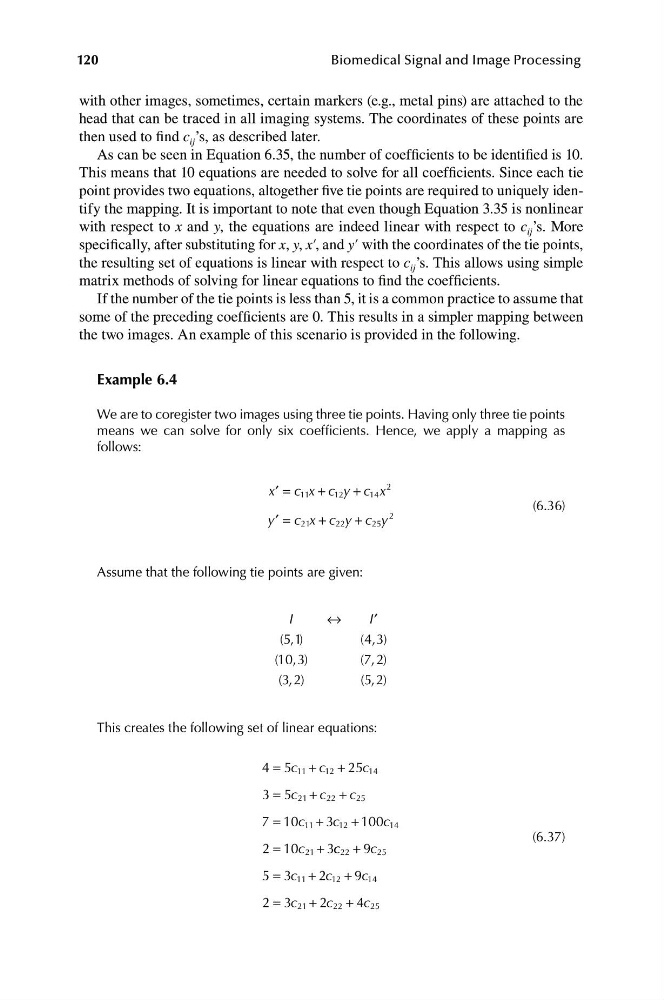
Example 6.4
We are to coregister two images using three tie points. Having only three tie points
means we can solve for only six coefficients. Hence, we apply a mapping as
follows:
x′ = c 11 x + c 12 y + c 14 x
2
(6.36)
y′ = c +
21 x c 22 y + c 25 y
2
Assume that the following tie points are given:
I
↔
I′
( ,
5 1 )
( 4 , 3 )
( ,
10 3 )
( 7 , 2 )
( ,
3 2 )
( 5 , 2 )
This creates the following set of linear equations:
4 5
= c 11 + c 12 + 25c 14
3 5
= c 21 + c 22 + c 25
7 = 10c 11 + 3c 12 + 100c 14
(6.37)
2 1
= 0 c 21 + 3 c c 22 + 9 c 25
5 3
= c 11 + 2c 12 + 9c 14
2 3
= c 21 + 2c 22 + 4c 25
Biomedical Signal and Image Processing
with other images, sometimes, certain markers (e.g., metal pins) are attached to the
head that can be traced in all imaging systems. The coordinates of these points are
then used to find c ij ’s, as described later.
As can be seen in Equation 6.35, the number of coefficients to be identified is 10.
This means that 10 equations are needed to solve for all coefficients. Since each tie
point provides two equations, altogether five tie points are required to uniquely identify the mapping. It is important to note that even though Equation 3.35 is nonlinear
with respect to x and y, the equations are indeed linear with respect to c ij ’s. More
specifically, after substituting for x, y, x′, and y′ with the coordinates of the tie points,
the resulting set of equations is linear with respect to c ij ’s. This allows using simple
matrix methods of solving for linear equations to find the coefficients.
If the number of the tie points is less than 5, it is a common practice to assume that
some of the preceding coefficients are 0. This results in a simpler mapping between
the two images. An example of this scenario is provided in the following.
Example 6.4
We are to coregister two images using three tie points. Having only three tie points
means we can solve for only six coefficients. Hence, we apply a mapping as
follows:
x′ = c 11 x + c 12 y + c 14 x
2
(6.36)
y′ = c +
21 x c 22 y + c 25 y
2
Assume that the following tie points are given:
I
↔
I′
( ,
5 1 )
( 4 , 3 )
( ,
10 3 )
( 7 , 2 )
( ,
3 2 )
( 5 , 2 )
This creates the following set of linear equations:
4 5
= c 11 + c 12 + 25c 14
3 5
= c 21 + c 22 + c 25
7 = 10c 11 + 3c 12 + 100c 14
(6.37)
2 1
= 0 c 21 + 3 c c 22 + 9 c 25
5 3
= c 11 + 2c 12 + 9c 14
2 3
= c 21 + 2c 22 + 4c 25