

119
Other Signal and Image Processing Methods
case that the patient’s exact position during the imaging acquisition changes from one
set of measurement to another set of images captured at a different time. Moreover,
the calibration of the imaging machines might be slightly different from one day to
another. Therefore, such captured images need to be registered with each other using
image processing methods.
There is another reason why image registration is a much needed process in imaging systems. It is often the case that when an image is generated by an imaging
modality such as PET, the geometry of the produced image is a distorted version of
the true geometry of the imaged tissue. For instance, it is often the case that some
objects in the center are enlarged and some objects located toward the corners of the
image are made smaller in size. In addition, it is rather usual to see that some or all of
the imaged objects are tilted. In such cases, we need to use the available knowledge
about the tissue to compensate for these distortions in the produced image and to
form an image with the desired geometrical characteristics.
Returning to the typical use of image registration between two captured images,
it is rather straightforward to note that image registration is simply creating a mathematical mapping between the pixel coordinates across a pair of images. This means
that registration is nothing but forming a mapping T that maps the coordinates (x, y)
in image I to the coordinates (x′, y′) in image I′. When coregistering the images taken
by the same modality, since the physics governing the formation of both images is
the same, the type of mapping T used for registration is often assumed to be linear.
However, when registering the images captured by different modalities (e.g., registering MRI with PET images), the successful mapping functions are almost always
nonlinear.
In the following, we discuss a general family of nonlinear mappings among
images. Even though these mappings are nonlinear in their general formulation, they
can be easily reduced to simple linear mappings. This mapping is very popular in
biomedical image processing and is known to present reliable registration of modalities such as PET and MRI.
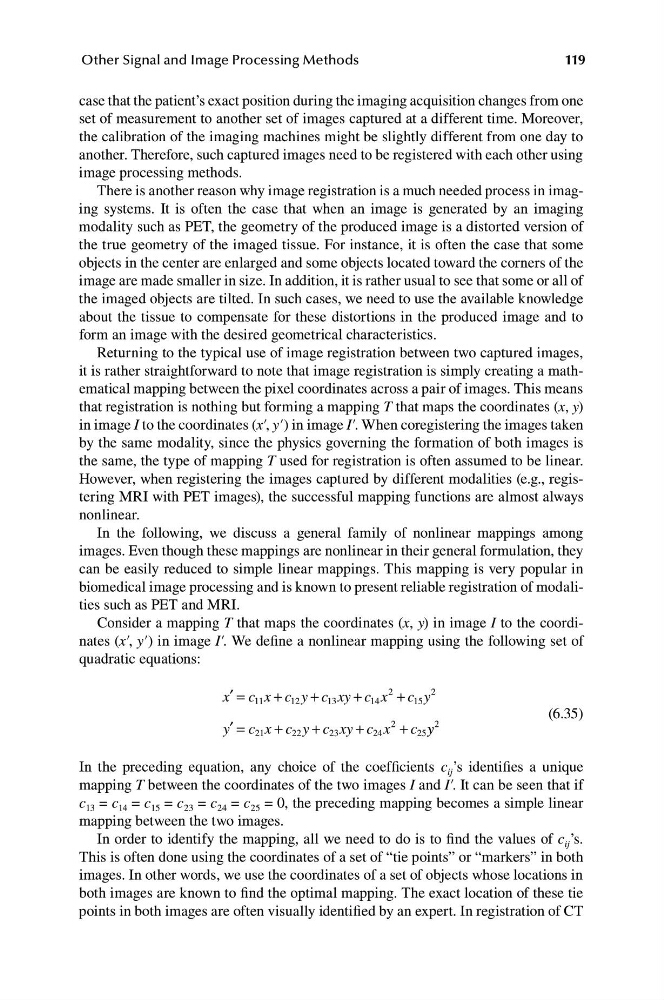
Consider a mapping T that maps the coordinates (x, y) in image I to the coordinates (x′, y′) in image I′. We define a nonlinear mapping using the following set of
quadratic equations:
x′ = c
2
13 xy + c 14 x + c
2
11 x + c 12 y + c
15 y
(6.35)
y′ = c
c xy + c 24 x
2
23
+
21 x + c 22 y +
c 25 y y
2
In the preceding equation, any choice of the coefficients c ij ’s identifies a unique
mapping T between the coordinates of the two images I and I′. It can be seen that if
c 13 = c 14 = c 15 = c 23 = c 24 = c 25 = 0, the preceding mapping becomes a simple linear
mapping between the two images.
In order to identify the mapping, all we need to do is to find the values of c ij ’s.
This is often done using the coordinates of a set of “tie points” or “markers” in both
images. In other words, we use the coordinates of a set of objects whose locations in
both images are known to find the optimal mapping. The exact location of these tie
points in both images are often visually identified by an expert. In registration of CT
Other Signal and Image Processing Methods
case that the patient’s exact position during the imaging acquisition changes from one
set of measurement to another set of images captured at a different time. Moreover,
the calibration of the imaging machines might be slightly different from one day to
another. Therefore, such captured images need to be registered with each other using
image processing methods.
There is another reason why image registration is a much needed process in imaging systems. It is often the case that when an image is generated by an imaging
modality such as PET, the geometry of the produced image is a distorted version of
the true geometry of the imaged tissue. For instance, it is often the case that some
objects in the center are enlarged and some objects located toward the corners of the
image are made smaller in size. In addition, it is rather usual to see that some or all of
the imaged objects are tilted. In such cases, we need to use the available knowledge
about the tissue to compensate for these distortions in the produced image and to
form an image with the desired geometrical characteristics.
Returning to the typical use of image registration between two captured images,
it is rather straightforward to note that image registration is simply creating a mathematical mapping between the pixel coordinates across a pair of images. This means
that registration is nothing but forming a mapping T that maps the coordinates (x, y)
in image I to the coordinates (x′, y′) in image I′. When coregistering the images taken
by the same modality, since the physics governing the formation of both images is
the same, the type of mapping T used for registration is often assumed to be linear.
However, when registering the images captured by different modalities (e.g., registering MRI with PET images), the successful mapping functions are almost always
nonlinear.
In the following, we discuss a general family of nonlinear mappings among
images. Even though these mappings are nonlinear in their general formulation, they
can be easily reduced to simple linear mappings. This mapping is very popular in
biomedical image processing and is known to present reliable registration of modalities such as PET and MRI.
Consider a mapping T that maps the coordinates (x, y) in image I to the coordinates (x′, y′) in image I′. We define a nonlinear mapping using the following set of
quadratic equations:
x′ = c
2
13 xy + c 14 x + c
2
11 x + c 12 y + c
15 y
(6.35)
y′ = c
c xy + c 24 x
2
23
+
21 x + c 22 y +
c 25 y y
2
In the preceding equation, any choice of the coefficients c ij ’s identifies a unique
mapping T between the coordinates of the two images I and I′. It can be seen that if
c 13 = c 14 = c 15 = c 23 = c 24 = c 25 = 0, the preceding mapping becomes a simple linear
mapping between the two images.
In order to identify the mapping, all we need to do is to find the values of c ij ’s.
This is often done using the coordinates of a set of “tie points” or “markers” in both
images. In other words, we use the coordinates of a set of objects whose locations in
both images are known to find the optimal mapping. The exact location of these tie
points in both images are often visually identified by an expert. In registration of CT