

25
20
15
10
5
0
Pulse I
(c)
0
50
100
150
25
20
15
10
5
0
0
50
100
150
Pulse II
(d)
Frequency
82
Biomedical Signal and Image Processing
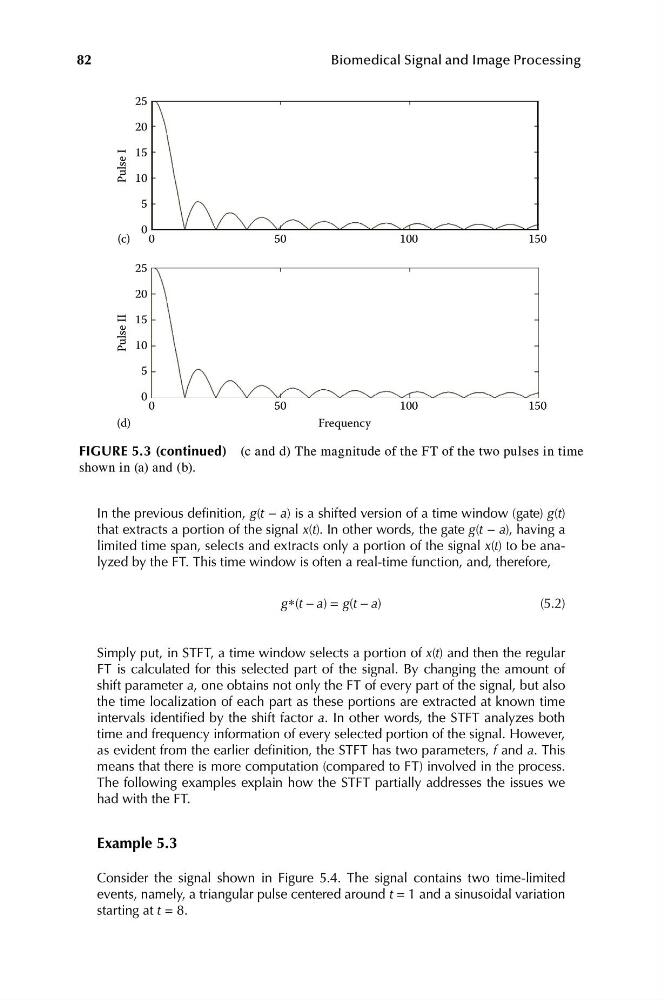
FIGURE 5.3 (continued) (c and d) The magnitude of the FT of the two pulses in time
shown in (a) and (b).
In the previous definition, g(t − a) is a shifted version of a time window (gate) g(t)
that extracts a portion of the signal x(t). In other words, the gate g(t − a), having a
limited time span, selects and extracts only a portion of the signal x(t) to be analyzed by the FT. This time window is often a real-time function, and, therefore,
g t
∗( − a ) = g(t − a )
(5.2)
Simply put, in STFT, a time window selects a portion of x(t) and then the regular
FT is calculated for this selected part of the signal. By changing the amount of
shift parameter a, one obtains not only the FT of every part of the signal, but also
the time localization of each part as these portions are extracted at known time
intervals identified by the shift factor a. In other words, the STFT analyzes both
time and frequency information of every selected portion of the signal. However,
as evident from the earlier definition, the STFT has two parameters, f and a. This
means that there is more computation (compared to FT) involved in the process.
The following examples explain how the STFT partially addresses the issues we
had with the FT.
Example 5.3
Consider the signal shown in Figure 5.4. The signal contains two time-limited
events, namely, a triangular pulse centered around t = 1 and a sinusoidal variation
starting at t = 8.
20
15
10
5
0
Pulse I
(c)
0
50
100
150
25
20
15
10
5
0
0
50
100
150
Pulse II
(d)
Frequency
82
Biomedical Signal and Image Processing
FIGURE 5.3 (continued) (c and d) The magnitude of the FT of the two pulses in time
shown in (a) and (b).
In the previous definition, g(t − a) is a shifted version of a time window (gate) g(t)
that extracts a portion of the signal x(t). In other words, the gate g(t − a), having a
limited time span, selects and extracts only a portion of the signal x(t) to be analyzed by the FT. This time window is often a real-time function, and, therefore,
g t
∗( − a ) = g(t − a )
(5.2)
Simply put, in STFT, a time window selects a portion of x(t) and then the regular
FT is calculated for this selected part of the signal. By changing the amount of
shift parameter a, one obtains not only the FT of every part of the signal, but also
the time localization of each part as these portions are extracted at known time
intervals identified by the shift factor a. In other words, the STFT analyzes both
time and frequency information of every selected portion of the signal. However,
as evident from the earlier definition, the STFT has two parameters, f and a. This
means that there is more computation (compared to FT) involved in the process.
The following examples explain how the STFT partially addresses the issues we
had with the FT.
Example 5.3
Consider the signal shown in Figure 5.4. The signal contains two time-limited
events, namely, a triangular pulse centered around t = 1 and a sinusoidal variation
starting at t = 8.