

76
3 Dopaquinone Conversion and Related Reactions
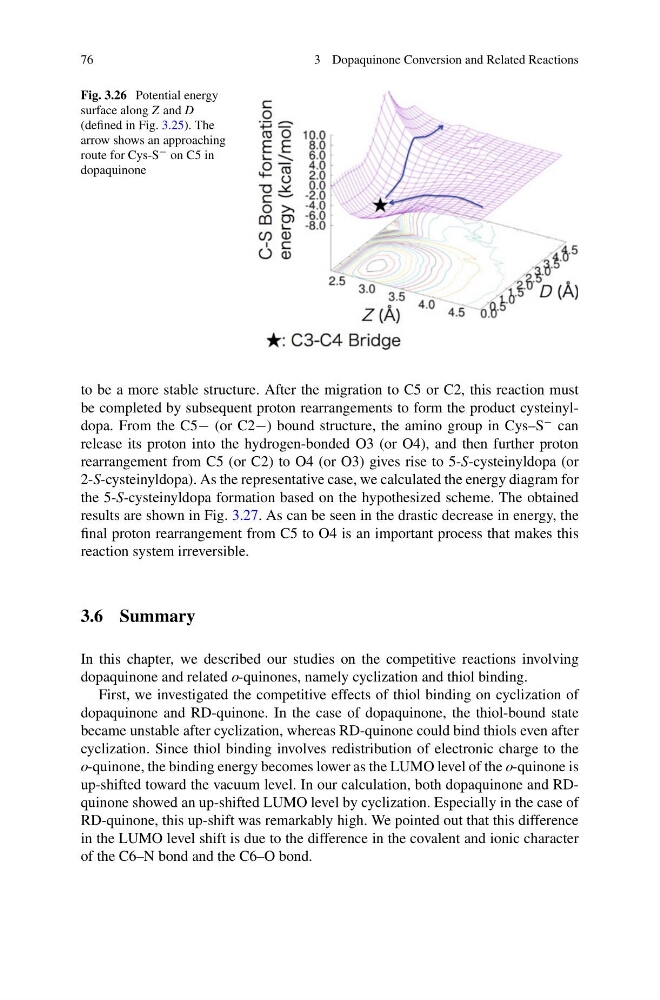
Fig. 3.26 Potential energy
surface along Z and D
(defined in Fig. 3.25). The
arrow shows an approaching
route for Cys-S − on C5 in
dopaquinone
to be a more stable structure. After the migration to C5 or C2, this reaction must
be completed by subsequent proton rearrangements to form the product cysteinyldopa. From the C5− (or C2−) bound structure, the amino group in Cys–S
− can
release its proton into the hydrogen-bonded O3 (or O4), and then further proton
rearrangement from C5 (or C2) to O4 (or O3) gives rise to 5-S-cysteinyldopa (or
2-S-cysteinyldopa). As the representative case, we calculated the energy diagram for
the 5-S-cysteinyldopa formation based on the hypothesized scheme. The obtained
results are shown in Fig. 3.27. As can be seen in the drastic decrease in energy, the
final proton rearrangement from C5 to O4 is an important process that makes this
reaction system irreversible.
3.6 Summary
In this chapter, we described our studies on the competitive reactions involving
dopaquinone and related o-quinones, namely cyclization and thiol binding.
First, we investigated the competitive effects of thiol binding on cyclization of
dopaquinone and RD-quinone. In the case of dopaquinone, the thiol-bound state
became unstable after cyclization, whereas RD-quinone could bind thiols even after
cyclization. Since thiol binding involves redistribution of electronic charge to the
o-quinone, the binding energy becomes lower as the LUMO level of the o-quinone is
up-shifted toward the vacuum level. In our calculation, both dopaquinone and RDquinone showed an up-shifted LUMO level by cyclization. Especially in the case of
RD-quinone, this up-shift was remarkably high. We pointed out that this difference
in the LUMO level shift is due to the difference in the covalent and ionic character
of the C6–N bond and the C6–O bond.
3 Dopaquinone Conversion and Related Reactions
Fig. 3.26 Potential energy
surface along Z and D
(defined in Fig. 3.25). The
arrow shows an approaching
route for Cys-S − on C5 in
dopaquinone
to be a more stable structure. After the migration to C5 or C2, this reaction must
be completed by subsequent proton rearrangements to form the product cysteinyldopa. From the C5− (or C2−) bound structure, the amino group in Cys–S
− can
release its proton into the hydrogen-bonded O3 (or O4), and then further proton
rearrangement from C5 (or C2) to O4 (or O3) gives rise to 5-S-cysteinyldopa (or
2-S-cysteinyldopa). As the representative case, we calculated the energy diagram for
the 5-S-cysteinyldopa formation based on the hypothesized scheme. The obtained
results are shown in Fig. 3.27. As can be seen in the drastic decrease in energy, the
final proton rearrangement from C5 to O4 is an important process that makes this
reaction system irreversible.
3.6 Summary
In this chapter, we described our studies on the competitive reactions involving
dopaquinone and related o-quinones, namely cyclization and thiol binding.
First, we investigated the competitive effects of thiol binding on cyclization of
dopaquinone and RD-quinone. In the case of dopaquinone, the thiol-bound state
became unstable after cyclization, whereas RD-quinone could bind thiols even after
cyclization. Since thiol binding involves redistribution of electronic charge to the
o-quinone, the binding energy becomes lower as the LUMO level of the o-quinone is
up-shifted toward the vacuum level. In our calculation, both dopaquinone and RDquinone showed an up-shifted LUMO level by cyclization. Especially in the case of
RD-quinone, this up-shift was remarkably high. We pointed out that this difference
in the LUMO level shift is due to the difference in the covalent and ionic character
of the C6–N bond and the C6–O bond.