

3.6 Summary
77
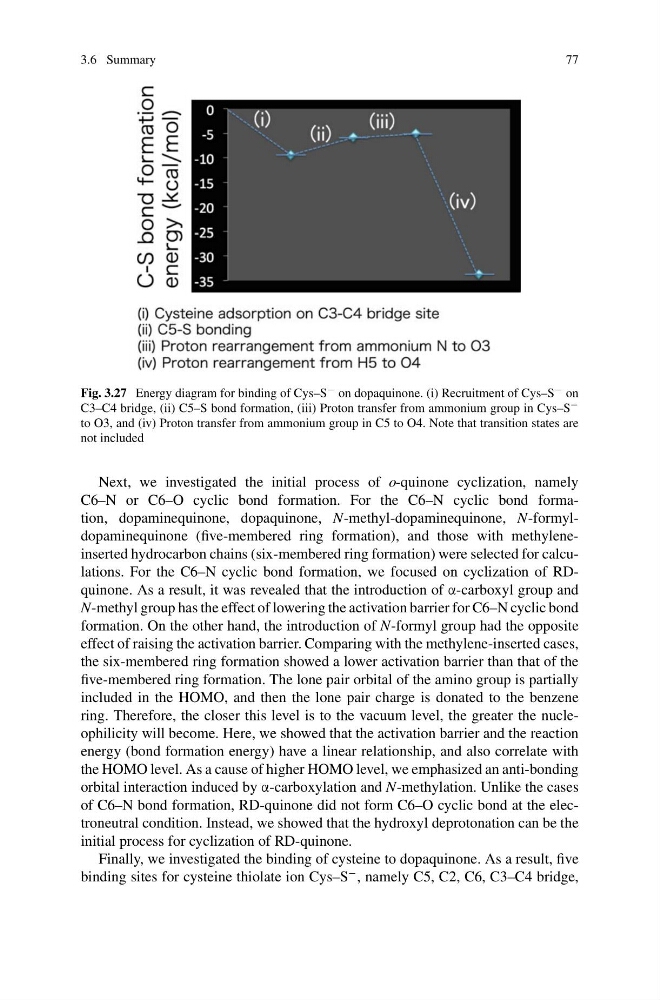
Fig. 3.27 Energy diagram for binding of Cys–S − on dopaquinone. (i) Recruitment of Cys–S − on
C3–C4 bridge, (ii) C5–S bond formation, (iii) Proton transfer from ammonium group in Cys–S −
to O3, and (iv) Proton transfer from ammonium group in C5 to O4. Note that transition states are
not included
Next, we investigated the initial process of o-quinone cyclization, namely
C6–N or C6–O cyclic bond formation. For the C6–N cyclic bond formation, dopaminequinone, dopaquinone, N-methyl-dopaminequinone, N-formyldopaminequinone (five-membered ring formation), and those with methyleneinserted hydrocarbon chains (six-membered ring formation) were selected for calculations. For the C6–N cyclic bond formation, we focused on cyclization of RDquinone. As a result, it was revealed that the introduction of α-carboxyl group and
N-methyl group has the effect of lowering the activation barrier for C6–N cyclic bond
formation. On the other hand, the introduction of N-formyl group had the opposite
effect of raising the activation barrier. Comparing with the methylene-inserted cases,
the six-membered ring formation showed a lower activation barrier than that of the
five-membered ring formation. The lone pair orbital of the amino group is partially
included in the HOMO, and then the lone pair charge is donated to the benzene
ring. Therefore, the closer this level is to the vacuum level, the greater the nucleophilicity will become. Here, we showed that the activation barrier and the reaction
energy (bond formation energy) have a linear relationship, and also correlate with
the HOMO level. As a cause of higher HOMO level, we emphasized an anti-bonding
orbital interaction induced by α-carboxylation and N-methylation. Unlike the cases
of C6–N bond formation, RD-quinone did not form C6–O cyclic bond at the electroneutral condition. Instead, we showed that the hydroxyl deprotonation can be the
initial process for cyclization of RD-quinone.
Finally, we investigated the binding of cysteine to dopaquinone. As a result, five
binding sites for cysteine thiolate ion Cys–S
− , namely C5, C2, C6, C3–C4 bridge,
77
Fig. 3.27 Energy diagram for binding of Cys–S − on dopaquinone. (i) Recruitment of Cys–S − on
C3–C4 bridge, (ii) C5–S bond formation, (iii) Proton transfer from ammonium group in Cys–S −
to O3, and (iv) Proton transfer from ammonium group in C5 to O4. Note that transition states are
not included
Next, we investigated the initial process of o-quinone cyclization, namely
C6–N or C6–O cyclic bond formation. For the C6–N cyclic bond formation, dopaminequinone, dopaquinone, N-methyl-dopaminequinone, N-formyldopaminequinone (five-membered ring formation), and those with methyleneinserted hydrocarbon chains (six-membered ring formation) were selected for calculations. For the C6–N cyclic bond formation, we focused on cyclization of RDquinone. As a result, it was revealed that the introduction of α-carboxyl group and
N-methyl group has the effect of lowering the activation barrier for C6–N cyclic bond
formation. On the other hand, the introduction of N-formyl group had the opposite
effect of raising the activation barrier. Comparing with the methylene-inserted cases,
the six-membered ring formation showed a lower activation barrier than that of the
five-membered ring formation. The lone pair orbital of the amino group is partially
included in the HOMO, and then the lone pair charge is donated to the benzene
ring. Therefore, the closer this level is to the vacuum level, the greater the nucleophilicity will become. Here, we showed that the activation barrier and the reaction
energy (bond formation energy) have a linear relationship, and also correlate with
the HOMO level. As a cause of higher HOMO level, we emphasized an anti-bonding
orbital interaction induced by α-carboxylation and N-methylation. Unlike the cases
of C6–N bond formation, RD-quinone did not form C6–O cyclic bond at the electroneutral condition. Instead, we showed that the hydroxyl deprotonation can be the
initial process for cyclization of RD-quinone.
Finally, we investigated the binding of cysteine to dopaquinone. As a result, five
binding sites for cysteine thiolate ion Cys–S
− , namely C5, C2, C6, C3–C4 bridge,