

72
3 Dopaquinone Conversion and Related Reactions
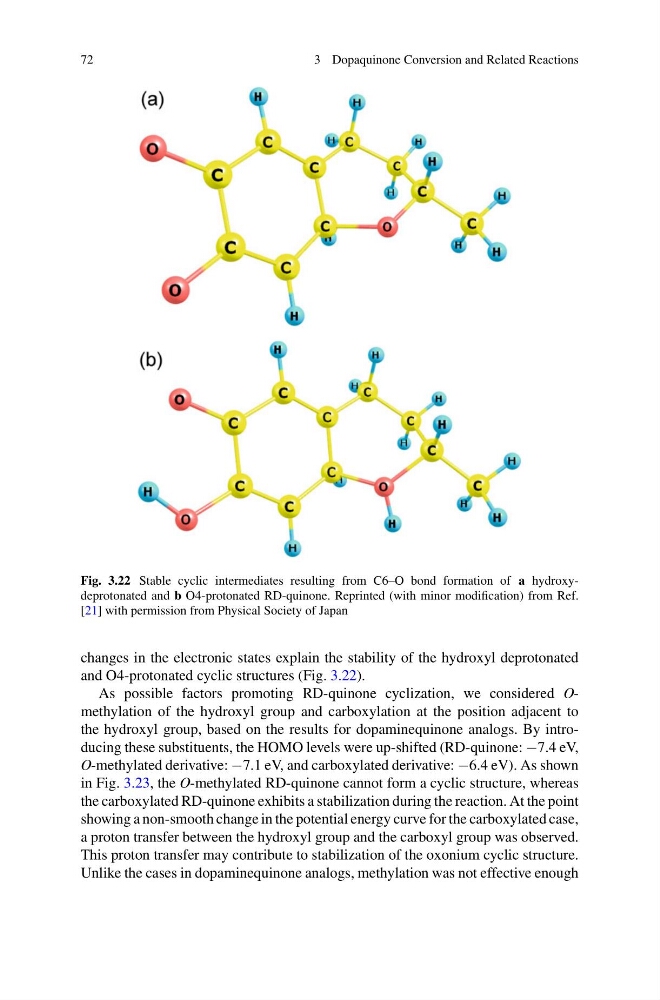
Fig. 3.22 Stable cyclic intermediates resulting from C6–O bond formation of a hydroxydeprotonated and b O4-protonated RD-quinone. Reprinted (with minor modification) from Ref.
[21] with permission from Physical Society of Japan
changes in the electronic states explain the stability of the hydroxyl deprotonated
and O4-protonated cyclic structures (Fig. 3.22).
As possible factors promoting RD-quinone cyclization, we considered Omethylation of the hydroxyl group and carboxylation at the position adjacent to
the hydroxyl group, based on the results for dopaminequinone analogs. By introducing these substituents, the HOMO levels were up-shifted (RD-quinone: −7.4 eV,
O-methylated derivative: −7.1 eV, and carboxylated derivative: −6.4 eV). As shown
in Fig. 3.23, the O-methylated RD-quinone cannot form a cyclic structure, whereas
the carboxylated RD-quinone exhibits a stabilization during the reaction. At the point
showing a non-smooth change in the potential energy curve for the carboxylated case,
a proton transfer between the hydroxyl group and the carboxyl group was observed.
This proton transfer may contribute to stabilization of the oxonium cyclic structure.
Unlike the cases in dopaminequinone analogs, methylation was not effective enough
3 Dopaquinone Conversion and Related Reactions
Fig. 3.22 Stable cyclic intermediates resulting from C6–O bond formation of a hydroxydeprotonated and b O4-protonated RD-quinone. Reprinted (with minor modification) from Ref.
[21] with permission from Physical Society of Japan
changes in the electronic states explain the stability of the hydroxyl deprotonated
and O4-protonated cyclic structures (Fig. 3.22).
As possible factors promoting RD-quinone cyclization, we considered Omethylation of the hydroxyl group and carboxylation at the position adjacent to
the hydroxyl group, based on the results for dopaminequinone analogs. By introducing these substituents, the HOMO levels were up-shifted (RD-quinone: −7.4 eV,
O-methylated derivative: −7.1 eV, and carboxylated derivative: −6.4 eV). As shown
in Fig. 3.23, the O-methylated RD-quinone cannot form a cyclic structure, whereas
the carboxylated RD-quinone exhibits a stabilization during the reaction. At the point
showing a non-smooth change in the potential energy curve for the carboxylated case,
a proton transfer between the hydroxyl group and the carboxyl group was observed.
This proton transfer may contribute to stabilization of the oxonium cyclic structure.
Unlike the cases in dopaminequinone analogs, methylation was not effective enough