

3.4 Cyclization of Dopamine Quinone Analogs
71
Table 3.4 Condensed-to-atom Fukui indices for side chains of dopaminequinone analogs (left
derivative f + and right derivative f − )
Label
o-Quinone
Atom/Group
f +
f −
(a)
Dopaminequinone
Amino N
−0.01
0.33
(a)
Dopaminequinone
Whole side chain a
0.05
0.56
(b)
Dopaquinone
Amino N
−0.01
0.26
(b)
Dopaquinone
Carboxyl O
0.01
0.19
(b)
Dopaquinone
Carboxyl O
0.01
0.33
(b)
Dopaquinone
Whole side chain a
0.04
0.91
(c)
N-Methyl-dopaminequinone
Amino N
0.00
0.45
(c)
N-Methyl-dopaminequinone
N-Methyl C
0.00
−0.05
(c)
N-Methyl-dopaminequinone
Whole side chain a
0.04
0.80
(d)
N-Formyl-dopaminequinone
Amino N
−0.01
0.02
(d)
N-Formyl-dopaminequinone
N-Formyl C
0.00
0.02
(d)
N-Formyl-dopaminequinone
N-Formyl O
0.00
0.00
(d)
N-Formyl-dopaminequinone
Whole side chain a
0.05
0.11
a Condensed-to-atom Fukui indices were integrated for all the side chain atoms
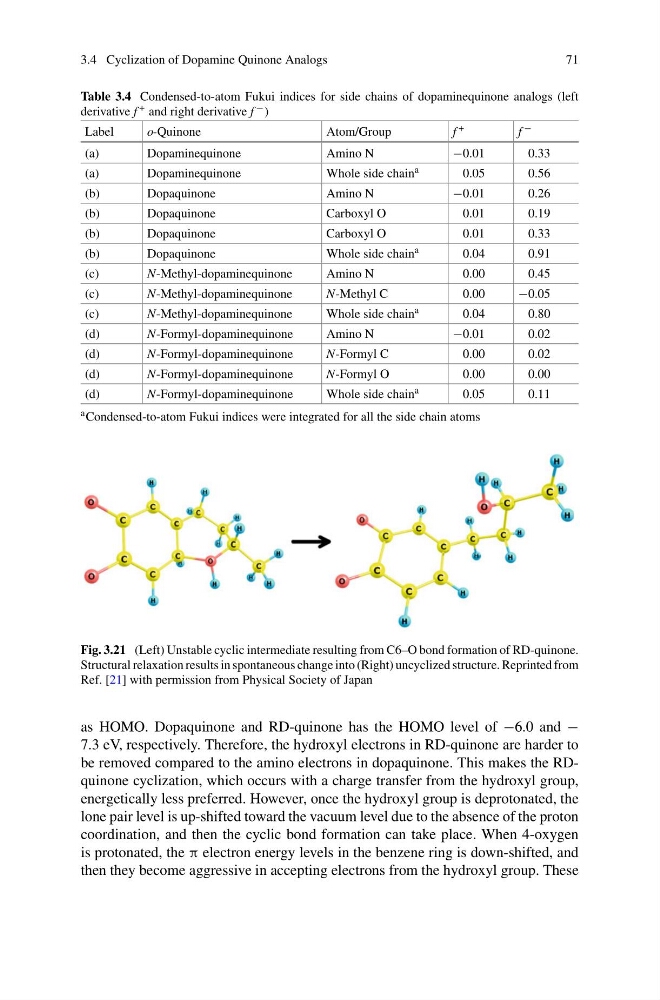
Fig. 3.21 (Left) Unstable cyclic intermediate resulting from C6–O bond formation of RD-quinone.
Structural relaxation results in spontaneous change into (Right) uncyclized structure. Reprinted from
Ref. [21] with permission from Physical Society of Japan
as HOMO. Dopaquinone and RD-quinone has the HOMO level of −6.0 and −
7.3 eV, respectively. Therefore, the hydroxyl electrons in RD-quinone are harder to
be removed compared to the amino electrons in dopaquinone. This makes the RDquinone cyclization, which occurs with a charge transfer from the hydroxyl group,
energetically less preferred. However, once the hydroxyl group is deprotonated, the
lone pair level is up-shifted toward the vacuum level due to the absence of the proton
coordination, and then the cyclic bond formation can take place. When 4-oxygen
is protonated, the π electron energy levels in the benzene ring is down-shifted, and
then they become aggressive in accepting electrons from the hydroxyl group. These
71
Table 3.4 Condensed-to-atom Fukui indices for side chains of dopaminequinone analogs (left
derivative f + and right derivative f − )
Label
o-Quinone
Atom/Group
f +
f −
(a)
Dopaminequinone
Amino N
−0.01
0.33
(a)
Dopaminequinone
Whole side chain a
0.05
0.56
(b)
Dopaquinone
Amino N
−0.01
0.26
(b)
Dopaquinone
Carboxyl O
0.01
0.19
(b)
Dopaquinone
Carboxyl O
0.01
0.33
(b)
Dopaquinone
Whole side chain a
0.04
0.91
(c)
N-Methyl-dopaminequinone
Amino N
0.00
0.45
(c)
N-Methyl-dopaminequinone
N-Methyl C
0.00
−0.05
(c)
N-Methyl-dopaminequinone
Whole side chain a
0.04
0.80
(d)
N-Formyl-dopaminequinone
Amino N
−0.01
0.02
(d)
N-Formyl-dopaminequinone
N-Formyl C
0.00
0.02
(d)
N-Formyl-dopaminequinone
N-Formyl O
0.00
0.00
(d)
N-Formyl-dopaminequinone
Whole side chain a
0.05
0.11
a Condensed-to-atom Fukui indices were integrated for all the side chain atoms
Fig. 3.21 (Left) Unstable cyclic intermediate resulting from C6–O bond formation of RD-quinone.
Structural relaxation results in spontaneous change into (Right) uncyclized structure. Reprinted from
Ref. [21] with permission from Physical Society of Japan
as HOMO. Dopaquinone and RD-quinone has the HOMO level of −6.0 and −
7.3 eV, respectively. Therefore, the hydroxyl electrons in RD-quinone are harder to
be removed compared to the amino electrons in dopaquinone. This makes the RDquinone cyclization, which occurs with a charge transfer from the hydroxyl group,
energetically less preferred. However, once the hydroxyl group is deprotonated, the
lone pair level is up-shifted toward the vacuum level due to the absence of the proton
coordination, and then the cyclic bond formation can take place. When 4-oxygen
is protonated, the π electron energy levels in the benzene ring is down-shifted, and
then they become aggressive in accepting electrons from the hydroxyl group. These