

3.4 Cyclization of Dopamine Quinone Analogs
63
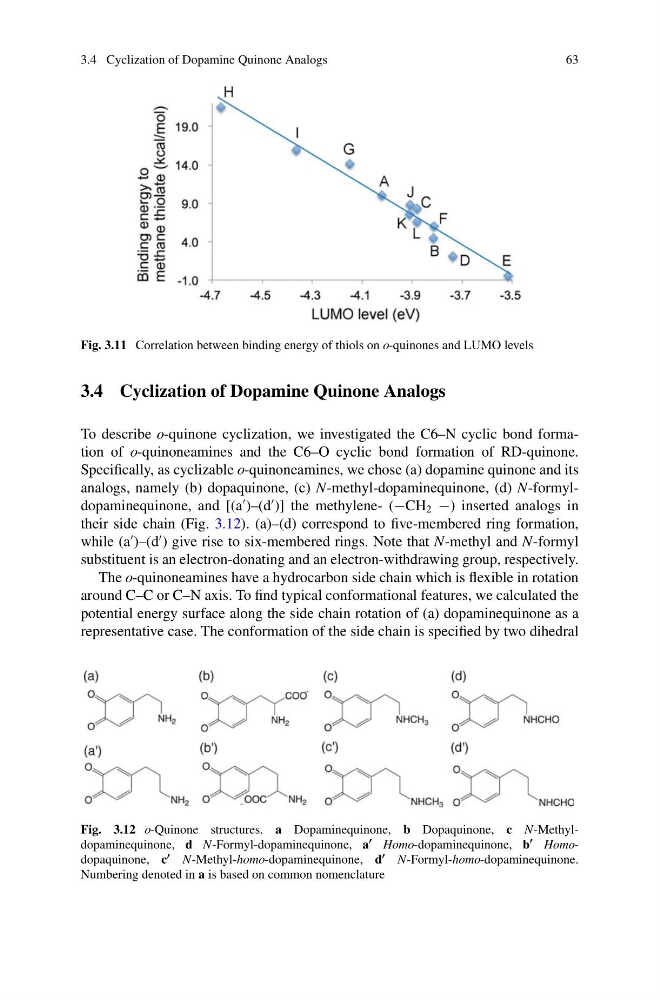
Fig. 3.11 Correlation between binding energy of thiols on o-quinones and LUMO levels
3.4 Cyclization of Dopamine Quinone Analogs
To describe o-quinone cyclization, we investigated the C6–N cyclic bond formation of o-quinoneamines and the C6–O cyclic bond formation of RD-quinone.
Specifically, as cyclizable o-quinoneamines, we chose (a) dopamine quinone and its
analogs, namely (b) dopaquinone, (c) N-methyl-dopaminequinone, (d) N-formyldopaminequinone, and [(a
)–(d
)] the methylene- (−CH 2 −) inserted analogs in
their side chain (Fig. 3.12). (a)–(d) correspond to five-membered ring formation,
while (a
)–(d
) give rise to six-membered rings. Note that N-methyl and N-formyl
substituent is an electron-donating and an electron-withdrawing group, respectively.
The o-quinoneamines have a hydrocarbon side chain which is flexible in rotation
around C–C or C–N axis. To find typical conformational features, we calculated the
potential energy surface along the side chain rotation of (a) dopaminequinone as a
representative case. The conformation of the side chain is specified by two dihedral
Fig. 3.12 o-Quinone structures. a Dopaminequinone, b Dopaquinone, c N-Methyldopaminequinone, d N-Formyl-dopaminequinone, a Homo-dopaminequinone, b Homodopaquinone, c N-Methyl-homo-dopaminequinone, d N-Formyl-homo-dopaminequinone.
Numbering denoted in a is based on common nomenclature
63
Fig. 3.11 Correlation between binding energy of thiols on o-quinones and LUMO levels
3.4 Cyclization of Dopamine Quinone Analogs
To describe o-quinone cyclization, we investigated the C6–N cyclic bond formation of o-quinoneamines and the C6–O cyclic bond formation of RD-quinone.
Specifically, as cyclizable o-quinoneamines, we chose (a) dopamine quinone and its
analogs, namely (b) dopaquinone, (c) N-methyl-dopaminequinone, (d) N-formyldopaminequinone, and [(a
)–(d
)] the methylene- (−CH 2 −) inserted analogs in
their side chain (Fig. 3.12). (a)–(d) correspond to five-membered ring formation,
while (a
)–(d
) give rise to six-membered rings. Note that N-methyl and N-formyl
substituent is an electron-donating and an electron-withdrawing group, respectively.
The o-quinoneamines have a hydrocarbon side chain which is flexible in rotation
around C–C or C–N axis. To find typical conformational features, we calculated the
potential energy surface along the side chain rotation of (a) dopaminequinone as a
representative case. The conformation of the side chain is specified by two dihedral
Fig. 3.12 o-Quinone structures. a Dopaminequinone, b Dopaquinone, c N-Methyldopaminequinone, d N-Formyl-dopaminequinone, a Homo-dopaminequinone, b Homodopaquinone, c N-Methyl-homo-dopaminequinone, d N-Formyl-homo-dopaminequinone.
Numbering denoted in a is based on common nomenclature