

62
3 Dopaquinone Conversion and Related Reactions
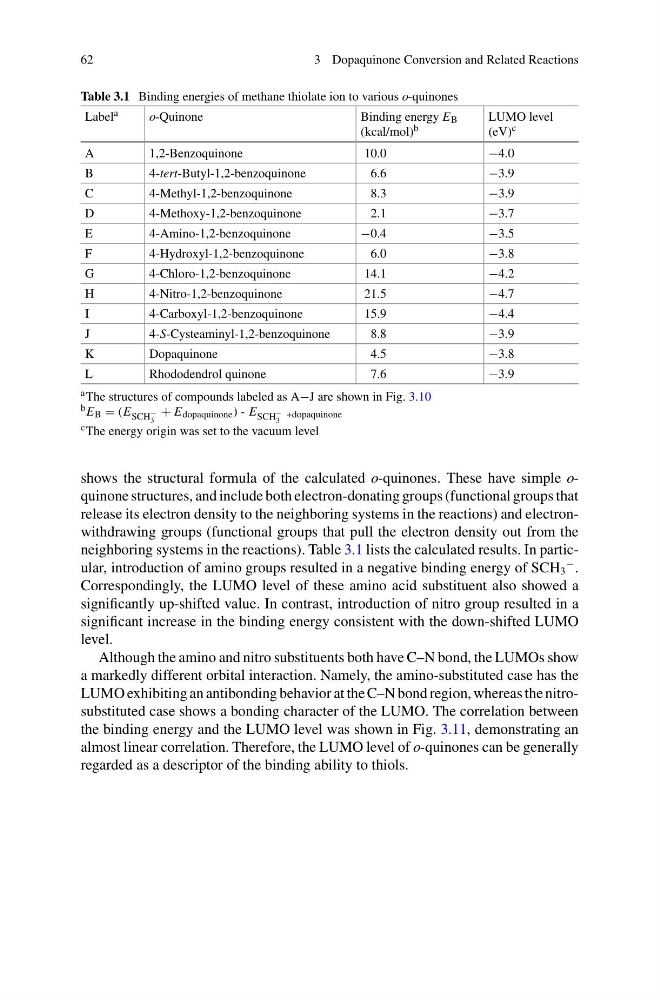
Table 3.1 Binding energies of methane thiolate ion to various o-quinones
Label a
o-Quinone
Binding energy E B
(kcal/mol) b
LUMO level
(eV) c
A
1,2-Benzoquinone
10.0
−4.0
B
4-tert-Butyl-1,2-benzoquinone
6.6
−3.9
C
4-Methyl-1,2-benzoquinone
8.3
−3.9
D
4-Methoxy-1,2-benzoquinone
2.1
−3.7
E
4-Amino-1,2-benzoquinone
−0.4
−3.5
F
4-Hydroxyl-1,2-benzoquinone
6.0
−3.8
G
4-Chloro-1,2-benzoquinone
14.1
−4.2
H
4-Nitro-1,2-benzoquinone
21.5
−4.7
I
4-Carboxyl-1,2-benzoquinone
15.9
−4.4
J
4-S-Cysteaminyl-1,2-benzoquinone
8.8
−3.9
K
Dopaquinone
4.5
−3.8
L
Rhododendrol quinone
7.6
−3.9
a The structures of compounds labeled as A−J are shown in Fig. 3.10
b E B = (E SCH
−
3
+ E dopaquinone ) - E SCH
−
3
+dopaquinone
c The energy origin was set to the vacuum level
shows the structural formula of the calculated o-quinones. These have simple oquinone structures, and include both electron-donating groups (functional groups that
release its electron density to the neighboring systems in the reactions) and electronwithdrawing groups (functional groups that pull the electron density out from the
neighboring systems in the reactions). Table 3.1 lists the calculated results. In particular, introduction of amino groups resulted in a negative binding energy of SCH 3
− .
Correspondingly, the LUMO level of these amino acid substituent also showed a
significantly up-shifted value. In contrast, introduction of nitro group resulted in a
significant increase in the binding energy consistent with the down-shifted LUMO
level.
Although the amino and nitro substituents both have C–N bond, the LUMOs show
a markedly different orbital interaction. Namely, the amino-substituted case has the
LUMO exhibiting an antibonding behavior at the C–N bond region, whereas the nitrosubstituted case shows a bonding character of the LUMO. The correlation between
the binding energy and the LUMO level was shown in Fig. 3.11, demonstrating an
almost linear correlation. Therefore, the LUMO level of o-quinones can be generally
regarded as a descriptor of the binding ability to thiols.
3 Dopaquinone Conversion and Related Reactions
Table 3.1 Binding energies of methane thiolate ion to various o-quinones
Label a
o-Quinone
Binding energy E B
(kcal/mol) b
LUMO level
(eV) c
A
1,2-Benzoquinone
10.0
−4.0
B
4-tert-Butyl-1,2-benzoquinone
6.6
−3.9
C
4-Methyl-1,2-benzoquinone
8.3
−3.9
D
4-Methoxy-1,2-benzoquinone
2.1
−3.7
E
4-Amino-1,2-benzoquinone
−0.4
−3.5
F
4-Hydroxyl-1,2-benzoquinone
6.0
−3.8
G
4-Chloro-1,2-benzoquinone
14.1
−4.2
H
4-Nitro-1,2-benzoquinone
21.5
−4.7
I
4-Carboxyl-1,2-benzoquinone
15.9
−4.4
J
4-S-Cysteaminyl-1,2-benzoquinone
8.8
−3.9
K
Dopaquinone
4.5
−3.8
L
Rhododendrol quinone
7.6
−3.9
a The structures of compounds labeled as A−J are shown in Fig. 3.10
b E B = (E SCH
−
3
+ E dopaquinone ) - E SCH
−
3
+dopaquinone
c The energy origin was set to the vacuum level
shows the structural formula of the calculated o-quinones. These have simple oquinone structures, and include both electron-donating groups (functional groups that
release its electron density to the neighboring systems in the reactions) and electronwithdrawing groups (functional groups that pull the electron density out from the
neighboring systems in the reactions). Table 3.1 lists the calculated results. In particular, introduction of amino groups resulted in a negative binding energy of SCH 3
− .
Correspondingly, the LUMO level of these amino acid substituent also showed a
significantly up-shifted value. In contrast, introduction of nitro group resulted in a
significant increase in the binding energy consistent with the down-shifted LUMO
level.
Although the amino and nitro substituents both have C–N bond, the LUMOs show
a markedly different orbital interaction. Namely, the amino-substituted case has the
LUMO exhibiting an antibonding behavior at the C–N bond region, whereas the nitrosubstituted case shows a bonding character of the LUMO. The correlation between
the binding energy and the LUMO level was shown in Fig. 3.11, demonstrating an
almost linear correlation. Therefore, the LUMO level of o-quinones can be generally
regarded as a descriptor of the binding ability to thiols.