

3.3 Competition Between Cyclization and Thiol Binding—Comparison …
61
o-Quinones become less reactive to thiols after cyclization. The influence of
cyclization on the reactivity to thiols was different between dopaquinone and RDquinone. In this sense, RD-quinone can be said to be oriented to thiol binding more
than dopaquinone. After dopaquinone forms the C6–N cyclic bond, the spatial distribution of the LUMO around the C6–N shows a nodal plane through the middle of
the bond axis, indicating an antibonding orbital interaction between the lone pair
orbital of the amino group (mainly appeared as the HOMO) and one of the π-orbital
of the benzene ring (appeared as the LUMO) [Fig. 3.6b]. In the case of the C6–
O cyclic bond formation of RD-quinone, the LUMO distribution also exhibits an
antibonding orbital interaction between the lone pair orbital of the hydroxyl group
(mainly appeared as the HOMO) and one of the π-orbital of the benzene ring (as
the LUMO) [Fig. 3.9b]. RD-quinone cyclization proceeds by forming an ionic C–O
bonding, which is less covalent character compared to that of the C–N bonding. This
gave the larger HOMO–LUMO gap (3.35 eV) of RD-quinone than that (2.18 eV) of
dopaquinone. As can be theoretically predicted (for typical example, by the secondorder perturbation theory), an orbital interaction gives an energy shift, which becomes
large when the energy levels of the two orbitals to be interacted are closer as in the
cases of covalent bonding. Accordingly, the larger LUMO shift (toward the vacuum
level) in the RD-quinone cyclization can be explained based on the ionic character
of the C–O bonding.
As mentioned above, the binding energy of thiols would be explained based on
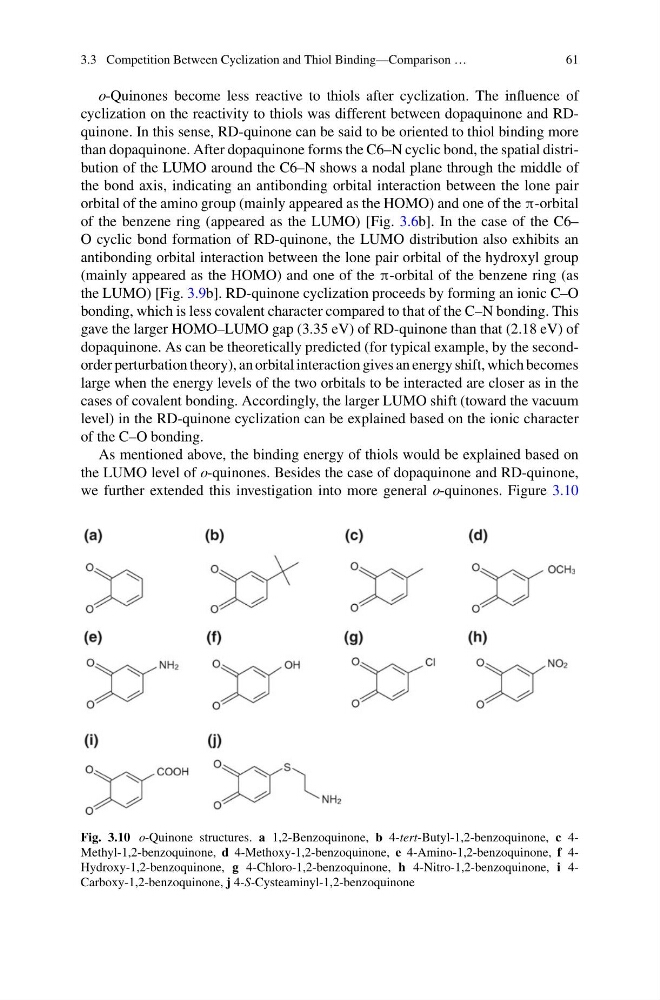
the LUMO level of o-quinones. Besides the case of dopaquinone and RD-quinone,
we further extended this investigation into more general o-quinones. Figure 3.10
Fig. 3.10 o-Quinone structures. a 1,2-Benzoquinone, b 4-tert-Butyl-1,2-benzoquinone, c 4Methyl-1,2-benzoquinone, d 4-Methoxy-1,2-benzoquinone, e 4-Amino-1,2-benzoquinone, f 4Hydroxy-1,2-benzoquinone, g 4-Chloro-1,2-benzoquinone, h 4-Nitro-1,2-benzoquinone, i 4Carboxy-1,2-benzoquinone, j 4-S-Cysteaminyl-1,2-benzoquinone
61
o-Quinones become less reactive to thiols after cyclization. The influence of
cyclization on the reactivity to thiols was different between dopaquinone and RDquinone. In this sense, RD-quinone can be said to be oriented to thiol binding more
than dopaquinone. After dopaquinone forms the C6–N cyclic bond, the spatial distribution of the LUMO around the C6–N shows a nodal plane through the middle of
the bond axis, indicating an antibonding orbital interaction between the lone pair
orbital of the amino group (mainly appeared as the HOMO) and one of the π-orbital
of the benzene ring (appeared as the LUMO) [Fig. 3.6b]. In the case of the C6–
O cyclic bond formation of RD-quinone, the LUMO distribution also exhibits an
antibonding orbital interaction between the lone pair orbital of the hydroxyl group
(mainly appeared as the HOMO) and one of the π-orbital of the benzene ring (as
the LUMO) [Fig. 3.9b]. RD-quinone cyclization proceeds by forming an ionic C–O
bonding, which is less covalent character compared to that of the C–N bonding. This
gave the larger HOMO–LUMO gap (3.35 eV) of RD-quinone than that (2.18 eV) of
dopaquinone. As can be theoretically predicted (for typical example, by the secondorder perturbation theory), an orbital interaction gives an energy shift, which becomes
large when the energy levels of the two orbitals to be interacted are closer as in the
cases of covalent bonding. Accordingly, the larger LUMO shift (toward the vacuum
level) in the RD-quinone cyclization can be explained based on the ionic character
of the C–O bonding.
As mentioned above, the binding energy of thiols would be explained based on
the LUMO level of o-quinones. Besides the case of dopaquinone and RD-quinone,
we further extended this investigation into more general o-quinones. Figure 3.10
Fig. 3.10 o-Quinone structures. a 1,2-Benzoquinone, b 4-tert-Butyl-1,2-benzoquinone, c 4Methyl-1,2-benzoquinone, d 4-Methoxy-1,2-benzoquinone, e 4-Amino-1,2-benzoquinone, f 4Hydroxy-1,2-benzoquinone, g 4-Chloro-1,2-benzoquinone, h 4-Nitro-1,2-benzoquinone, i 4Carboxy-1,2-benzoquinone, j 4-S-Cysteaminyl-1,2-benzoquinone