

3.1 Introduction
53
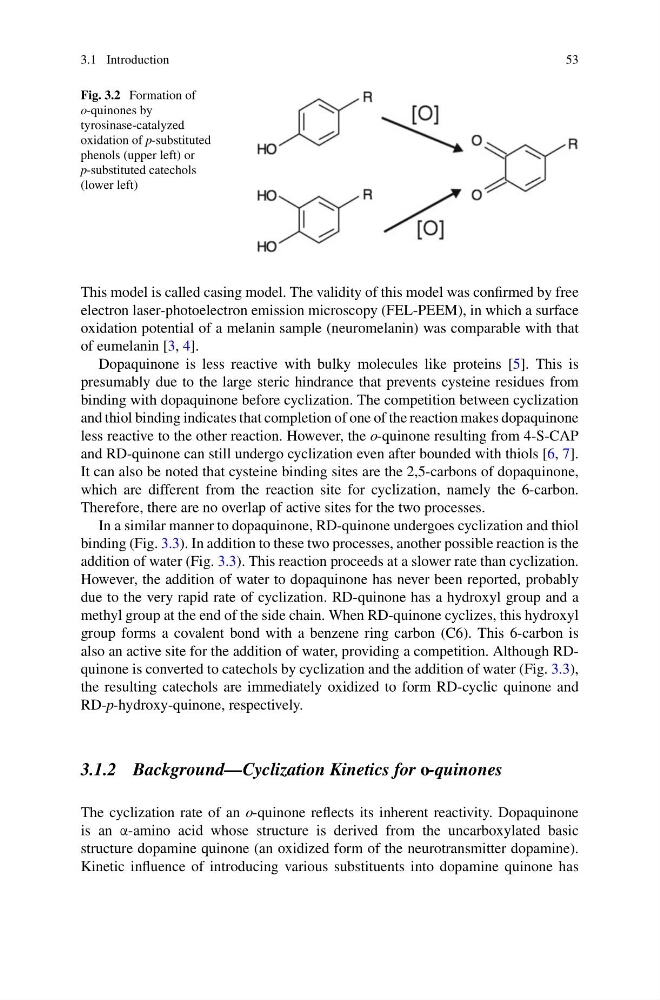
Fig. 3.2 Formation of
o-quinones by
tyrosinase-catalyzed
oxidation of p-substituted
phenols (upper left) or
p-substituted catechols
(lower left)
This model is called casing model. The validity of this model was confirmed by free
electron laser-photoelectron emission microscopy (FEL-PEEM), in which a surface
oxidation potential of a melanin sample (neuromelanin) was comparable with that
of eumelanin [3, 4].
Dopaquinone is less reactive with bulky molecules like proteins [5]. This is
presumably due to the large steric hindrance that prevents cysteine residues from
binding with dopaquinone before cyclization. The competition between cyclization
and thiol binding indicates that completion of one of the reaction makes dopaquinone
less reactive to the other reaction. However, the o-quinone resulting from 4-S-CAP
and RD-quinone can still undergo cyclization even after bounded with thiols [6, 7].
It can also be noted that cysteine binding sites are the 2,5-carbons of dopaquinone,
which are different from the reaction site for cyclization, namely the 6-carbon.
Therefore, there are no overlap of active sites for the two processes.
In a similar manner to dopaquinone, RD-quinone undergoes cyclization and thiol
binding (Fig. 3.3). In addition to these two processes, another possible reaction is the
addition of water (Fig. 3.3). This reaction proceeds at a slower rate than cyclization.
However, the addition of water to dopaquinone has never been reported, probably
due to the very rapid rate of cyclization. RD-quinone has a hydroxyl group and a
methyl group at the end of the side chain. When RD-quinone cyclizes, this hydroxyl
group forms a covalent bond with a benzene ring carbon (C6). This 6-carbon is
also an active site for the addition of water, providing a competition. Although RDquinone is converted to catechols by cyclization and the addition of water (Fig. 3.3),
the resulting catechols are immediately oxidized to form RD-cyclic quinone and
RD-p-hydroxy-quinone, respectively.
3.1.2 Background—Cyclization Kinetics for o-quinones
The cyclization rate of an o-quinone reflects its inherent reactivity. Dopaquinone
is an α-amino acid whose structure is derived from the uncarboxylated basic
structure dopamine quinone (an oxidized form of the neurotransmitter dopamine).
Kinetic influence of introducing various substituents into dopamine quinone has
53
Fig. 3.2 Formation of
o-quinones by
tyrosinase-catalyzed
oxidation of p-substituted
phenols (upper left) or
p-substituted catechols
(lower left)
This model is called casing model. The validity of this model was confirmed by free
electron laser-photoelectron emission microscopy (FEL-PEEM), in which a surface
oxidation potential of a melanin sample (neuromelanin) was comparable with that
of eumelanin [3, 4].
Dopaquinone is less reactive with bulky molecules like proteins [5]. This is
presumably due to the large steric hindrance that prevents cysteine residues from
binding with dopaquinone before cyclization. The competition between cyclization
and thiol binding indicates that completion of one of the reaction makes dopaquinone
less reactive to the other reaction. However, the o-quinone resulting from 4-S-CAP
and RD-quinone can still undergo cyclization even after bounded with thiols [6, 7].
It can also be noted that cysteine binding sites are the 2,5-carbons of dopaquinone,
which are different from the reaction site for cyclization, namely the 6-carbon.
Therefore, there are no overlap of active sites for the two processes.
In a similar manner to dopaquinone, RD-quinone undergoes cyclization and thiol
binding (Fig. 3.3). In addition to these two processes, another possible reaction is the
addition of water (Fig. 3.3). This reaction proceeds at a slower rate than cyclization.
However, the addition of water to dopaquinone has never been reported, probably
due to the very rapid rate of cyclization. RD-quinone has a hydroxyl group and a
methyl group at the end of the side chain. When RD-quinone cyclizes, this hydroxyl
group forms a covalent bond with a benzene ring carbon (C6). This 6-carbon is
also an active site for the addition of water, providing a competition. Although RDquinone is converted to catechols by cyclization and the addition of water (Fig. 3.3),
the resulting catechols are immediately oxidized to form RD-cyclic quinone and
RD-p-hydroxy-quinone, respectively.
3.1.2 Background—Cyclization Kinetics for o-quinones
The cyclization rate of an o-quinone reflects its inherent reactivity. Dopaquinone
is an α-amino acid whose structure is derived from the uncarboxylated basic
structure dopamine quinone (an oxidized form of the neurotransmitter dopamine).
Kinetic influence of introducing various substituents into dopamine quinone has