

54
3 Dopaquinone Conversion and Related Reactions
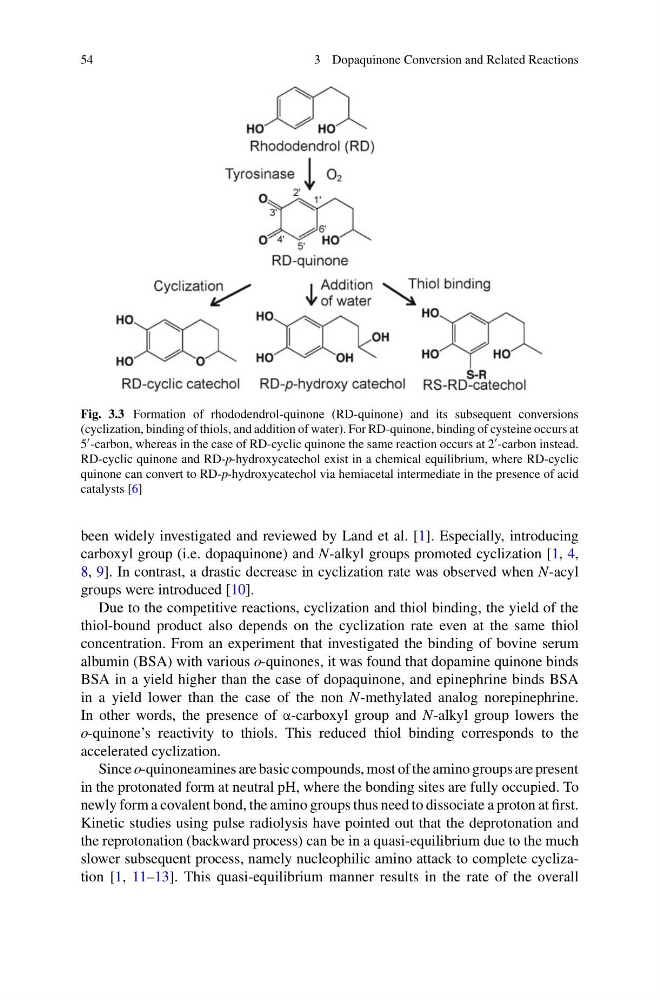
Fig. 3.3 Formation of rhododendrol-quinone (RD-quinone) and its subsequent conversions
(cyclization, binding of thiols, and addition of water). For RD-quinone, binding of cysteine occurs at
5 -carbon, whereas in the case of RD-cyclic quinone the same reaction occurs at 2 -carbon instead.
RD-cyclic quinone and RD-p-hydroxycatechol exist in a chemical equilibrium, where RD-cyclic
quinone can convert to RD-p-hydroxycatechol via hemiacetal intermediate in the presence of acid
catalysts [6]
been widely investigated and reviewed by Land et al. [1]. Especially, introducing
carboxyl group (i.e. dopaquinone) and N-alkyl groups promoted cyclization [1, 4,
8, 9]. In contrast, a drastic decrease in cyclization rate was observed when N-acyl
groups were introduced [10].
Due to the competitive reactions, cyclization and thiol binding, the yield of the
thiol-bound product also depends on the cyclization rate even at the same thiol
concentration. From an experiment that investigated the binding of bovine serum
albumin (BSA) with various o-quinones, it was found that dopamine quinone binds
BSA in a yield higher than the case of dopaquinone, and epinephrine binds BSA
in a yield lower than the case of the non N-methylated analog norepinephrine.
In other words, the presence of α-carboxyl group and N-alkyl group lowers the
o-quinone’s reactivity to thiols. This reduced thiol binding corresponds to the
accelerated cyclization.
Since o-quinoneamines are basic compounds, most of the amino groups are present
in the protonated form at neutral pH, where the bonding sites are fully occupied. To
newly form a covalent bond, the amino groups thus need to dissociate a proton at first.
Kinetic studies using pulse radiolysis have pointed out that the deprotonation and
the reprotonation (backward process) can be in a quasi-equilibrium due to the much
slower subsequent process, namely nucleophilic amino attack to complete cyclization [1, 11–13]. This quasi-equilibrium manner results in the rate of the overall
3 Dopaquinone Conversion and Related Reactions
Fig. 3.3 Formation of rhododendrol-quinone (RD-quinone) and its subsequent conversions
(cyclization, binding of thiols, and addition of water). For RD-quinone, binding of cysteine occurs at
5 -carbon, whereas in the case of RD-cyclic quinone the same reaction occurs at 2 -carbon instead.
RD-cyclic quinone and RD-p-hydroxycatechol exist in a chemical equilibrium, where RD-cyclic
quinone can convert to RD-p-hydroxycatechol via hemiacetal intermediate in the presence of acid
catalysts [6]
been widely investigated and reviewed by Land et al. [1]. Especially, introducing
carboxyl group (i.e. dopaquinone) and N-alkyl groups promoted cyclization [1, 4,
8, 9]. In contrast, a drastic decrease in cyclization rate was observed when N-acyl
groups were introduced [10].
Due to the competitive reactions, cyclization and thiol binding, the yield of the
thiol-bound product also depends on the cyclization rate even at the same thiol
concentration. From an experiment that investigated the binding of bovine serum
albumin (BSA) with various o-quinones, it was found that dopamine quinone binds
BSA in a yield higher than the case of dopaquinone, and epinephrine binds BSA
in a yield lower than the case of the non N-methylated analog norepinephrine.
In other words, the presence of α-carboxyl group and N-alkyl group lowers the
o-quinone’s reactivity to thiols. This reduced thiol binding corresponds to the
accelerated cyclization.
Since o-quinoneamines are basic compounds, most of the amino groups are present
in the protonated form at neutral pH, where the bonding sites are fully occupied. To
newly form a covalent bond, the amino groups thus need to dissociate a proton at first.
Kinetic studies using pulse radiolysis have pointed out that the deprotonation and
the reprotonation (backward process) can be in a quasi-equilibrium due to the much
slower subsequent process, namely nucleophilic amino attack to complete cyclization [1, 11–13]. This quasi-equilibrium manner results in the rate of the overall